
The rapid evolution of agentic AI is fundamentally reshaping supply chain management, with the market projected to skyrocket to $53 billion by 2030. Driven by escalating geopolitical tensions and climate risks, companies must adopt AI to transition from reactive troubleshooting to predictive, real-time optimization. Integrating machine learning and IoT delivers up to 22% lower warehousing costs and 30% lower inventory levels. However, overcoming legacy infrastructure barriers and standardizing data protocols remain critical to unlocking these operational efficiencies.
As the supply chain processes become more complex and encompass far-reaching tasks, its management is unimaginable without intelligent automation, predictive approaches, and sustainability. All these aspects are achievable nowadays since logistics and supply chains are under the impact of Big Data. In turn, Big Data feeds artificial intelligence (AI), which makes it possible to make supply chain management much more powerful than it is now.
According to a Gartner, advancements in AI and agentic AI are expected to be the single most influential driver of supply chain performance over the next two years. Reflecting this urgency, Gartner forecasts supply chain software with agentic AI will skyrocket from under $2 billion in 2025 to $53 billion by 2030, which is a massive surge that signals a fundamental industry shift. So, the window is narrowing and you have to adopt AI before it becomes a baseline requirement, not a competitive edge.
The Current State of Supply Chain Management
Supply chains depend highly on external factors like changes in regulations, geopolitical events, climate shifts, etc. For example, COVID-19 had a huge impact on global supply chains and forced companies to reshape their approaches to inventory and warehouse management, distribution, collaboration with suppliers, and more.
Now, artificial intelligence in supply chain management puts many companies at ease by streamlining every stage of operations. Below, we explore how AI helps companies to adapt to global changes.
Policy Changes and Geopolitical Shifts
New regulations regarding product quality standards, allowed ingredients, environmental impact, or labor laws are coming up regularly. They can cause supply chain disruptions while businesses are adapting to new rules. Luckily, businesses can leverage predictive analytics along with AI in supply chain planning. With these technologies, companies can easily collect data on global news, economic reports, and social trends, then analyze it to understand how to adjust logistics workflows according to upcoming changes.
Predictive analytics can also help recognize geopolitical tensions, which negatively affect supply chains. According to McKinsey’s annual supply chain risk survey, 82% of companies reported their supply chains were affected by new tariffs and geopolitical pressures in 2025, with 20 to 40% of their supply chain activity impacted in some form. In cases of such major disturbances, from trade conflicts to regional instability, companies can utilize AI for supply chain optimization. AI technology can rapidly analyze multiple alternative suppliers, routes, and distributors that are less exposed to geopolitical risk, enabling faster, data-driven responses that would be impossible to model manually at scale.

Serhii Leleko
AI&ML Engineer at SPD Technology
“AI leverages advanced machine learning algorithms and Big Data analytics to process vast amounts of unstructured and structured data in real-time. This capability allows it to predict potential disruptions in the supply chain by identifying patterns and correlations that humans might overlook.”
Natural Disasters and Climate Change Effects
Predictive analytics can also help recognize environmental threats, which increasingly disrupt supply chains. According to the World Economic Forum’s Global Risks Report 2025, extreme weather events rank as the #1 global risk over the next decade — for the second year running, with supply chains among the most exposed systems.
Wondering how AI can solve supply chain problems in this case? It ensures that processes can be adapted to these changing conditions. Firstly, predictive analytics can enable weather and demand forecasting to anticipate changes in usual consumption patterns. In such a way, supply management can be done by taking into account yield changes, efficient routes, and inventory levels. Secondly, AI algorithms can be trained for scenario planning. It is an approach that helps model different cases of natural disasters allowing companies to adapt their operations accordingly.
In addition, AI can assist in identifying and putting into effect more environmentally friendly supply chain procedures, such as obtaining goods from suppliers that practice environmental responsibility or optimizing transportation routes to cut carbon emissions.
Evolving Work Landscape
Over recent years, globalization has influenced supply chains to experience drastic changes. Consumers require businesses to produce more personalized, high-quality products within a short period of time to accommodate their growing needs. Now, companies may struggle with complexities in supply chain management. However, AI enables automatization and personalization capabilities to overcome those challenges.
Generative AI, for instance, can help enterprises check for alternative ingredients for their products in order to suit more customer preferences. AI systems can analyze structured and unstructured data and pinpoint how to use more organic ingredients and offer hypoallergenic, vegan, and sustainable product formulas.
Additionally, AI and ML in manufacturing help in designing products. These technologies can collect data on targeted audience preferences in terms of packaging or labeling as well as the latest trends in design. Then, companies can use insights received from data analysis to customize item designs and achieve customer engagement.
Advantages of AI in Supply Chain Management
Utilizing AI in supply chain and logistics can improve almost every aspect of processes. It has the potential to increase operational efficiency, reduce costs, and even improve worker safety. How can AI be applied to supply chain activities to yield such benefits? Let’s have a closer look at each link in the chain.
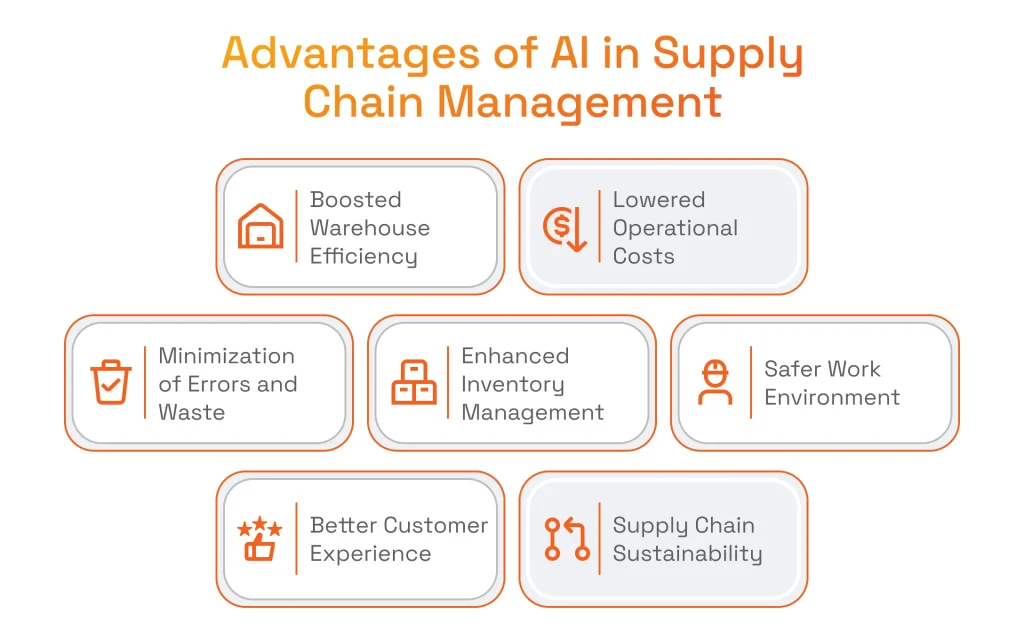
Boosted Warehouse Efficiency
According to Accenture, warehouses and fulfillment operations implementing AI solutions can benefit from significant operational gains: up to 15% higher inventory accuracy, up to 22% lower warehousing costs, and up to 20% greater productivity, alongside a 35 to 45% reduction in stockouts and a 40% improvement in forecast accuracy. To achieve similar results, supply chain and logistics companies need to consider implementing the following AI-driven solutions:
- Warehouse Management Systems (WMS): AI features in WMS allow not only to keep all the processes in one system but also generate insights on how to optimize storage space, adjust loading operations, and improve manual processes workflow.
- Robotic Process Automation (RPA): RPA development services equip businesses with robots that can completely transform processes that previously required human efforts like picking, packing, sorting, etc. Moreover, they can do it faster and more accurately.
- Predictive Maintenance: AI can collect the data from sensors on equipment, taking into account various metrics such as vibration, temperature, pressure, etc. This information serves as insights into machinery health and possible maintenance measures.
Lowered Operational Costs
The opportunity to lower operating costs is usually one of the main reasons why businesses start considering AI tools. According to McKinsey, embedding AI in supply chain operations can deliver reductions of 20 to 30% in inventory, 5 to 20% in logistics costs, and 5 to 15% in procurement spend. The possibilities that AI opens for cost reduction include, but are not limited to:
- Resource Optimization: Using AI in supply chain planning often involves working with data analytics. This allows companies to allocate human efforts and machinery to execute work more efficiently. These analytics also help distribute raw materials throughout the supply chain with sustainability in mind.
- Energy Management: Implementing AI for energy systems can lead to data-driven decision-making when it comes to how much energy is needed for particular tasks in a certain timeframe.
- Cost-Efficient Procurement: By analyzing data on contracting with vendors, suppliers and distributors, AI helps supply chain organizations make price comparisons and negotiate prices to find cost-effective approaches.
Minimization of Errors and Waste
AI and supply chain management make a powerful duo, when it comes to reducing waste and human errors. Automation, data analytics, demand forecasting, and anomaly detection can be used to help companies achieve the lowest level of defects and wastage possible. This is how those can assist:
- Process Automation: From document processing to logistics operations, AI can help employees minimize efforts for manual tasks and eliminate human error.
- Quality Control: Anomaly detection using machine learning can be implemented to inspect products for defects, providing real-time data on any anomalies for quick issue resolution.
- Efficient Resource Allocation: Supply chain solutions with AI can result in data-driven decisions about the amount of resources required for specific tasks, which leads to the minimization of material waste.
Enhanced Inventory Management
McKinsey reveals that AI can reduce inventory levels by 20 to 30% by improving demand forecasting through dynamic segmentation and machine learning, and optimizing inventory through simple and cost-effective tools. Indeed, intelligent systems equipped with advanced analytics can collect, process, and analyze past data to generate forecasts on how products might be ordered and distributed. To be more precise, AI can do the following:
- Demand Prediction: Historical sales data and market trends are analyzed by AI algorithms to forecast demand and suggest tips on how to maintain optimal inventory levels.
- Inventory Tracking: Sensors on IoT devices bring supply chain visibility as they allow monitoring the metrics of inventory and sending notifications to employees in case some issues with stock levels need to be resolved.
- Stock Replenishment: AI systems can automate reordering, including calculation of delivery time and negotiation of prices, that ensures stock replenishment is done in a timely manner.
Safer Work Environment and Material Handling
One of the most crucial benefits of AI in the supply chain is improved safety. IoT devices, combined with AI and computer vision, can significantly enhance safety in production environments, warehouses, and during transportation. Furthermore, employees can leverage robots for hazardous tasks with chemicals or heavy machinery, thereby minimizing injury risks and increasing operational efficiency. This is achievable by:
- Hazard Detection: The use of AI in the supply chain, along with cameras and sensors, is the way to detect spills and dangerous lifting techniques in real time and notify employees about possible accidents before they occur.
- Automated Handling: AI for supply network automates risky tasks (e.g. using large gear in warehouses), which lowers the possibility of worker casualties.
Faster Deliveries and Better Customer Experience
Companies using artificial intelligence in supply chain management not only improve conditions for their employees but also enhance customer satisfaction. According to McKinsey’s State of AI 2025 survey of nearly 2,000 respondents across 105 countries, nearly half of organizations report that AI use has led to improvement in customer satisfaction and competitive differentiation, making it one of the most consistently cited qualitative benefits of AI adoption alongside innovation gains.
Indeed, AI improves customer service in many ways. The most common are:
- Route Optimization: AI-driven deliveries become efficient like never before thanks to finding the most optimal routes that take less time for customers to wait for their orders.
- Real-Time Tracking: Sensors installed on delivery vehicles can provide customers with real-time, actionable insights into their order statuses.
- Customer Service: AI chatbots proved to be effective for instant responses to customer queries. This creates a powerful customer experience and long-term connections with brands.
Moreover, chatbots are extremely helpful for businesses and their tech support teams in terms of streamlining operational processes. For instance, we delivered a chatbot for one of our projects that used pre-trained machine learning models for data embedding and natural language processing to accurately respond to 99% of customer inquiries in less than ten seconds. At the same time, the support team could concentrate on tasks that required more creativity.

Greater Supply Chain Sustainability
Using AI for supply chain management can guide a company toward more environmentally conscious practices while also strengthening brand perception and long-term competitive advantage. As sustainability becomes a lifestyle choice for many consumers, stronger environmental performance can support customer engagement as well as business outcomes. According to Accenture’s survey of over 2,600 executives, 47% of CEOs now consider responsible supply chains a core part of their sustainability strategy, with many actively transitioning to circular business models to build resilience and reduce environmental risk.
With the right AI strategy, organizations can use AI and ML to combine external and internal information into data-driven insights that improve decision making and create measurable efficiency gains.
Key sustainability applications include:
- Sustainable sourcing (supplier management): Generative AI can analyze supplier data and signals from external data sources to assess sustainability practices, track supplier performance, and help teams decide which supply chain partners to work with. This creates more consistent standards across procurement and improves accountability.
- Waste management and automation: AI-powered automation (including robotics) can sort waste faster and more accurately, improving recycling outcomes and reducing landfill impact. This boosts productivity and is especially valuable in industries like food, where compliance and correct disposal matter.
- Emissions reduction in logistics processes: Generative AI can optimize transportation decisions (such as routing and load planning) to reduce fuel consumption across logistics networks. Over time, this supports broader digital transformation and a more sustainable operating model.
Wondering how AI transforms the food industry?
Learn in our featured article!
Main Use Cases of AI and ML in Supply Chain
With AI, supply chain management becomes data-driven and intelligent. Rather than relying on static forecasts and reacting to disruptions after they occur, companies can now benefit from real-time analytics and predictive modeling, which allows them to anticipate changes in demand, potential bottlenecks, and supplier risks. Below we describe the main AI/ML applications in supply chain operations.
AI Use Cases in Supply Chain at a Glance
The table below distills the most impactful AI applications across supply chain functions, pairing each use case with its measurable benefit and the research backing it. Use it as a quick reference to identify where AI can deliver the greatest return for your operations.
AI Use Case | Key Benefit | Supporting Data |
|---|---|---|
Simulation-Based Operational Optimization | Safer, faster testing of process changes | Digital twins let teams simulate disruptions before they occur in the real world |
Demand Prediction | Touchless, automated forecasting | 70% of large organizations adopting AI-based forecasting by 2030 |
Predictive Maintenance of Supply Chain Assets | Reduced unplanned downtime and repair costs | 20–30% reduction in equipment downtime |
Real-Time Analytics and AI-Driven Reporting | Proactive decisions, end-to-end visibility | Inventory, workforce, supplier, and demand data unified into instant, actionable insights |
AI Use Case
Simulation-Based Operational Optimization
Demand Prediction
Predictive Maintenance of Supply Chain Assets
Real-Time Analytics and AI-Driven Reporting
Key Benefit
Safer, faster testing of process changes
Touchless, automated forecasting
Reduced unplanned downtime and repair costs
Proactive decisions, end-to-end visibility
Supporting Data
Digital twins let teams simulate disruptions before they occur in the real world
70% of large organizations adopting AI-based forecasting by 2030
20–30% reduction in equipment downtime
Inventory, workforce, supplier, and demand data unified into instant, actionable insights
Each specific use case is analyzed below, illustrating a uniform transformation: the migration away from manual, reactive firefighting toward a proactive framework anchored in real-time data.
Simulation-Based Operational Optimization
AI is the main driver behind simulation models that replicate real-world scenarios in manufacturing processes, logistics routines, and broader supply chain operations. Many supply chain organizations implement multiple models for digital twins, virtual replicas of physical operations or logistics networks that let teams test changes safely before applying them in the real world. This enables businesses to identify the most practical and efficient ways to optimize processes, including:
- Scenario Analysis: Since AI can predict different outcomes, it can also simulate them through digital twins to reveal potential disruptions, support risk management, and show how those disruptions would affect end-to-end business processes.
- Capacity Planning: Supply chain systems enhanced with AI use simulations to assess whether logistics capacity can meet demand and to evaluate alternative plans when results are unsatisfactory, which helps teams improve efficiency and reduce operational bottlenecks.
Need to know how AI helps companies get the right product, to the right place, at the right time?
We have the article fully dedicated to AI in logistics!
Precise Demand Prediction
A Gartner forecast shows a decisive shift in how companies predict what customers will want to purchase: 70% of large-scale organizations will adopt AI-based forecasting to predict future demand by 2030, with AI enabling touchless, automated predictions at a frequency and granularity that traditional statistical engines simply cannot match. With this being said, we can only highlight the fact that AI is quickly becoming an irreplaceable tool for supply chain planning. Why do companies choose AI for supply chain management? Here are some of the factors:
- Predictive Analytics: AI-driven systems or AI agents have predictive capabilities that analyze historical data and market trends to generate accurate forecasts about what customers will be looking for in stores.
- Seasonal Adjustments: ML models can spot seasonal demand fluctuations (for example, during holidays or special events) and suggest marketing strategies like promotions, limited offers, or customized products.
- Market Insights: Improving businesses with machine learning and NLP makes it possible to process customer sentiment in reviews, social media trends, or analyze news to predict consumer behavior changes.
Predictive Maintenance of Supply Chain Assets with IoT
To adopt a preventive approach to equipment maintenance instead of repairing machines once they are out of order, supply chain companies can use IoT sensors and ML-powered software to monitor equipment health. It usually works the following way: IoT devices with sensors are installed on manufacturing machines, conveyor systems, and delivery vehicles, collect real-time performance data (e.g., vibration, temperature, energy consumption), and send them to ML algorithms models for the analysis. This approach to maintenance ensures:
- Cost Savings: Companies can act on emerging issues instead of fixed schedules and, therefore, reduce unplanned downtime and lower direct repair costs.
- Longer Equipment Lifespan: With scheduled maintenance, companies can reduce strain on components and keep assets running at peak efficiency. Over time, this approach extends machinery’s usable life and minimizes downtime.
Real-time Analytics and AI-Driven Reporting
Inventory levels, order status, human resources information (workforce availability, labor capacity, etc.), supplier updates, and customer demand signals create continuous data streams. This data can be fed to advanced analytics algorithms, which will transform it into instant insights for making decisions. ML algorithms can find trends and anomalies in this data and create dynamic dashboards and reports to support company employees with a concise summary of changes in demand and potential bottlenecks. With real-time analytics and reporting, companies can get:
- Proactive Decision-Making: With data analytics and AI, teams gain real-time visibility into potential disruptions or demand fluctuations and can make rapid adjustments to inventory strategies, production schedules, and logistics.
- Enhanced Visibility: AI-powered dashboards compile multiple performance indicators into a single view with all the bottlenecks and inefficiencies in real time. By taking all this information into account, it becomes possible to incorporate improvements and foster greater alignment among suppliers, manufacturers, and distribution channels.
Preparing Your Supply Chain for AI-Driven Change
Challenges always exist when you are about to transform how your business operates. However, if you know how to approach this transformation, those challenges will not scare you and your employees. Below, we share a few tips for connecting your supply chain and AI.
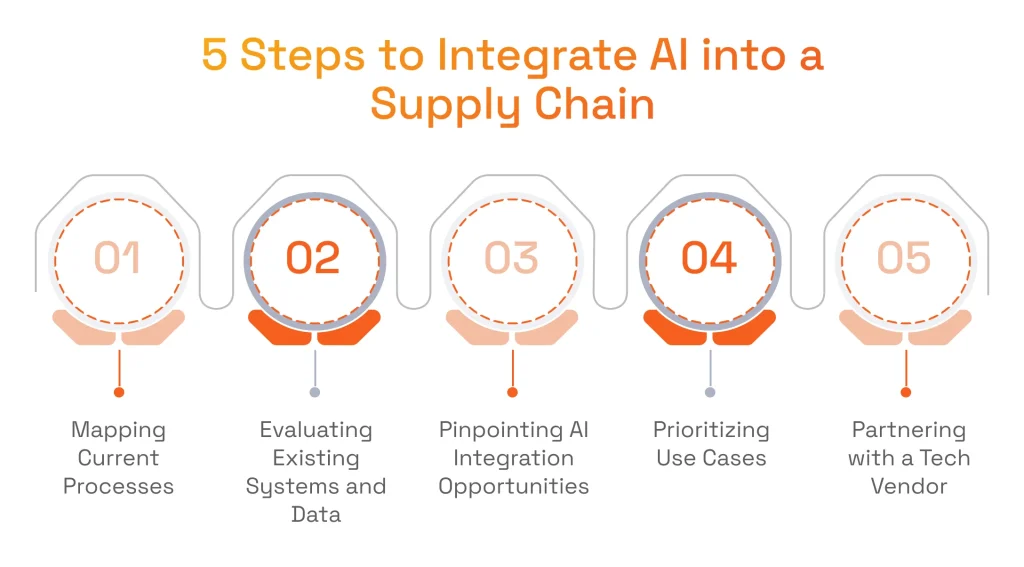
Mapping Current Processes
To perform the AI transformation neatly, it is crucial to start with a detailed visualization of all links in the supply chain. From procurement and production to distribution and delivery, businesses need to take into account not only the processes but also the roles and responsibilities of each employee working in the supply chain. All this information should be collected in the document that will serve as a blueprint for AI implementation.
Serhii Leleko
AI&ML Engineer
“Do not forget to include risks in your roadmap. It means you and your AI integration vendor should identify what inefficiencies, bottlenecks, or redundancies can be met during the project.”
Evaluating Existing Systems and Data
The integration of the newest technologies is impossible to perform without evaluating the state of the current technological infrastructure first. This assessment needs to cover software, hardware, and network capabilities. Companies must assess if modifications are required for the future incorporation of AI technologies.
Additionally, supply chain and logistics companies need to take care of the availability and correctness of their data. It is necessary to look at the sources and formats in order to find any gaps. In case the data requires cleansing and standardization, companies need to opt for building EDW systems to power AI models and algorithms with the correct and coherent data for accurate future insights.
Pinpointing AI Integration Opportunities
A Gartner survey of 140 senior supply chain leaders reveals the key barriers companies face when scaling AI: 56% of chief supply chain officers say integrating AI with legacy systems and processes is a major challenge, while 50% cite limited internal expertise or talent to implement and manage AI effectively. To achieve specific business goals with AI integrations, businesses need to identify specific areas where AI can bring the most value: it can be automation, predictive maintenance, or demand prediction. At the same time, processes that require a lot of data, are prone to mistakes, or are extremely repetitive should also be sought out by organizations since they are excellent candidates for AI-driven optimization.
Furthermore, analyzing operational difficulties and pain areas might highlight areas where AI has the potential to increase productivity or accuracy. In order to guarantee that AI projects are in line with overarching company objectives and target the most influential supply chain segments, this stage calls for a strategic approach.
Prioritizing Use Cases
After identifying potential AI integration opportunities, it is important to prioritize which use cases to focus on first, and which ones can wait till the next iterations. The criteria for prioritization may be a potential return on investment, feasibility, and alignment with strategic objectives.
Such an approach to planning AI integration into the supply chain systems helps accumulate resources and efforts on projects that offer the greatest benefits while minimizing risks. Considerations include the complexity of implementation, the readiness of existing systems, and the expected impact on operational performance.
Partnering with a Tech Vendor
In order to choose the best vendor, organizations must assess possible collaborators according to their experience, technological prowess, and history of supplying artificial intelligence solutions to the supply chain industry. A reputable tech provider can offer insightful information, cutting-edge resources, and continuous assistance throughout the AI deployment process.
If you need some assistance, our AI & ML development services are at your disposal. We have experience with both AI/ML integration and supply chain management specifics, and are ready to execute the technical assistance and guidance from initial planning through to full-scale deployment and support.
The Challenges of Developing an AI-Enabled Supply Chain Ecosystem
The impact of AI in supply chain management means transforming the entire niche and significantly boosting efficiency. However, adopting it isn’t always easy. Our clients frequently ask: “How does AI affect supply chain performance?”, “How expensive is AI?”, and “How will it work with other business systems?”. Below we share tips on how to overcome such issues.
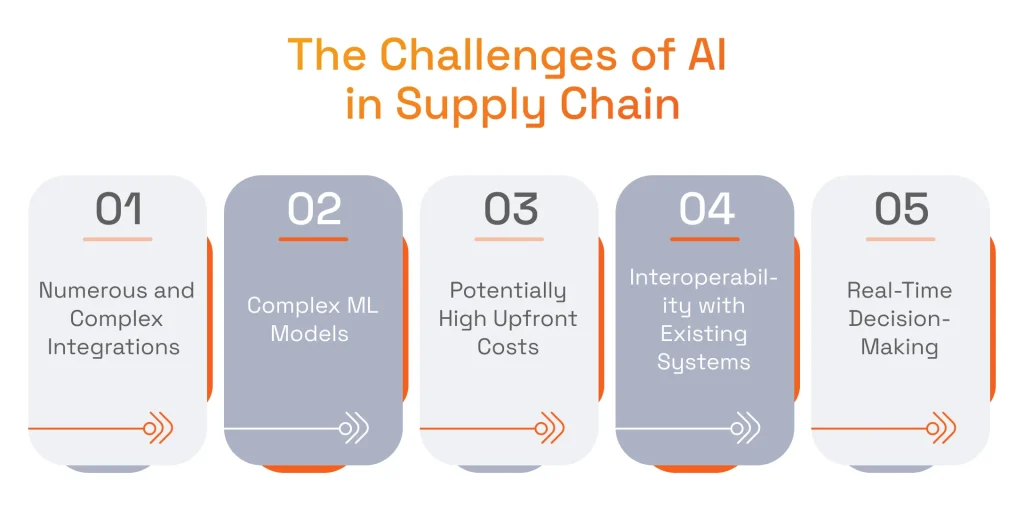
Numerous and Complex Integrations
Since each link of supply chains often relies on machinery work or transportation, it is important to add sensors or other IoT devices for the equipment. However, our clients often have difficulties with complex software integrations while connecting all the devices that transmit data to the entire ecosystem.
We never underestimate the power of integration and approach it carefully. Firstly, we pay particular attention to make all data the same protocols and formats. For this, we build a data warehouse that ensures that data is homogeneous. Secondly, to make sure all the components communicate with each other, we design APIs or migrate supply chain systems to microservices architectures. This approach ensures we can seamlessly connect new and existing components without incompatibility issues.
Complex ML Models
To create ML models with high accuracy and dependability, companies must choose the right algorithms, adjust hyperparameters, and train the models on large datasets. For our clients, who have extensive expertise in working with software for supply chain management but not in AI/ML development, this creates a significant problem. Even if our team takes complete control over designing ML models, the development teams from the client’s side need to know how to interpret them.
In order to facilitate this process, we incorporate Explainable AI techniques and provide clear, user-friendly documentation tailored to our clients’ projects. With Explainable AI frameworks, we ensure that decision drivers, feature importance, and the overall logic of the ML models are transparent and easy to understand.
Potentially High Upfront Costs
Supply chain and AI is a powerful yet expensive combination, especially in the beginning of its adoption. Apart from purchasing high-performance computing systems and IoT devices as well as specific software licenses and infrastructure investments, businesses will need to invest in the development and integration of customized AI systems.
One way to overcome the high initial costs is by adopting a phased implementation strategy. We always recommend beginning with small-scale pilot projects that demonstrate tangible returns before scaling up. In addition to this methodological solution, we also suggest a technological one: leveraging cloud services. Businesses can significantly reduce upfront capital expenditure if choosing cloud infrastructure with pay-per-use models.
Serhii Leleko
AI&ML Engineer at SPD Technology
“The high upfront costs are not limited to technological investments alone. Organizations must also allocate resources for training and upskilling their workforce to effectively utilize AI-driven tools.”
Interoperability with Existing Systems
Many of our clients relied on the software and infrastructure that was acquired a few years ago. However, as technologies are evolving exponentially fast, they need to revise their systems. If a business has a legacy system, it is possible that the integration of AI technologies will result in compatibility issues.
In such cases, we turn to middleware solutions. Middleware bridges this gap by providing standardized interfaces and APIs, enabling different systems to communicate effectively without requiring extensive modifications to existing infrastructure. During the completion of the projects for our clients, it allowed us to handle data transformation, ensuring that information is accurately translated between disparate formats, and manages authentication and security across platforms.
For example, we faced several challenges with complex third-party integrations during our work on a legacy system for our client. However, we overcame these complexities by using customly designed APIs and delivered a 100% cloud-based solution with top-notch UX, and allowed the business to expand to 20 states in the US.
Real-Time Decision-Making
Some of our clients require supply chain operations that can handle split-second decisions across multiple touchpoints, from updating supplier lead times to responding swiftly to fluctuating customer demand. However, data often resides in separate systems or is collected too infrequently, leading to delays, inefficiencies, and missed opportunities. This information gap makes it difficult to optimize routing, inventory levels, and production schedules on the fly, increasing the risk of stockouts and costly bottlenecks.
In this case, we suggest benefiting from data analytical services to integrate analytics platforms connected IoT sensors for every stage of the supply chain. With it, businesses gain continuous, granular data on inventory levels, equipment performance, and real-time shipment locations. This data is then processed through AI-driven tools capable of generating instant insights and predictive alerts. As a result, decision-makers can proactively re-route shipments, balance stock between warehouses, or adjust production schedules, all in real time.
Reasons to Partner with a Tech-Savvy Vendor for AI in Supply Chain Integration
The future of AI in the supply chain promises more powerful processes, and companies must adopt it today to yield the benefits later. Yet, AI and ML development require in-depth expertise, and the in-house development teams of supply management and logistics companies may not be able to keep up with this innovation. Luckily, there are technological vendors on the market that learned AI/ML from the onset and polish their skills as this technology evolves. With the help of a tech partner, a business can gain:
- Accelerated Time-to-Use: Through established best practices and proven methodologies, experts can rapidly prototype and deploy AI-driven solutions, expediting tangible results for the business.
- Access to Advanced Expertise and Tools: By partnering with a tech vendor, supply chain management companies can tap into seasoned professionals who leverage the latest AI/ML frameworks and technologies for streamlined supply chain processes.
- Ensured Optimal Use of Data Infrastructure: Skilled AI/ML specialists create robust data pipelines and integrations, guaranteeing reliable data flow and efficient analysis at every stage of the supply chain.
- Enhanced Security and Compliance: Tech partners know how to embed strict security measures and regulatory protocols to safeguard sensitive information and maintain compliance across global supply chain operations.
SPD Technology’s Experience and Expertise in AI for Supply Chain Management
When it comes to the development of projects for the supply chain sector, we approach them with careful consideration of all business requirements, industry-specific insights, and technical expertise. By partnering with us, you can count on:
- Strategic Alignment with Business Goals: We thoroughly analyze your operational priorities to ensure AI-driven solutions we develop deliver measurable outcomes and support overarching objectives.
- Experience with Integration of AI and IoT Ecosystems: Our cross-functional teams seamlessly connect diverse devices and platforms, providing real-time analytics and automation across the entire supply chain.
- Focus on Security and Compliance: We implement stringent security measures and adhere to global regulations (e.g. GDPR, FDA and REACH regulations), protecting sensitive data and maintaining enterprise-grade standards.
- Scalable and Future-Ready Solutions: Our team builds systems with modular architecture, which enables solutions that evolve with market demands and technological advancements.
HaulHub and SPD Technology Partnership Success Story
One of the notable projects we developed for the supply chain management niche is the all-in-one platform for HaulHub, which integrates and optimizes the entire transportation construction ecosystem.
Business Challenge
The client needed a full-fledged platform that would combine vendors, contractors, suppliers, and agencies operating in transportation construction to make it easier for all parties engaged in construction to collaborate. We were tasked with the development of such a platform and overhauling existing parts of the system as well as creating an automated reporting system, which needed AI/ML development. Additionally, our AI/ML skills were also required for image processing, traffic analysis, and customer support features.
SPD Technology’s Approach
By leveraging our AI/ML skills, we completed several functionalities for HaulHub’s platform:
- We used AI and ML for automated reporting that analyzed daily work data and generated targeted insights.
- Our team developed and trained AI models for traffic analysis and worker safety, translating nuanced requirements into AI-friendly formats.
- We implemented image processing and traffic analysis tools and thus ensured safety compliance, identified areas for improvement, and provided insights into the impact of construction on traffic.
- Our AI also parsed large datasets to inform more efficient decision-making.
- We built intelligent chatbots to facilitate seamless data access and timely responses.
Value Delivered
Through solutions we built, our AI/ML development team successfully delivered key features and optimized HaulHub’s transportation construction ecosystem, driving efficiency, safety, and collaboration across all stakeholders.
Key Takeaways
- Lagging AI adoption diminishes market competitiveness as Gartner forecasts supply chain software with agentic AI will skyrocket from under $2 billion in 2025 to $53 billion by 2030, shifting the technology from a competitive edge to a baseline operational requirement.
- Geopolitical instability and trade conflicts cause severe operational disruptions, forcing 82% of companies to experience supply chain impacts from new tariffs and geopolitical pressures in 2025.
- Deploying predictive analytics and AI algorithms minimizes geopolitical and climate vulnerabilities by enabling rapid modeling of alternative suppliers, demand shifts, and efficient transportation routes at a scale impossible to achieve manually.
- Integrating AI solutions into warehouse and fulfillment operations delivers significant cost and efficiency gains, resulting in up to 15% higher inventory accuracy, up to 22% lower warehousing costs, and a 35% to 45% reduction in stockouts.
- Embedding AI into core supply network management lowers overhead expenditures, driving structural cost reductions of 20% to 30% in inventory, 5% to 20% in logistics, and 5% to 15% in procurement spend.
- Relying on outdated technological infrastructure blocks artificial intelligence deployment, creating critical compatibility issues that require custom APIs or middleware to connect legacy systems with advanced ML models.
- Failing to standardize data protocols across multiple touchpoints compromises system visibility, while establishing central data warehouses creates homogeneous, reliable data streams necessary for real-time anomaly detection and decision-making.
In short: Advancements in agentic AI will drive supply chain performance toward a $53 billion market by 2030, but capturing this efficiency requires overcoming legacy system integration barriers through structured data infrastructure and technical partnership.
FAQ
How much does AI implementation in supply chain management typically cost?
While total costs vary depending on operational scope, enterprise-level AI implementation is highly capital-intensive upfront. Expenses stem from custom machine learning model development, deploying IoT sensors across infrastructure, acquiring specialized software licenses, and building cloud computing architecture. To offset these steep initial capital expenditures, organizations frequently leverage a phased implementation strategy, starting with low-cost, small-scale cloud pilots under pay-per-use models before budgeting for full enterprise scaling.
What are the biggest barriers to AI adoption in supply chain operations?
According to a Gartner survey of senior supply chain leaders, the two most critical roadblocks are:
- Legacy System Integration (56%): Chief supply chain officers cite major difficulties when trying to make advanced, real-time AI algorithms communicate with aging, rigid software infrastructure.
- Talent Scarcity (50%): A severe limitation in internal technical expertise and specialized talent needed to successfully implement, interpret, and manage complex machine learning models over time.
How long does AI supply chain integration take from pilot to full deployment?
A standard enterprise deployment typically ranges from 6 to 18 months, moving through a strict structural sequence:
- Phase 1: Blueprinting & Data Cleansing (1–3 months): Mapping supply chain links and building enterprise data warehouses (EDW) to clean and standardize legacy data.
- Phase 2: Small-Scale Pilot (2–4 months): Testing custom ML models on specific use cases (like a single warehouse or localized shipping route) to demonstrate clear ROI.
- Phase 3: Phased Scaling & Full Deployment (3–12 months): Gradually connecting additional touchpoints, installing broader IoT networks, and migrating systems to modern API or microservices architectures.
What data quality problems most frequently undermine supply chain AI projects?
AI models are entirely dependent on high-quality input, yet supply chain projects are routinely undermined by fragmented, non-standardized data siloed across separate systems. When data streams arrive from various vendors, legacy tools, or transport sensors in entirely different formats and protocols, it introduces severe information gaps. Without data transformation via a centralized data warehouse to make input homogeneous and consistent, AI models generate inaccurate demand forecasts and failed anomaly detections.
What supply chain AI use cases deliver the fastest and most reliable ROI?
The fastest, most quantifiable returns on investment come from two highly data-dense areas:
- Warehouse Optimization & Inventory Management: Directly slashes overhead costs by driving a 20% to 30% reduction in inventory levels, boosting inventory accuracy by up to 15%, and cutting stockouts by 35% to 45% through predictive ML demand forecasting.
- Automated Route Optimization: Delivers rapid financial payback by instantly analyzing live traffic, shifting weather, and shipping data to optimize logistics paths, yielding a 5% to 20% drop in total logistics and fuel costs.
How does AI help in optimizing inventory management?
Supply chain AI optimizes stock levels by combining machine learning models, generative AI, and forecasting analytics to process vast streams of market signals. This drastically reduces excess inventory and costly stockouts. By pairing automated reordering workflows with real-time tracking across Enterprise Resource Planning (ERP) networks, supply chain planners secure end-to-end operational visibility, lower carrying costs, and improve overall productivity.
How can small and medium-sized businesses (SMBs) use AI in their supply chains?
SMBs do not need massive, custom-built infrastructure; instead, they can deploy affordable, plug-and-play cloud-based supply network AI tools. These platforms provide predictive analytics for demand forecasting, inventory tracking, supplier risk scoring, dynamic pricing, and document automation. By leveraging these subscription-based cloud applications, smaller businesses can significantly boost operational agility, lower everyday overhead, and better compete with enterprise rivals.
How can AI help in mitigating supply chain risks?
Supply chain AI strengthens risk management by processing real-time external data, such as political updates, social trends, and climate patterns, to recognize disruptions before they manifest. When regional instabilities or extreme weather threats are identified, the AI calculates pattern correlations to help teams instantly build contingency plans. By automatically recommending alternative suppliers and optimizing backup shipping routes at scale, it reduces the operational impact of macro disruptions.
How do companies measure the success of AI implementations?
Supply chain leaders evaluate effectiveness by tracking specific Key Performance Indicators (KPIs) that directly validate their initial AI investments. Key metrics include:
- Financial Metrics: Lower overall operational costs, reduced procurement spend, and optimized energy usage.
- Accuracy Metrics: Higher demand forecasting accuracy and increased inventory turnover rates.
- Fulfillment Metrics: Faster order delivery speeds, fewer stockouts, and higher customer satisfaction scores.
- Resilience Metrics: Decreased response and resolution times when reacting to sudden global or supplier disruptions.
What companies are leading in AI-driven supply chains?
The global enterprises consistently recognized for pioneering aggressive AI adoption across their logistics networks include:
- Retail & eCommerce Giants: Amazon, Walmart, and Alibaba (specializing in highly autonomous fulfillment centers and predictive regional stock positioning).
- Logistics & Shipping Networks: DHL, UPS, and Maersk (pioneering predictive global routing and real-time transit analytics).
- Industrial & Consumer Manufacturing: Siemens, Schneider Electric, Procter & Gamble, and Unilever (utilizing adaptive planning algorithms and automated quality control).
What is the future of AI in supply chain management?
The future points directly toward the realization of completely autonomous supply chains. Driven by a massive market shift, where agentic AI supply chain software is forecast to reach $53 billion by 2030, systems will evolve from basic predictive dashboards into proactive decision-making ecosystems. Future frameworks will deploy advanced AI agents capable of continuously digesting multi-stream data, automatically adjusting procurement contracts, handling touchless last-mile logistics execution, and rebalancing global inventory on the fly without requiring human intervention.