

Success in financial services increasingly depends on how effectively organizations use data. Data analytics in finance provides a framework for collecting, integrating, analyzing, and interpreting information from multiple sources to improve forecasting, strengthen compliance, enhance customer understanding, and support more informed business decisions across the enterprise.
With an estimated 402.74 million terabytes of data generated every day, making sense of that data is the key to securing profitability, resilience, and sustainable growth of your financial business.
The statistics prove the importance of leveraging data analytics in finance — organizations that don’t use data for financial services personalization lose more than 50% of customers. On the other hand, those leveraging the power of data can expect significant advantages for their finance business, such as 9% annual portfolio growth and insightful investment ideas with enhanced alpha potential, as 98% of investment professionals agree.
Implementing data analytics in finance is an excellent move for your organization. However, it requires an expertise-driven approach to breaking silos, addressing technical debt, and ensuring compliance and security.
The Impact and Evolution of Data Analytics in Finance
Traditionally, data analytics in finance focused on answering two questions: “What happened?” (descriptive analytics) and “Why did it happen?” (diagnostic analytics).
Today’s data analytics has evolved far beyond those traditional approaches. It is combined with AI/ML that is fueled by petabytes of customer, market, transaction, and other data. The ultimately large data volumes analyzed by sophisticated machine learning algorithms allow for:
- Predictive analytics that forecasts future outcomes and runs simulations to predict market trends and assess risks
- Prescriptive analytics that recommend the next best action for optimization and better decision-making.
The Rise of Predictive Analytics in Finance
As the name suggests, predictive analytics algorithms can determine the likelihood of a specific event based on historical data. In finance, these predictions can concern fraud, credit risk, demand and sales forecasting, and regulatory compliance.
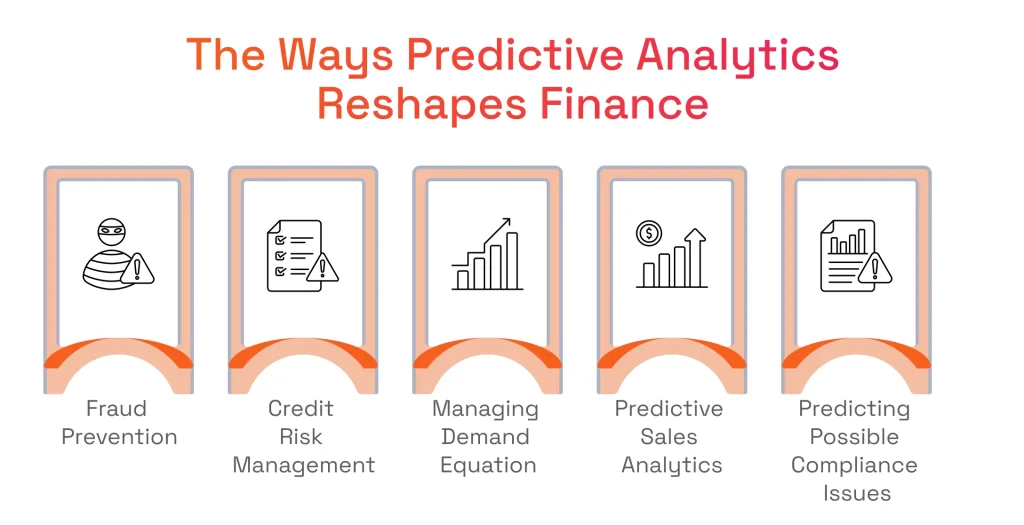
Fraud Prevention
Compared to traditional rule-based methods, credit card fraud detection using machine learning offers significantly enhanced accuracy and adaptability. Predictive analytics, in turn, transforms detection into prevention, enabling ML models to catch fraudulent behavior patterns before the risk is realized. This way, financial institutions can anticipate potential threats and proactively block suspicious activities, at no cost to customer experience.
Credit Risk Management
Predictive analytics can predict how likely a consumer is to default on a loan, enabling a more granular risk assessment in underwriting. Combined with alternative data, it becomes even more potent. Organizations can take into account hundreds of additional data points, such as transaction, telecom, utility, rental, social media activity, clickstream, and survey and questionnaire data.
Managing Demand Equation
Predictive analytics can forecast consumer behavior and balance the supply and demand for financial products and services. This, in turn, helps maintain liquidity and maximize capital efficiency. For example, it can predict that more consumers may start applying for loans following a decrease in federal interest rates.

Serhii Leleko
AI & ML Engineer at SPD Technology
“Predictive analytics in finance enable organizations to improve resilience and operational efficiency. Combined with prescriptive analytics, predictive models can become a valuable asset from front- to back-office.”
Predictive Sales Analytics
Using historical and real-time data, predictive models can forecast sales volumes, cash flows, and revenues. This helps ensure compliance with liquidity requirements and maximize capital efficiency. Furthermore, predictive models can be used for more effective lead scoring, targeted promotions and marketing campaigns, and upselling and cross-selling recommendations.
Predicting Possible Compliance Issues
Predictive models can identify and prioritize compliance risks. They can do so by powering regulatory horizon scanning and intelligence across hundreds of jurisdictions. They can also reveal emerging regulatory trends, inform prescriptive analytics for mitigating compliance risks, and simulate various regulatory scenarios.
Strategic Advantages of Using Financial Data Analytics
In 2025, 45% of financial organizations worldwide are expected to adopt AI for data analysis, considering this technology critical for gaining a competitive advantage. Below are more strategic benefits of leveraging data analytics capabilities for the finance sector.
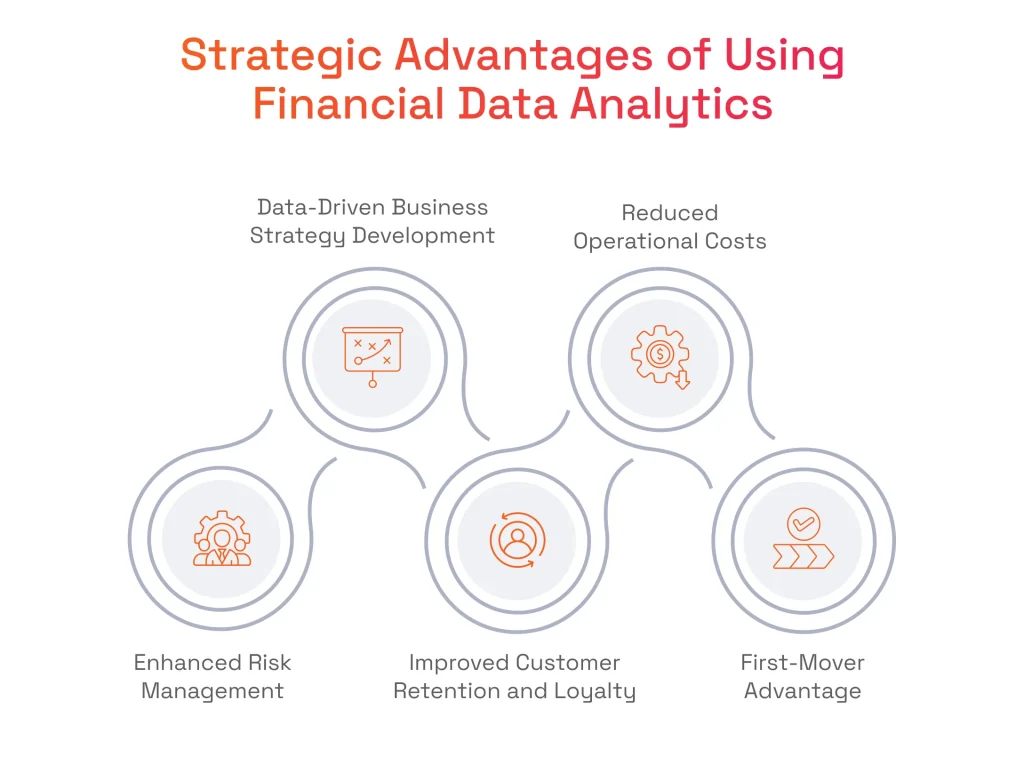
Enhanced Risk Management
More accurate risk and mitigation strategy assessment is one of the principal advantages of introducing data analytics in finance. In fact, risk management is the leading AI and data analytics use case among financial organizations, with 36% reporting this use case for the two technologies.
As climate and cybersecurity risks pose novel challenges to risk management strategies, predictive models can offer better visibility into the likelihood of risk realization. These models can also ingest hundreds of data points in real time to run simulations and assess the consequences of various realized risks.
For example, insurers can train predictive models to assess the likelihood of extreme weather events during P&C policy underwriting to inform pricing. Accurate risk assessments will then ensure liquidity and solvency if those risks are realized. All in all, leveraging advanced data analytics allows you to enhance risk management, improve the efficacy of your mitigation strategy, and quickly assess detect and novel threats.
Data-Driven Business Strategy Development
Truly data-driven strategic decision-making is another advantage of data analytics in the finance industry.Three-quarters of CEOs already rely on operational and transactional data to make decisions. However, 82% of companies continue to make decisions using stale data.
With the volumes of data available rising exponentially, making sense of that data can help you take advantage of a new business opportunity, improve operations, and make smarter investments.
For example, combined with data visualization, financial data analytics tools give decision-makers a 360-degree view of every aspect of operations. Data analytics tools can also make the next best action suggestions, thus enabling smarter decisions across the value chain.
Improved Customer Retention and Loyalty
Over half of financial services customers are ready to change providers if the provided services come across as impersonal. So, CX personalization isn’t just a trendy objective — it means meeting customer expectations.
For example, Bank of America’s chatbot, Erica, leverages data analytics to provide proactive financial advice to its users. Predictive analytics can also suggest the best next action for preventing customer churn and cross-selling or upselling.
Like data analytics in ecommerce, using data analytics to streamline back-office processes and personalize CX translates into higher customer retention, loyalty, and lifetime value.
Serhii Leleko
AI & ML Engineer at SPD Technology
“Treating every customer as a segment of one is impossible without advanced data analytics. However, to implement it, assess your organization’s data maturity first to ensure the analytics tools rely on accurate, up-to-date data.”
Reduced Operational Costs
Data analytics can also help you create operational efficiencies, decreasing running costs as a result. According to NVIDIA’s survey, 35% of U.S.-based financial organizations leveraged AI and data analytics for this exact purpose, while 20% more used the technology to reduce the TCO. A third of them managed to reduce costs by over 10%.
As galloping inflation since 2020 has substantially decreased consumers’ purchasing power, competing on price has become more crucial than ever. Cutting operational costs enables you to offer products and services at more affordable prices.
For example, data analytics can identify and eliminate inefficiencies and bottlenecks across functions. It can also automate fully or partially certain tasks, such as risk assessment, investment portfolio optimization, or KYC checks (e.g., perpetual KYC). Besides enabling you to compete on price, reducing operational costs is also key to maintaining and improving profitability in turbulent market conditions.
First-Mover Advantage
Finally, leveraging the business impact of Big Data and advanced data analytics ahead of competitors allows you to secure the first-mover advantage. Furthermore, 75% of CEOs believe that competitive advantage will hinge on who has the most advanced generative AI – and genAI requires high volumes of quality data to be trained on.
Advanced analytics capabilities allow organizations to offer cutting-edge new products and services. For example, organizations already leverage AI and data analytics to offer their customers products like parametric insurance (e.g., Descartes Underwriting) or access to high-growth stock indexes (e.g., HSBC). Securing the first-mover advantage means strengthening your brand recognition, boosting customer loyalty, and gaining a higher market share and share of wallet.
Looking to leverage cutting-edge advantages of data analytics for your organization? Get started by developing an enterprise data strategy with our thorough article.
Main Use Cases of Data Analytics in Finance Verticals
As finance and data analytics go hand in hand, offering a wide range of use cases that drive strategic growth. Here’s how data analytics transforms operations across five verticals.
Data Analytics in Banking
Corporate and commercial banks are already leveraging advanced analytics for fraud detection and prevention, CX personalization, and credit risk modeling. However, the list of potential data analytics use cases in banking doesn’t stop there. Data analytics can also power:
- Predictive maintenance for ATMs and other equipment
- Intelligent support ticket triaging
- Response suggestions for call center agents
- Automated cybersecurity threat detection and response
- Personal finance management suggestions and tips for customers
- Branch performance and resource allocation optimization
- Cash flow analytics and liquidity forecasting.
Benefits of Data Analytics in Banking
Leveraging data analytics allows commercial and corporate banks to sharpen their competitive edge with:
- Hyper-personalized CX, powered by a 360-degree view of customers and behavioral and sentiment analysis.
- Improved customer lifetime value, thanks to more effective churn prediction and outreach campaigns.
- Higher conversion rates with more accurate lead scoring and tailored product recommendations.
- Granular product pricing with what-if modeling and advanced risk assessment.
- Data-driven decision-making on all levels with business intelligence tools.
- Enhanced risk assessment, prioritization, and management.
Data Analytics for Insurance Companies
Data analytics in insurance enables companies to offer new products, streamline underwriting and claims management, and optimize risk management with:
- Personalized pricing and coverage powered by advanced risk modeling using traditional and alternative data
- Usage-based insurance that calculates premiums based on driving behavior
- Parametric insurance to leverage alternative data like satellite imagery and weather conditions to identify when the insured event occurs
- Automated data verification and validation during claims processing
- Automated first notice of loss (FNOL) via telematics data analytics.
Analytics in Investment Banking
Data analytics is one of the leading applications of AI in investment banking, with predictive financial modeling among the most prominent use cases. Traditionally, financial modeling was done manually and carried a high risk of human error. Today, data analytics can take it on, easily accounting for hundreds of variables and detecting patterns invisible to the human eye. As a result, investment banks receive more accurate forecasts of market trends and volatility, asset prices and returns, and liquidity and cash flows.
Investment banks and capital markets organizations are now using the technology to:
- Identify stocks with the highest growth potential to increase ROI (e.g., HSBC).
- Monitor market conditions and identify trends, assess volatility, and predict asset prices.
- Power algorithmic and high-frequency trading.
- Determine the optimal hedging strategy based on market conditions.
- Detect market manipulation.
- Predict liquidity risks under extreme market conditions (e.g., the COVID-19 pandemic).
Predictive Analytics in Accounting
Predictive analytics powers an emerging field of financial management: predictive accounting. This type of accounting leverages big-data-driven forecasts to gain visibility into future cash flows, revenue streams, business growth rates, liquidity, solvency, and more.
These forecasts allow companies to maximize capital efficiency while maintaining compliance with regulatory requirements.
Top use cases for AI-powered analytics in corporate finance also include:
- Anomaly and error detection
- Decision-making support
- Percentage-of-completion revenue forecasting
- Cash collection forecasting.
Data Analytics for Financial Services
In financial services, data analytics can power highly personalized financial planning. Financial advisors can use data analytics to run multiple risk modeling scenarios and recommend the best financial strategy that matches the client’s risk appetite and goals. Predictive analytics in financial services can also help tax professionals grasp how new regulations and developments (e.g., the 2025 tax cliff) can impact the client’s bottom line.
Besides the above-mentioned, financial service companies use AI and data analytics to streamline the next processes:
- Wealth transfer and management automation
- Beneficiary designation optimization
- Asset protection strategies enhancement.
Although the underlying technologies are often similar, the business problems they address differ across finance verticals. Data analytics supports a wide range of operational and strategic objectives throughout the financial ecosystem.
Finance Vertical | Key Applications | Primary Objective | Business Impact |
|---|---|---|---|
Banking | Fraud detection, FX optimization, branch performance analysis, cash flow forecasting | Improve operational performance and risk management | Better customer service, reduced fraud losses, and more efficient operations |
Corporate and commercial banking | Customer segmentation, churn prediction, personalized recommendations | Improve customer acquisition and retention | Increased customer lifetime value and loyalty |
Insurance | Risk modeling, personalized pricing, claims analytics, telematics-based underwriting | Improve underwriting accuracy and claims management | Lower losses and more competitive insurance products |
Investment banking | Market forecasting, portfolio optimization, trading analytics, risk assessment | Improve investment decisions | Higher returns and improved risk-adjusted performance |
Accounting and finance operations | Revenue forecasting, cash flow forecasting, anomaly detection | Improve financial planning and reporting | Better budgeting and financial control |
Wealth management | Portfolio analysis, risk profiling, investment recommendations | Improve client outcomes and advisory services | Stronger portfolio performance and client satisfaction |
Financial services providers | Product optimization, customer analytics, operational forecasting | Improve profitability and service delivery | Faster growth and more informed business decisions |
Finance Vertical
Banking
Corporate and commercial banking
Insurance
Investment banking
Accounting and finance operations
Wealth management
Financial services providers
Key Applications
Fraud detection, FX optimization, branch performance analysis, cash flow forecasting
Customer segmentation, churn prediction, personalized recommendations
Risk modeling, personalized pricing, claims analytics, telematics-based underwriting
Market forecasting, portfolio optimization, trading analytics, risk assessment
Revenue forecasting, cash flow forecasting, anomaly detection
Portfolio analysis, risk profiling, investment recommendations
Product optimization, customer analytics, operational forecasting
Primary Objective
Improve operational performance and risk management
Improve customer acquisition and retention
Improve underwriting accuracy and claims management
Improve investment decisions
Improve financial planning and reporting
Improve client outcomes and advisory services
Improve profitability and service delivery
Business Impact
Better customer service, reduced fraud losses, and more efficient operations
Increased customer lifetime value and loyalty
Lower losses and more competitive insurance products
Higher returns and improved risk-adjusted performance
Better budgeting and financial control
Stronger portfolio performance and client satisfaction
Faster growth and more informed business decisions
The Future Role of Big Data Analytics for Financial Services
Big Data is the future of data analytics in finance for two reasons. The first one is that the volumes of generated data continue rising exponentially and are expected to reach 181 zettabytes in 2025. As for the second, the proliferation of open banking regulations (e.g., PSD2) means financial organizations can gain access to even more data while capitalizing on their data streams.
These three trends will shape the future of Big Data analytics in financial services:
- Collaboration and data sharing across ecosystems: Open banking regulations mandate financial institutions to provide access to customer data via secure APIs.
- Innovative financial products and services: For example, predictive analytics can power cutting-edge fintech products for algorithmic trading, financial advice, tax optimization, etc.
- Enhanced strategic value as a competitive differentiator: Those who harness the potential of Big Data analytics will gain an edge with superior customer experiences, more cost-efficient operations, and never-before-seen products and services.
Main Challenges of Finance and Banking Analytics Implementation
At SPD Technology, we’re well-acquainted with the most common fintech applications development challenges. Below are six of the most important ones.
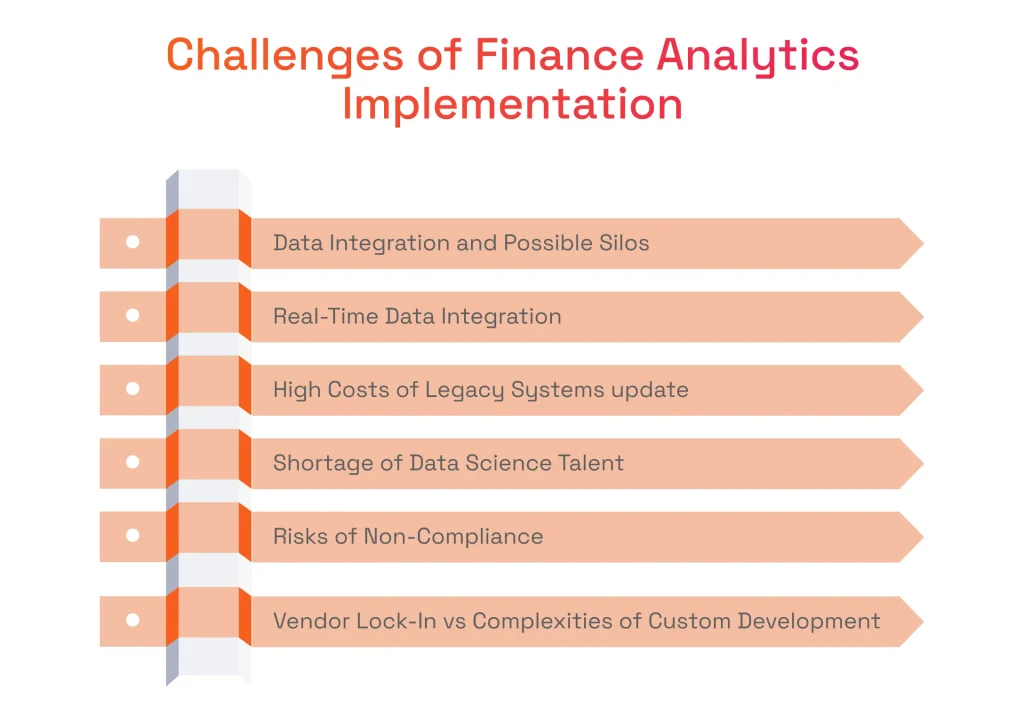
Data Integration and Possible Silos
The importance of data integration is hard to overstate: data silos are the biggest barrier to innovation and hinder digital transformation efforts for 81% of organizations.
Data silos prevent organizations from getting a complete and accurate view of their financial operations. Breaking these silos is crucial to enabling a 360-degree view and ensuring the output accuracy.
How to address it: Assess the data maturity of your organization before kicking off the data analytics project. Ensure your data is consolidated in a centralized data repository and that you have a robust data governance framework and data strategy beforehand, as well.
Real-Time Data Integration
Aggregating and transforming data from multiple sources in real time can be challenging due to data volumes, velocity, latency, and quality requirements. Real-time processing also needs significant computing resources.
However, certain projects, such as real-time risk assessment and fraud software development, are impossible to complete without integrating real-time data streams.
How to address it: Invest in scalable infrastructure and opt for the event-driven approach to architecture to support data analytics solutions. Verify your data quality controls are robust and your tech stack is adapted to stream processing (e.g., Apache Kafka) to enable real-time analytics.
Legacy Systems at High Costs for Their Modernization
The average age of a universal bank’s core applications is 14 years, with the figure rising to 18 years for an average insurer. Decades-old legacy systems, however, prevent organizations from reaping the full cloud computing infrastructure benefits.
Adopting the cloud is a prerequisite for running Big Data analytics and AI/ML models, as these technologies require cloud infrastructure to function. Migrating to the cloud, however, is a costly and resource-intensive undertaking. Modernizing legacy systems, in turn, is even more expensive and resource-demanding in most cases.
How to address it: Evaluate your legacy systems and existing technical debt against data analytics needs early on. Identify which systems need to be modernized before implementing data analytics and select the right modernization approach (rehost, re-platform, refactor, rearchitect, rebuild, replace). Consider moving away from legacy infrastructure to the cloud in increments.
Possible Shortage of Data Science Talent
Recruiting tech talent is a challenge across all sectors, with a data scientist’s average time-to-fill reaching 60 days. As the need for data scientists grows together with data volumes, finding the right talent to design, develop, implement, and maintain data analytics tools may not be as straightforward as you’d expect.
The lack of relevant data science expertise during data analytics development and implementation can lead to poorly aligned technical requirements, inaccurate output, and underwhelming ROI.
How to address it: When hiring in-house, consider your internal talent pool and promote employees willing to undergo data science training. You can also tap into the global talent supply. If in-house recruitment isn’t a suitable option for you, consider hiring a data analytics implementation partner.
Risk of Non-Compliance
The financial sector is heavily regulated, and your solution may have to comply with hundreds of regulations across multiple jurisdictions. You should be especially careful when implementing KYC standards in financial services, as they should remain unbiased and compliant without sacrificing customer experience. You should also pay attention to data security in fintech applications, from enforcing password hygiene to authentication and authorization.
Failure to comply with privacy, security, and other regulations can lead to fines and damage to your reputation. You should pay extra attention to novel AI regulations aimed at ensuring model fairness and transparency.
In the United States, the Equal Credit Opportunity Act (ECOA) requires ML models to prevent discrimination in lending. The Bank Secrecy Act (BSA), in turn, imposes requirements for ML models used for transaction monitoring to ensure their effectiveness in detecting suspicious activity.
How to address it: Assess all regulatory requirements for the future data analytics solution before finalizing functional and non-functional requirements for it. To protect sensitive data, prioritize strong encryption methods (e.g., Twofish, Blowfish, AES, RSA) and data tokenization.
Vendor Lock-In vs. the Complexities of Custom Finance Data Analytics Software Development
Buy vs build is the eternal question. Getting an off-the-shelf solution may easily result in vendor lock-in, where leaving a vendor is too costly or complicated, but the solution no longer meets your needs. On the other hand, the build approach comes with its challenges: project management, considerable overhead, and alignment with business needs are just a few.
Choosing the unsuitable approach to ramping up data analytics capabilities may undermine the solution’s ROI, lead to resource waste, and prevent you from achieving your business objectives with data.
How to address it: Conduct a thorough buy vs build analysis. Consider cost factors, competitive differentiation, scale and complexity, time frames, and data and security requirements during the analysis. Perform discovery interviews to define and prioritize requirements.
The obstacles described above rarely exist in isolation. Data silos affect reporting quality, legacy systems slow modernization efforts, and compliance requirements influence nearly every analytics initiative. Understanding the business impact of these challenges helps organizations prioritize the right mitigation strategies from the beginning.
Challenge | Business Risk | Impact | Recommended Mitigation |
|---|---|---|---|
Data integration and silos | Incomplete visibility into financial operations | Inconsistent reporting and fragmented decision-making | Enterprise integration strategy and centralized data architecture |
Real-time data integration | Delayed insights and missed opportunities | Slower responses to risk and market events | Event-driven architectures and scalable infrastructure |
Legacy system modernization | High maintenance costs and limited scalability | Reduced innovation and operational inefficiencies | Phased modernization and cloud migration |
Data science talent shortages | Slower project delivery and lower analytics maturity | Delayed ROI and limited innovation | Upskilling, external expertise, and automation |
Compliance and regulatory risk | Fines, audits, and reputational damage | Increased operational and legal exposure | Strong governance and compliance controls |
Vendor lock-in vs. custom development | Limited flexibility or increased complexity | Higher long-term costs and technical constraints | Architecture aligned with business objectives and future growth |
Challenge
Data integration and silos
Real-time data integration
Legacy system modernization
Data science talent shortages
Compliance and regulatory risk
Vendor lock-in vs. custom development
Business Risk
Incomplete visibility into financial operations
Delayed insights and missed opportunities
High maintenance costs and limited scalability
Slower project delivery and lower analytics maturity
Fines, audits, and reputational damage
Limited flexibility or increased complexity
Impact
Inconsistent reporting and fragmented decision-making
Slower responses to risk and market events
Reduced innovation and operational inefficiencies
Delayed ROI and limited innovation
Increased operational and legal exposure
Higher long-term costs and technical constraints
Recommended Mitigation
Enterprise integration strategy and centralized data architecture
Event-driven architectures and scalable infrastructure
Phased modernization and cloud migration
Upskilling, external expertise, and automation
Strong governance and compliance controls
Architecture aligned with business objectives and future growth
Tested and Proven Approaches to Finance and Banking Data Analytics Integration
At SPD Technology, we routinely help our clients overcome these and other challenges when providing data analytics services. Here are our five tried-and-true best practices to maximize the advantages of strategic technology consulting for our clients – and ensure your data analytics efforts pay off.
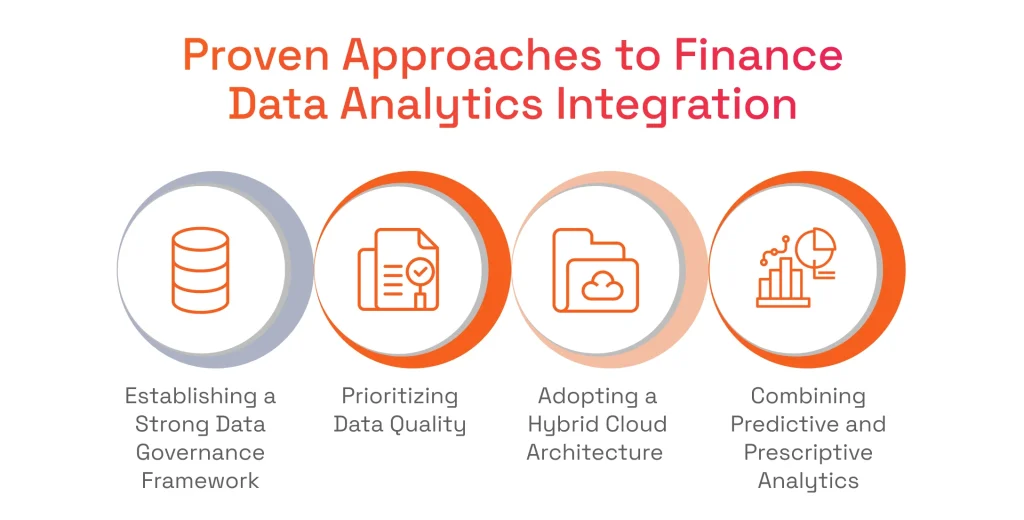
Establishing a Strong Data Governance Framework
A data governance framework is crucial for maintaining compliance, security, and data quality. When providing data analytics consulting services, we help our clients design a comprehensive framework that outlines:
- Key data governance roles and responsibilities across functions
- Success metrics and KPIs
- Necessary data security measures
- Data ownership and accountability policy
- Risk management practices
- Data quality
- Master data and metadata
- Architecture management practices
Prioritizing Data Quality
The output of data analytics models is only as good as the quality of data fed into it. That’s why ensuring data quality is a top priority in any data analytics project. It involves:
- Establishing data quality standards across the organization.
- Implementing data validation techniques (e.g., format validation, range constraints) and data cleansing tools.
- Monitoring the quality of master data and other critical data assets.
- Conducting regular data quality audits.
Don’t know where to start with data quality? Learn more about data quality management in our dedicated article.
Adopting a Hybrid Cloud Architecture
The cloud provides the scalability and computing power necessary for handling Big Data analytics. However, strict regulatory requirements may mandate on-premises data storage. That’s why the hybrid cloud is usually more suitable for financial organizations.
Hybrid cloud infrastructure delivers the best of both worlds: the security and compliance of on-premises storage and the scalability and flexibility of the cloud. When helping our customers adopt it, we start by providing a tailored assessment of their existing IT infrastructure to find a reasonable balance between cloud and on-premises environments. During the next steps, our approach balances compliance with scalability. According to it, we suggest integrating sensitive datasets into a secure, compliant on-premises environment, while using cloud resources for real-time analytics processing and Big Data handling.
Combining Predictive and Prescriptive Analytics
While financial predictive analytics can identify trends and predict cash flows or market conditions, combining it with prescriptive analytics is the ultimate game-changer. Prescriptive analytics determine the next best action to enhance risk management, optimize portfolio management, personalize CX, and more.
To combine predictive and prescriptive analytics for financial services firms, our approach involves a strategic integration of advanced data processing, ML models, and decision-support systems. First, we build predictive models that work within vast datasets to predict risk factors and possible outcomes using real-time data analysis. These predictions form the foundation for prescriptive analytics, where we incorporate optimization algorithms and AI-driven decision engines to suggest the most effective actions in response to those predictions.
Implementing Advanced Risk Analytics and Stress Testing
Advanced risk analytics in banking and financial services allows organizations to mitigate risks effectively and cost-efficiently. Stress testing portfolios, for example, lets organizations maximize their preparedness for potential financial shocks.
We help our clients implement:
- Value at risk (VaR) models for quantifying the risk of loss based on market volatility and exposure
- Scenario-based stress testing for assessing resilience and refining risk mitigation strategies based on the most likely outcomes of scenarios (e.g., regulatory changes)
- Liquidity risk monitoring for monitoring and forecasting liquidity levels and requirements to avoid cash flow crises and maintain compliance.
Our Professional Vision of Finance Data Analysis Implementation
As one of the best fintech development companies in London, UK, we specialize in delivering complex data analytics solutions to mid-sized and large financial organizations. Our AI/ML and data science expertise, coupled with business acumen, enable us to deliver solutions that become the value-driving backbone of enterprise decision-making.
Our approach to data analytics projects rests on three pillars:
- Building a scalable and flexible architecture that evolves together with the business
- Helping break down data and organizational silos
- Emphasizing the use of predictive analytics.
See our expertise in action in our case study on real-time data analytics development for a P2P lending company.
Business Challenge
Our client, a P2P lending company, turned to us with a request to build a data warehouse to streamline multi-source data integration and quality management. It also required a robust solution to successfully handle rising data volumes and complexity.
Furthermore, our client was also aiming to enhance its value proposition with real-time analytics and dynamic risk profiling. The data analytics solution, however, had to ensure AI model fairness and transparency to mitigate compliance risks and avoid biased output.
SPD Technology’s Approach
We began our collaboration by developing a data governance framework, followed by a strategic data integration plan and data quality metrics. With those foundations laid down, we moved on to designing the data warehouse with extra consideration for security measures and access controls.
With the data warehouse design complete, we developed and deployed real-time data pipelines based on the defined data analytics metrics. We ensured the AI infrastructure remains scalable as the client’s operations grow while maintaining performance and accuracy. As for the AI models’ fairness and transparency, we applied fairness constraints, disparate impact analysis, and regularization methods, as well as local and global explainability techniques and bias audits.
Value Delivered
As a result, our client received a single solution that consolidated data from 15+ sources, while also reducing data inconsistencies by 40% and query speed by 60%. Our real-time data analytics model allowed for more granular risk profiling, with 10-second risk updates replacing hourly ones the company relied on before. In addition, our solution accelerated borrower-lender matching by 70%, thus improving customer experience.
Key Takeaways
- Financial data analytics enables organizations to improve decision-making by transforming large volumes of financial and operational data into actionable insights.
- Regulatory compliance and risk management depend on accurate, governed, and auditable data.
- Fraud detection and risk modeling are among the most valuable applications of analytics in financial services.
- Data quality issues can significantly reduce the reliability of forecasts, models, and business decisions.
- Advanced analytics technologies allow organizations to move from descriptive reporting to predictive and prescriptive decision-making.
- Successful financial analytics initiatives require strong governance, data quality controls, and cross-functional collaboration.
In short: financial data analytics provides the foundation for better decisions, stronger compliance, more effective risk management, and sustainable business growth in financial services.
FAQ
How much does building a financial data analytics platform cost?
The cost depends on the number of data sources, regulatory requirements, analytics complexity, security controls, and whether advanced capabilities such as AI, machine learning, or real-time analytics are included. Focused analytics initiatives centered on reporting, dashboards, and performance monitoring often range from $75,000–$250,000, while enterprise-scale financial analytics platforms commonly range from $250,000–$1 million+.
Costs typically include data integration, cloud or on-premises infrastructure, governance controls, security implementation, analytics development, reporting tools, testing, and ongoing support. Regulated environments often require additional investment in auditability, compliance monitoring, and data lineage capabilities.
What are the model risk and regulatory compliance risks of analytics in financial services?
Analytics models can create significant risk when they rely on incomplete data, outdated assumptions, biased training datasets, or insufficient validation processes. Poorly governed models may produce inaccurate forecasts, flawed credit decisions, incorrect risk assessments, or ineffective fraud detection outcomes.
From a compliance perspective, financial institutions must demonstrate transparency, auditability, data lineage, explainability, and appropriate controls over how analytics models are developed and used. Regulatory scrutiny increases when analytics influences lending, investment, insurance, risk, or customer-facing decisions. Strong governance, validation frameworks, and ongoing model monitoring help mitigate these risks.
How long does financial analytics implementation take in a regulated environment?
Implementation timelines vary depending on organizational complexity, regulatory obligations, data maturity, and integration requirements. Foundational analytics capabilities such as reporting, KPI dashboards, and performance monitoring can often be deployed within 3–6 months, while enterprise-wide financial analytics programs typically require 9–18 months or longer.
Projects in regulated environments often take longer due to governance reviews, security assessments, model validation procedures, audit requirements, and compliance approvals. Many organizations accelerate delivery by implementing analytics in phases, starting with high-priority business use cases.
What data governance failures most frequently derail financial analytics projects?
The most common governance failures include unclear data ownership, inconsistent business definitions, poor data quality controls, fragmented data sources, weak metadata management, and insufficient accountability for data stewardship. These issues often result in conflicting reports, unreliable analytics, and reduced trust in business insights.
Many financial organizations also struggle when governance processes are implemented after analytics initiatives have already begun. Without established standards for quality, lineage, security, and access management, analytics projects frequently encounter delays, compliance concerns, and adoption challenges.
What is the difference between financial reporting, financial analytics, and financial BI?
Financial reporting focuses on presenting historical financial information such as revenue, expenses, profitability, and regulatory disclosures. Its primary goal is to communicate what happened during a specific period.
Financial business intelligence (BI) expands on reporting by providing dashboards, visualizations, KPI monitoring, and self-service analysis that help users understand performance trends and operational metrics. Financial analytics goes a step further by applying statistical analysis, predictive modeling, machine learning, and forecasting techniques to explain why events occurred and predict what is likely to happen next.
In practice, reporting describes the past, BI helps monitor the present, and analytics helps organizations anticipate and shape future outcomes.