

A data management framework defines the processes, policies, technologies, and roles for managing an organization’s data assets throughout their lifecycle. It covers seven core components (governance, architecture, quality, integration, storage, security, and lifecycle management) and can be built on proven standards like DAMA-DMBOK, COBIT, or TOGAF, or designed as a custom solution. With 63% of organizations lacking AI-ready data management practices and 60% of AI projects at risk of abandonment as a result, the framework is the foundation that determines whether data investments deliver results.
Today the correct approach to data management determines if you maintain the competitive advantage. According to Deloitte’s 2025 Tech Executive Survey of 622 US technology leaders, CIOs singled out harnessing the full potential of AI, data, and analytics as the area where they’re spending most of their time and energy, with 64% of organizations planning to increase AI investments over the next two years. Yet despite this intensity of focus, 47% of CDOs say competing organizational priorities hinder their ability to realize the full value of data.
To set your data initiatives on the right track, you need to have the data management framework. In this article, we examine why it is important and what are the best practices for creating one.
Data Management Framework Definition
To understand how the framework helps to organize all your data-related activities, let’s define its role and purpose.
What Is Data Management Framework?
A data management framework is a structured approach, a vision that defines the processes, policies, technologies, and roles required to manage an organization’s data assets effectively. It provides a structure for how data is created, stored, maintained, and utilized throughout its lifecycle, ensuring data is accurate, secure, accessible, and aligned with business objectives.
A data management framework helps organizations to maximize the value of their data. It is usually done by achieving consistency and quality, compliance with regulatory requirements, facilitating the reliable use of data, and minimizing risks related to data breaches, loss, or mismanagement.
The framework should not be confused with the data management roadmap, which is a strategic document containing the steps and milestones necessary to achieve the objectives defined by the framework. Data management strategy, in turn, is formed based on the roadmap.
Need to figure out what a data management strategy is?
Learn in our guide!
What Is Data Management Framework’s Purpose?
The purpose of a data management framework is to provide a structured approach for effectively working with organization’s data assets and resolving data management challenges. According to Statista, the most common roadblocks with data management are storage cost, orchestration, security, disaster recovery, synchronization, visibility, compliance, among others.
To deal with such complexities, the framework establishes standardized processes, policies, and tools, ensuring that everyone in the organization is working towards the same objectives. In such a way, the company can eliminate silos and promote collaboration for effective data management.

Serhii Leleko
AI & ML Engineer at SPD Technology
“I’d like to emphasize that a data management framework is a guide for your data efforts on the road toward a data-driven organization. Without a clear framework, companies can’t build a sustainable and scalable data infrastructure.”
Benefits of Implementing Data Management Framework
According to Gartner, 63% of organizations either don’t have or aren’t sure they have the right data management practices for AI — and through 2026, organizations will abandon 60% of AI projects unsupported by AI-ready data — making a structured data management framework the essential foundation before any analytics or AI initiative can deliver results.
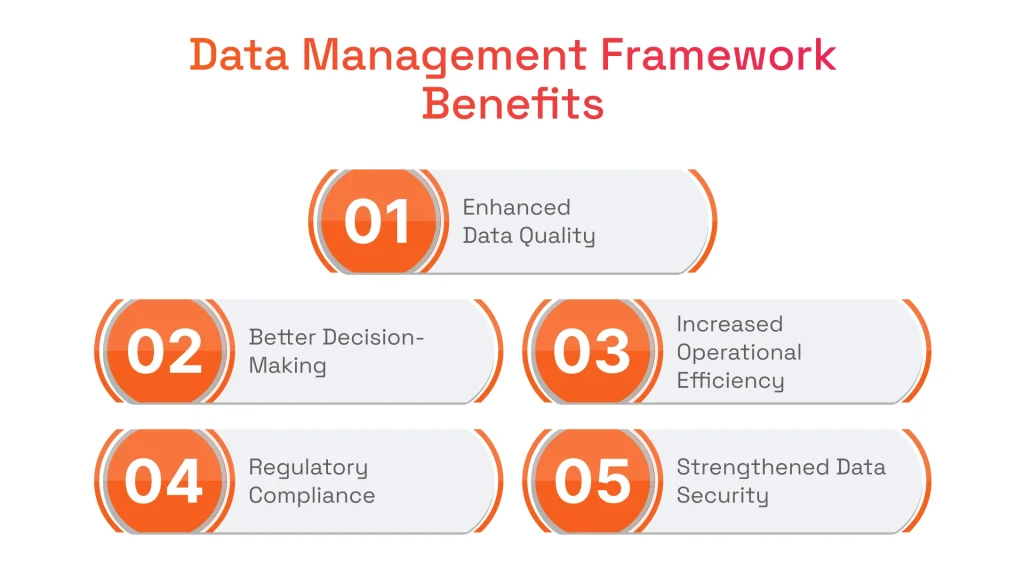
Consider the following advantages of implementing the framework to understand its value:
- Enhanced Data Quality: The framework ensures that data avoids errors and discrepancies. With the focus on quality, it ensures that the clean data contributes to the effectiveness of analytics and reporting.
- Better Decision-Making: As long as the framework provides the team with structured access to high-quality data, all stakeholders across the company can make strategic decisions on the basis of reliable insights instead of assumptions.
- Increased Operational Efficiency: Businesses that choose to follow the framework make sure that it helps streamline data processes and reduce duplicates. In such a way, the personnel usually experience a productivity boost.
- Regulatory Compliance: One of the framework’s focuses is data governance and security protocols. Thanks to that, organizations meet legal and industry-specific regulations concerning data management and avoid penalties.
- Strengthened Data Security: The framework enforces stringent security measures to make sure data is securely stored, managed, and accessed only by authorized personnel.
Key Components of Data Management Framework
The data management framework introduces several initiatives. Each plays a crucial role providing all the necessary means for establishing a data-driven enterprise. See the breakdown of data management components below.
Component | Primary purpose | Key tools & processes | Primary business benefit |
|---|---|---|---|
Data governance | Define policies, roles, and accountability for how data is managed across the organization | Governance committees, data stewardship, compliance management, metrics and monitoring tools | Reliable, secure, accessible data with minimized risk of misuse and compliance violations |
Data architecture | Design how data is structured, stored, and accessed to support business strategies | Data models, flow diagrams, integration platforms, metadata repositories, data pipelines | Consistent data flow across departments, scalable infrastructure, and improved operational efficiency |
Data quality | Ensure data is clean, accurate, complete, consistent, and reliable for analytical use | Data profiling tools, validation rules, cleansing processes, quality metrics, continuous monitoring | Reduced errors, trustworthy insights, and AI/analytics initiatives that scale beyond pilots |
Data integration | Combine data from disparate sources into a single, unified, and consistent view | ETL/ELT processes, data warehouses and lakes, middleware, APIs, synchronization tools | Elimination of data silos, coherent cross-system reporting, and holistic business visibility |
Data storage | Define methods and technologies for securely storing and retrieving data at scale | Database systems, cloud storage, storage area networks, archival systems, backup and recovery tools | Business continuity, optimized performance, and cost-efficient use of storage resources |
Data security & privacy | Protect sensitive data from unauthorized access, breaches, and regulatory non-compliance | Encryption, access controls, firewalls, intrusion detection systems, compliance measures | Reduced breach exposure, regulatory compliance, and protection of customer trust and reputation |
Data lifecycle management | Govern data from creation through archiving and disposal across its full lifespan | Lifecycle policies, data classification schemes, retention schedules, archiving and disposal procedures | Efficient storage use, reduced compliance risk, and elimination of outdated or unnecessary data |
Component
Data governance
Data architecture
Data quality
Data integration
Data storage
Data security & privacy
Data lifecycle management
Primary purpose
Define policies, roles, and accountability for how data is managed across the organization
Design how data is structured, stored, and accessed to support business strategies
Ensure data is clean, accurate, complete, consistent, and reliable for analytical use
Combine data from disparate sources into a single, unified, and consistent view
Define methods and technologies for securely storing and retrieving data at scale
Protect sensitive data from unauthorized access, breaches, and regulatory non-compliance
Govern data from creation through archiving and disposal across its full lifespan
Key tools & processes
Governance committees, data stewardship, compliance management, metrics and monitoring tools
Data models, flow diagrams, integration platforms, metadata repositories, data pipelines
Data profiling tools, validation rules, cleansing processes, quality metrics, continuous monitoring
ETL/ELT processes, data warehouses and lakes, middleware, APIs, synchronization tools
Database systems, cloud storage, storage area networks, archival systems, backup and recovery tools
Encryption, access controls, firewalls, intrusion detection systems, compliance measures
Lifecycle policies, data classification schemes, retention schedules, archiving and disposal procedures
Primary business benefit
Reliable, secure, accessible data with minimized risk of misuse and compliance violations
Consistent data flow across departments, scalable infrastructure, and improved operational efficiency
Reduced errors, trustworthy insights, and AI/analytics initiatives that scale beyond pilots
Elimination of data silos, coherent cross-system reporting, and holistic business visibility
Business continuity, optimized performance, and cost-efficient use of storage resources
Reduced breach exposure, regulatory compliance, and protection of customer trust and reputation
Efficient storage use, reduced compliance risk, and elimination of outdated or unnecessary data
Data Governance
Data governance is the set of policies, procedures, standards, and roles that guide how data is managed across the organization. It ensures data is accurate, secure, and used effectively to meet business objectives. The data governance framework consists of:
- Policies and Standards
- Data Stewardship
- Governance Committees
- Compliance Management Processes
- Metrics and Monitoring Tools.
The primary goal of data governance structure is to establish accountability and ensure the data is reliable, secure, and accessible. Data governance initiatives minimize risks of data misuse and promote an informed decision-making process.
Data Architecture
Data architecture is the design of how an organization structure, store, and access its data. It outlines how data is collected, stored, integrated, and utilized, providing a structured approach for managing data flow and ensuring that data aligns with business strategies.
The components of data architecture are:
- Data Models
- Data Flow Diagrams
- Integration Platforms
- Metadata Repositories
- Standards and Protocols
Data architecture ensures that information flows easily across departments and applications by addressing such aspects as consistency and scalability. One of the critical solutions within the frame of data architecture is building data pipelines for keeping data organized and, thus, boosting operational efficiency. For example, we leveraged our data expertise and helped a US-based business research company to data loading and processing pipeline as the main components of the AI-powered tool for automating the data collection process. Our efforts resulted in 100% atomated of media image metrics calculation.
Data Quality
Data quality refers to the measures that make data clean, accurate, complete, consistent, and reliable. According to Deloitte’s 2025 CDO Survey, data governance remains the top priority for 51% of CDOs, driven by the recognition that without clean, governed data, analytics and AI initiatives cannot scale beyond pilots.
Data quality involves the following tools and processes:
- Data Profiling Tools
- Validation Rules
- Data Cleansing Processes
- Quality Metrics
- Continuous Monitoring Systems.
While poor data quality can lead to misguided strategies, financial losses, and reputational damage, high quality data reduces errors, increases efficiency, and builds trust in the data. We adopted a qualitative approach to data, when working on our client’s peer-to-peer lending platform. We implemented data quality standards that led to a 40% reduction in data errors.
Data Integration
When it comes to data integration, it means that the framework defines the process of combining data from different sources to provide a single, unified view. In such a way, it becomes possible to ensure that data is consistent and accessible across the company’s systems and applications.
Data integration focuses on the following:
- ETL Processes
- Data Warehouses and Lakes
- Middleware Solutions
- APIs and Web Services
- Data Synchronization Tools.
Combining data from disparate sources enables coherent analysis and reporting. The importance of data integration lies in seamless data flows across different systems, applications, and databases. This entails breaking down silos and promoting a holistic understanding of information.
Data Storage
The increase in data creation is the reason why global revenue in the data center market’s storage is projected to grow by over 70% from 2024 to 2029. That statistics also means that companies will spend a lot on storing data. However, with an effective approach to data storage, the cost may be reduced. The framework addresses this aspect that encompasses the methods and technologies (hardware and software) used to store and retrieve data.
Critical components of data storage are:
- Database Systems
- Cloud Storage Services
- Storage Area Networks
- Archival Systems
- Backup and Recovery Tools.
The enterprise data management framework with a proper storage approach ensures that data is preserved securely and is readily available upon request. This ensures business continuity and optimizes performance because the company uses the right storage solutions for different types of data.
Data Security and Privacy
According to IBM’s Cost of a Data Breach Report 2025, the global average cost of a data breach stands at $4.44 million. For this reason, data security is another crucial component of the framework that explains how to safeguard sensitive data from unauthorized access, breaches, and misuse. Here, compliance importance is also highlighted, indicating the significance of data privacy regulations such as GDPR, HIPAA, and CCPA.
The essential factors addressed within the frame of data security are:
- Encryption Methods
- Access Controls
- Firewalls and Intrusion Detection Systems
- Privacy Policies
- Regulatory Compliance Measures.
The importance of data security lies in maintaining customer trust and protecting the organization’s reputation. When the organization’s data assets are secure, companies safeguard their business and customers from breaches and legal penalties.
Data Lifecycle Management (DLM)
DLM is a policy-driven approach that allows keeping focus on data during its full lifecycle, from creation to eventual disposal. This approach guarantees efficient data management at every stage of its lifespan, maximizing compliance, retention, and storage.
DLM prioritizes the following areas:
- Lifecycle Policies
- Data Classification Schemes
- Retention Schedules
- Archiving Solutions
- Disposal Procedures.
With DLM, companies can ensure efficient use of storage resources, reduce costs, and maintain adherence to laws and regulations. Thanks to including this aspect in the framework, companies get benchmarks in mitigating risks associated with outdated or unnecessary data.
Choose Right Data Management Framework for Your Business
You do not have to invent the framework from scratch: there are proven ones that address specific project areas and in some cases it might be a better option than a custom one. However, you need to focus on selecting the appropriate framework to make sure you accommodate your most pressing needs. This guarantees that your project will go according to test methodologies, best practices, and guidelines. Let’s review some of the examples.
Adapt and Adopt Established Frameworks
We offer you to take the following frameworks to your attention.
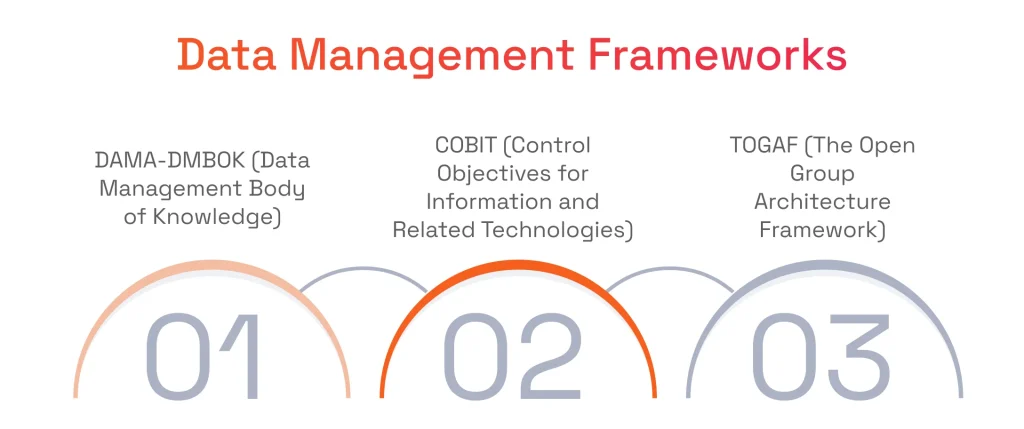
DAMA-DMBOK (Data Management Body of Knowledge)
The DAMA-DMBOK is an authoritative framework that defines the key disciplines essential for competent data management. It covers several foundational areas including data governance, data architecture, data quality, and data storage. Thus, this framework offers an all-in-one approach to handling critical business information.
DAMA-DMBOK encourages standardized processes and a shared knowledge across teams. Businesses looking to improve data quality management and build strong data governance may find this methodology especially helpful.
COBIT (Control Objectives for Information and Related Technologies)
COBIT is a data control framework that encompasses a broad range of IT processes, it emphasizes specific components relevant to data management, such as information security, data integrity, and compliance.
Adopting COBIT means firms can guarantee regulatory compliance, establish efficient risk management procedures, and match their IT strategy with their long-term business plans. Organizations that need strict control over their data-related procedures and information systems should use this approach.
TOGAF (The Open Group Architecture Framework)
TOGAF outlines a structured approach for designing, planning, implementing, and governing an enterprise information architecture. It offers tools and methodologies for developing data architectures, facilitating effective data integration, and promoting scalability.
In order to ensure that data management initiatives complement broader corporate objectives, it stresses the connection of IT strategy with business goals. Organizations that thrive for achieving greater flexibility in data management practices, enhanced interoperability between systems, and support for long-term strategic planning need to pay attention to this framework.
Sergii Leleko
AI & ML Engineer at SPD Technology
“You can also try and combine elements from these frameworks. Each of them offers distinct advantages, and incorporating a little bit of each, you can achieve a customized solution that maximizes the effectiveness of your data management.”
Designing a Custom Framework
While recognized frameworks like DAMA-DMBOK, COBIT, and TOGAF allow you to benefit from proven tactics, stakeholders may still see the need for a tailored approach to address specific issues or find competitive advantage. So, let’s see some recommendations on creating a custom framework.
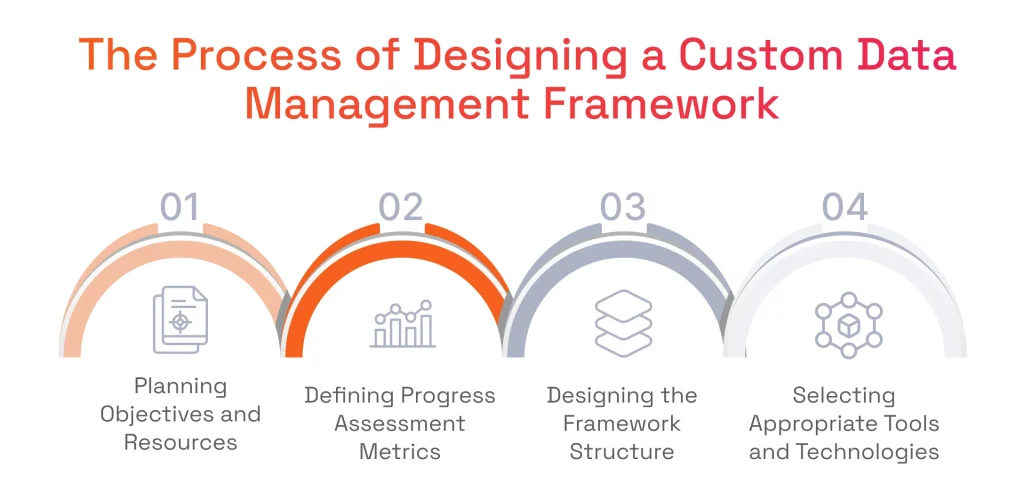
Planning Objectives and Resources
Begin by clearly defining the goals you aim to achieve with your framework. You might aim for improving data quality, ensuring regulatory compliance, or enhancing data accessibility. The data management framework can be focused on one of these objectives (suitable for smaller businesses) or target several at once (suitable for enterprises).
Whatever goal you choose, you need to pinpoint the most important objective and evaluate if your current resources (personnel, technology, budget, and data assets) can accommodate the enterprise data strategy you follow. If not, identify existing strengths and gaps, and make sure you can fill them during the framework implementation.
Defining Progress Assessment Metrics
Equally important is assessing your progress. For that, you can establish KPIs as they provide insights into the effectiveness of their data management initiatives. They span various components of the framework, such as data governance, data quality, data storage, etc. Some of the KPIs you might need are data accuracy rate, data completeness, regulatory compliance rate, data retrieval speed, and/or user satisfaction score. However, you can focus on those more relevant to your project.
Designing the Framework Structure
With your objectives defined, focus on building the structure of your framework. For that, identify the core components necessary for data management, such as data governance, architecture, quality management, metadata management, and security. Then, develop standardized processes and policies for data collection, storage, processing, and dissemination. In this manner, you ensure consistency and reliability across all data management activities.
Selecting Appropriate Tools and Technologies
The next step is equipping your framework with the selection of tools and technologies. We recommend beginning by identifying the specific functionalities and capabilities required to support your framework. Here, you need to pay attention to data integration, analytics, reporting, visualization, and security. Based on your need, select technologies compatible with your current capabilities.
Data Management Framework Implementation
Now let’s talk about the phases required for a successful framework implementation. Their sequential execution ensures that data promotes informed decision-making.
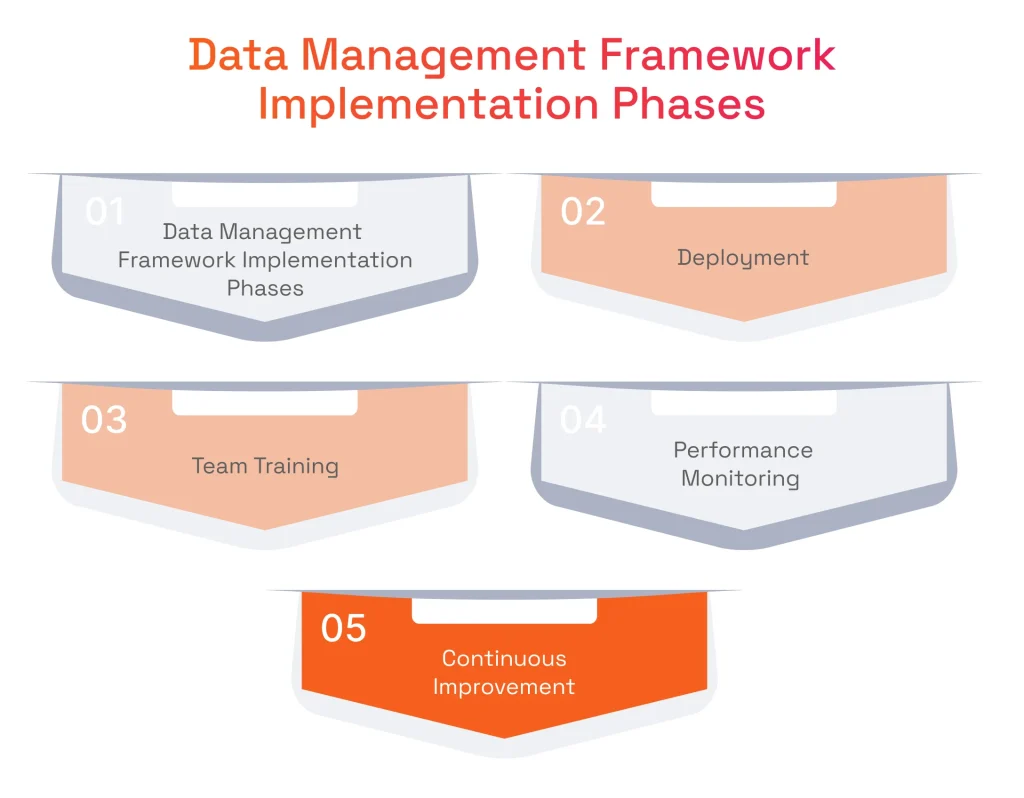
Deployment
First comes the deployment phase. The process starts with assessing the existing data infrastructure and identifying any issues connected to the framework components. After the evaluation, the next priority is establishing governance structures. This means elaborating responsibilities for data stewards and owners, as well as setting up procedures that help control how data is accessed, managed, and secured.
Following the governance setup, the technical implementation takes place. It focuses on integrating tools and systems that enable data quality management, security protocols, and process automation. Plus, if you are willing to streamline the data processes and reduce error, automation solutions will be helpful during this stage.
Team Training
Your company cannot move to new data practices without a proper training and education. Let your team adopt new practices, approaches, technologies, and tools. This may involve creating training programs, conducting workshops, webinars, and hands-on sessions. Also, consider tailoring training sessions to address the specific needs of different roles within your organization.
It is also crucial that your team revisit some documentation or learning materials. Therefore, your company needs to take care of the creation of a knowledge repository with resources, tutorials, and FAQs.
Performance Monitoring
To measure the effectiveness of the key activities in the frame of your data management framework and, thus, achieve competitive advantage, assess the progress according to the established key performance indicators (KPIs). Focus KPIs that include metrics related to data quality, data accessibility, compliance rates, user satisfaction, or any that can help to understand the progress of the implementation.
Moreover, you can conduct regular audits and assessments to guarantee that the framework is functioning as intended. You can use automated tools and manual reviews to evaluate data governance practices, adherence to policies, and the overall health of your data ecosystem.
Continuous Improvement
As technologies advance at a rapid pace, business requirements evolve, and company grows, new challenges also emerge. The framework should be flexible enough to adapt and accommodate the growing needs. Those needs may be scaling data infrastructure, integrating new technologies, ensuring compliance with updated regulations, and addressing increased data volume, security threats, and advanced analytics requirements.
In addition to such a flexible adjustment approach, prioritize changes that address critical issues and document those changes to avoid misunderstandings across the departments.
Data Management Framework Implementation Best Practices
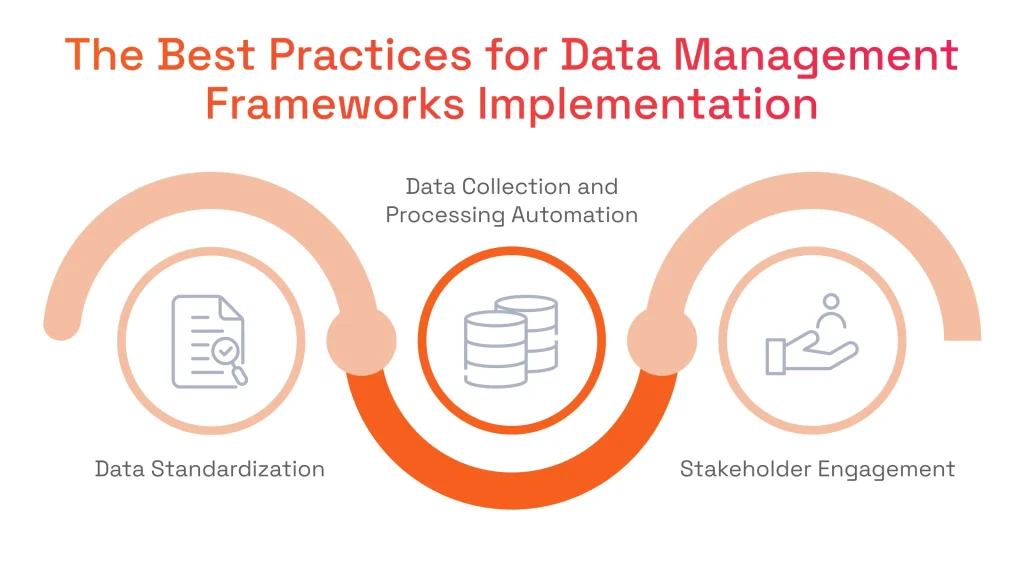
To achieve a proper execution of the framework, we strongly advise applying industry best practices concerning standardization, automation, and stakeholder engagement. Below, we provide an overview of how we use them to ensure best results for our clients.
Standardization
Our data scientists focus on standardization to ensure uniformity in data handling, which significantly improves data quality and reduces discrepancies. Thanks to following this practice, we adopt unified data standards, such as standardized formats and definitions, it facilitates seamless integration across different systems and departments. For example, we worked on harmonized data for categorization, when developing functionalities for a US-based online store. After we removed data discrepancies, our team achieved an impressive 90% accuracy in categorization allowing the store to attract 1.5 times more customers.
Automation
If your project needs to handle repetitive tasks like data entry, cleansing, and validation with the utmost efficiency, we usually set up automated processes. According to a 2026 Fivetran benchmark, organizations running automated integration platforms are nearly twice as likely to exceed ROI expectations from their data investments. As we establish automated workflow, we not only speed up your processes but also minimize errors and improve productivity as it promotes the focus on strategic initiatives.
Consequently, when our team designs streamlined workflows through automation, we ensure smooth data flow between systems, maintain consistency, and enable timely updates. While developing the ML-powered solution for paperwork and invoice processing for our client, we were required to automate data collection and processing. As a result of our efforts, the system was completely automated and processing time and errors were significantly reduced.
Stakeholder Engagement
We also believe that involving stakeholders for refining the framework is equally important. This is why we always engage professionals across all departments to contribute to the framework from the very first stages. In such a way, our team guarantees gathering of diverse insights and addressing the vital needs of the organization. This collaborative relationship between IT, data specialists, and business units, enables us to promote seamless integration of the framework and quick resolution of any challenges that arise.
Consider Professional Data Management Consulting Services
One of the advantages of strategic technology consulting is that professionals focus on core business values, look for innovation opportunities, and are ready to execute sharp expertise blended with proven skills. When it comes to implementing a framework, partnering with our team can provide an edge in terms of strategy, execution, and results. Check below what you can get when collaborating with us.
Why Choose SDP Technology for Data Management Consulting?
Partnering with our team means working with a team that not only designs the strategy but also has the expertise to implement it successfully. The collaboration with us is supported by:
- Best Practices and Proven Methodologies: We employ time-tested best practices and methodologies refined through extensive industry experience. Thus, we ensure your data management processes are both efficient and reliable.
- Comprehensive Expertise and Experience: At SDP Technology, we go beyond consulting. We also specialize in data engineering, and deep expertise in actual implementation means that our recommendations are grounded in real-world experience, ensuring practical results.
- Advanced Technology and Tools: From AI-driven analytics to cloud-based or microservices platforms, we utilize advanced tools to help you stay ahead of the curve and enhance your data management capabilities.
- Focus on Business Value and ROI: Every data management strategy our data scientists design is aimed at maximizing your ROI, improving operational efficiency, and supporting data-driven decision-making processes that lead to growth.
Our Success Stories
Supported by our thorough approach to building a data management framework, we bring our strategic vision to life, delivering measurable results for businesses.
HaulHub’s Data-Driven Growth with Scalable Data Solutions
One of our notable cases comes from our collaboration with HaulHub, a transportation construction company. We were tasked with the development of an all-in-one platform for the construction ecosystem. The project required building complex features such as digital ticketing, traffic analysis, and data visualization for agencies, contractors, and suppliers. Additionally, the platform also needed real-time project tracking and an AI-driven chatbot. All of those tasks required a diligent approach to data management.
Our team focused efforts on overhauling the data infrastructure to handle large datasets, enabling real-time processing and visualization. We paid particular attention to redesigning the data architecture to efficiently manage large-scale datasets, enabling real-time data processing and visualization capabilities. This included creating scalable data pipelines, establishing a comprehensive Data Lake, and seamlessly integrating external systems to optimize data flow and accessibility.
Upon the implementation of the planned scope of work, the client’s platform was equipped with such data-driven functionality as digital inspection, live construction activity view, activation and deactivation of digital work zones, worker presence analysis, automated traveler alerts, and more. These improvements have streamlined operations, boosted efficiency, and supported over 500 contractors across the U.S.
Enabling Morning Star to Scale Mission-Critical Business Data
Another data management example where we implemented the framework was for Morning Star, a billion-dollar U.S. asset management company. The client was facing significant challenges with their data collection system, which was limiting their ability to scale and effectively manage vast amounts of financial data.
By applying our meticulously-designed data management framework, our team completely overhauled and expanded their data collection application. We improved data reliability, processing speed, and scalability, enabling them to handle more data efficiently. Our team also redesigned data architecture, automated manual collection of financial report information, and set up efficient data integration with an external company’s partner.
Our approach allowed the company to rule out 90% of the possible data losses and optimize operations, which translated into higher system performance. As a result of our efforts, the client unlocked a new business line and started providing IPO data on behalf of one of the world’s premier providers of investment data.
Key Takeaways
- 63% of organizations lack the right data management practices for AI, and Gartner predicts 60% of AI projects will be abandoned through 2026 due to poor data readiness, making a data management framework the prerequisite that determines whether AI and analytics initiatives succeed or stall.
- Data governance is the top priority for 51% of CDOs because without governed, clean data, analytics and AI cannot scale beyond pilots, making governance the most foundational component of any framework regardless of industry or organization size.
- At $4.44 million average cost per breach, data security within the framework is a direct financial protection measure. Organizations that embed encryption, access controls, and compliance protocols into their data management approach reduce both breach exposure and regulatory penalty risk.
- Proven frameworks like DAMA-DMBOK, COBIT, and TOGAF offer ready-made structures that reduce implementation risk. But organizations with unique regulatory requirements, competitive priorities, or complex architectures benefit from combining elements of multiple frameworks into a custom approach.
- Automation of repetitive data tasks pays off, as teams running automated integration platforms are nearly twice as likely to exceed their data ROI expectations, but automation applied to poorly governed or inconsistent data amplifies errors rather than eliminating them, making standardization and quality controls a prerequisite for automation to deliver value.
In short: A data management framework is the operational structure that determines data quality, security, and AI readiness across the entire organization. Companies that treat it as foundational infrastructure consistently outperform those that build analytics and AI on top of ungoverned data.
FAQ
What does implementing a data management framework cost for an enterprise?
The cost of implementing a data management framework varies based on organizational size, data complexity, technology investments, and consulting requirements. Small initiatives may cost tens of thousands of dollars, while enterprise-wide programs can reach millions. Expenses typically include governance processes, technology platforms, staff training, data quality initiatives, and ongoing operational support.
What are the most common data management framework failures in large organizations?
Common failures include lack of executive sponsorship, unclear ownership of data assets, insufficient stakeholder engagement, poor data quality controls, and inadequate change management. Organizations also struggle when frameworks are overly complex or disconnected from business objectives. These issues often result in low adoption, inconsistent standards, and limited business value.
How long does it take to design and begin operating a data management framework?
Designing and launching a data management framework typically takes three to twelve months, depending on organizational size and scope. Initial phases include assessment, strategy development, governance design, and technology alignment. Large enterprises often implement the framework in stages, allowing critical functions to become operational before full-scale deployment is completed.
What is the difference between a data management framework and a data governance program?
A data management framework provides the overall structure, processes, standards, and capabilities required to manage data throughout its lifecycle. A data governance program is a component within that framework focused on decision-making, accountability, policies, and oversight. In essence, governance directs and controls data practices, while the framework encompasses broader operational execution.
What compliance and audit risks does poor data management framework create?
A weak data management framework increases the risk of regulatory violations, inaccurate reporting, data breaches, and incomplete audit trails. Organizations may struggle to demonstrate compliance with privacy, security, and industry regulations. Poor data controls can also lead to financial penalties, reputational damage, failed audits, and reduced confidence in business reporting.