

We live in the age of AI in lending, which is making a seismic shift as customer expectations, application volumes, and competitive pressure rise. In the evolving banking sector, AI technology has become essential in recent years, driving rapid transformation and innovation. What was once experimental is quickly becoming strategic: 59 % of finance leaders reported using AI in finance functions in 2025, with 67 % are positive of its impact, according to Gartner. For banks and lenders, this signals a critical turning point in how credit decisions, risk assessments, and customer engagements are delivered.
This article will help you discover how AI reimagines modern lending, which parts of it add the most value, and why proper implementation is mandatory for success.
Key Takeaways
- AI/ML has already become a strategic advantage for organizations that want to make faster decisions, have stronger risk management, and scale easily.
- It is possible to transform the entire lending process with AI, improving credit scoring, customer experience, and more.
- Compared with traditional rule-based approaches, AI-powered lending systems are superior.
- The impact of AI solutions depends more on data quality, security, governance, and integration than on specific models.
- Lenders that adopt AI will benefit from long-term market advantage.
What Is AI in Lending?
AI in lending refers to the application of artificial intelligence (AI) and machine learning (ML) to automate, enhance, and scale decision processes throughout the lending lifecycle, representing one of the most advanced and regulated applications of AI in fintech, combining machine learning, data engineering, and decision automation.
Rather than being dependent on predefined rules, AI systems learn from historical and live data to detect trends, assess risk, and support faster, more consistent lending decisions.
In modern lending, AI technology and tools are fundamental for automating and enhancing lending processes. Machine learning is at the forefront of this operation, since it continuously improves credit assessments as new data becomes available. So, AI/ML examines borrower behavior, financial history, and external signals to support more accurate credit scoring and credit risk assessment. These capabilities cover key stages of the lending process, including AI loans origination, where AI automates application intake and verification; lending decisions, where models assist with approval and pricing; and portfolio management, where AI enables ongoing risk monitoring.
The difference between traditional rule-based systems and AI-powered data-driven lending is in adaptability. Old systems use static thresholds and require manual updates, whereas modern AI models can automatically adjust to slight changes in conditions. With this versatility, it becomes possible to respond more accurately to borrower actions and market conditions.
However, to be truly effective, AI requires quality, well-governed, and trustworthy data. Having even minor inaccuracies in data inputs weakens the integrity of decisions and the performance of the most advanced ML models, not to mention off–the-shelf solutions. Since lending platforms process highly sensitive financial data, ensuring data security in fintech applications is a prerequisite for compliant and trustworthy AI-driven systems. AI relies on large amounts of data, which can expose sensitive and personal information to misuse or cybersecurity incidents.
How AI Is Transforming the Lending Industry
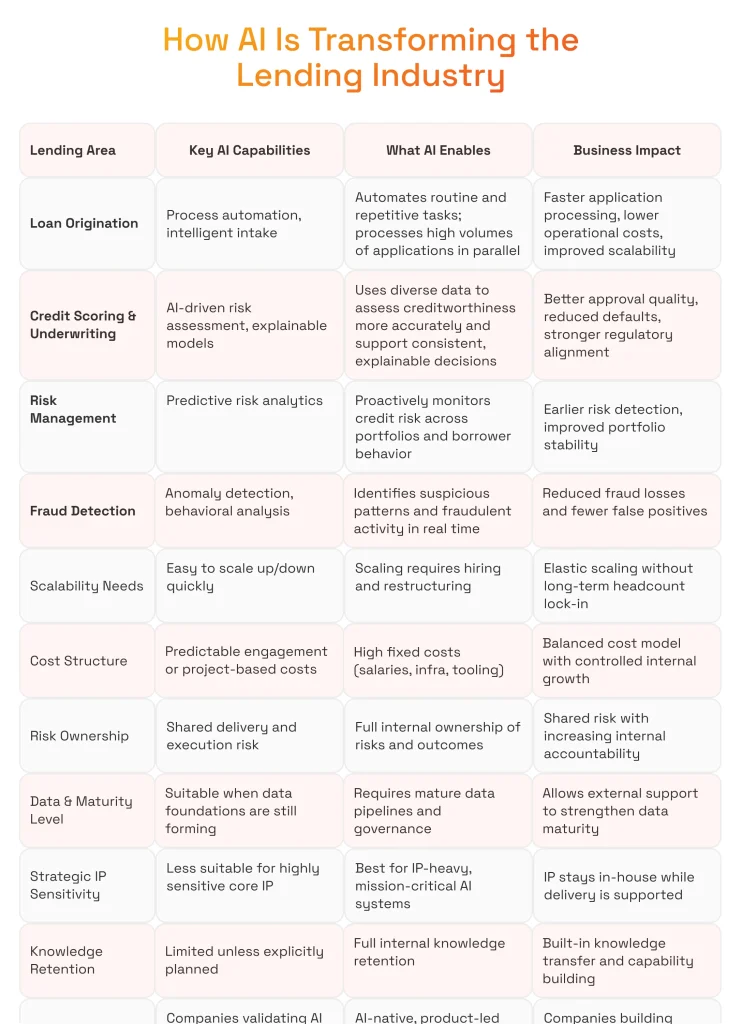
AI is changing lending by embedding intelligence into core processes, enabling lenders to operate faster, more accurately, and at greater scale. Let’s examine AI’s impact on this industry in greater detail.
AI in Loan Origination
AI loans origination aids in handling high application volume through the automation of routine tasks such as data extraction, validation, and document review. This automation allows lenders to handle high application volumes efficiently, even during peaks in demand, without sacrificing processing speed or consistency.
AI tools are used to automate and accelerate the loan origination process, supporting workflow automation, enhancing decision-making, and elevating overall efficiency.
AI-Driven Credit Scoring and Creditworthiness Assessment
ML models use varied data sources to assess creditworthiness more accurately than rule-based approaches. AI identifies key insights from borrower behavior and financial history, enabling transparent, consistent lending decisions. Lenders can dynamically adjust credit limits based on borrower behavior, enabling greater customization and responsible lending. Additionally, AI can analyze large volumes of data to predict the likelihood of repayment, enabling better-informed lending decisions.
Risk and Fraud Management
AI allows for a more proactive credit risk management through real-time tracking and predictive analytics, enabling a forward-looking strategy to risk management and compliance monitoring. AI-powered fraud detection software identifies anomalies and suspicious behavior in real time, enabling lenders to respond quickly, reduce losses, and minimize false positives.
AI techniques proven in credit card fraud detection, such as real-time behavioral monitoring and anomaly detection, are increasingly applied to wider credit risk assessment and portfolio oversight. Predictive analytics in AI helps identify borrowers likely to default, allowing banks to intervene before problems intensify. However, effective risk management with AI requires sufficient resources for data administration and model training, which can be a challenge for some financial institutions.
Find out more about AI in fraud detection as we share our practical insights in a featured article.
Customer-Facing Transformation
For customers, AI translates into faster approvals, smoother onboarding, and wider access to financial products and services. With the help of AI, it becomes possible to refine customer engagement by supplying individualized services and targeted financial advice, resulting in stronger relationships between lenders and borrowers. By reducing friction and enabling personalization, AI improves the overall customer experience, an increasingly major factor in lender competitiveness. AI-powered chatbots and virtual assistants provide 24/7 support, answering queries and offering recommendations, which not only improves customer experience as well as frees up human staff to attend to more complicated tasks.
Additionally, AI can improve customer satisfaction and retention by providing customized offers based on a borrower’s past spending behavior and credit history. Thanks to AI, borrowers are able to better understand credit options, repayment terms, and responsible borrowing practices, leading to better-informed financial decisions and greater financial inclusion. Customer-centric lending models like Buy Now, Pay Later (BNPL) depend on AI-powered decisioning to deliver instant approvals without harming risk controls.

Serhii Leleko
ML & AI Engineer at SPD Technology
“When implemented thoughtfully, AI transforms every stage of the lending lifecycle, enabling institutions to make faster, more accurate decisions while proactively managing risk. These capabilities do more than improve efficiency, as they empower lenders to remain agile and resilient, adapting to changing customer expectations.”
Key Benefits of AI in Lending for Banks and Lenders
As lending operations grow more complex and competitive, AI is becoming a practical lever for improving performance across cost, risk, and decision quality. By enabling lenders to fuel expansion through more tactical application of their existing resources, AI and automation allow staff to focus on high-value, critical efforts rather than routine tasks.
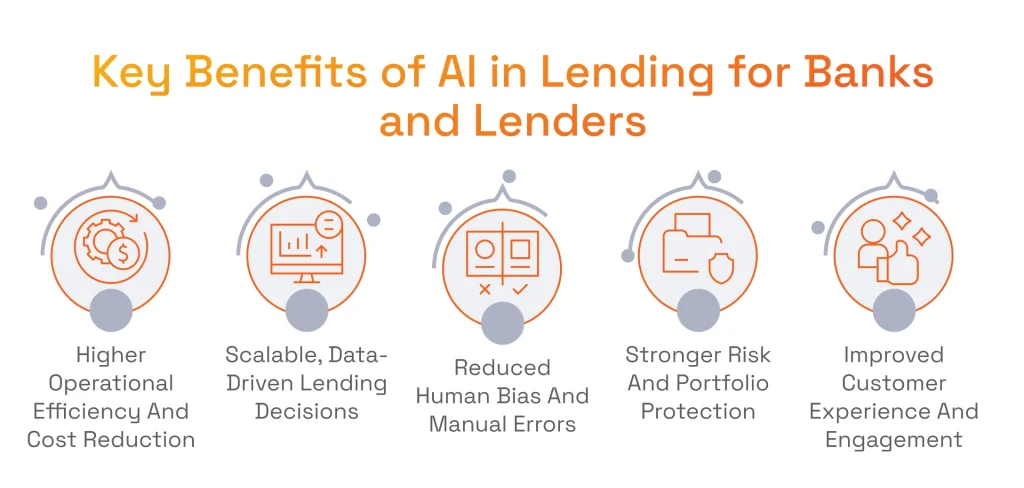
This shift not just improves efficiency and competitive advantage but also helps lenders become more agile, innovative, and customer-focused, offering more accessible, affordable, and inclusive credit to underserved segments of society. To fully realize the following benefits, lenders should rely on cutting-edge data analytics services that transform AI outputs into actionable portfolio insights and performance indicators.
Efficiency and Cost Impact
AI helps to elevate efficiency by taking over high-volume, repetitive processes, including initial risk checks, data validation, and application review. This frees employees’ hands to process more applications while retaining the same headcount and infrastructure. Operational expenses are also becoming lower thanks to highly configurable decision logic and auditable workflows.
Better Decisions at Scale
By operating with large, multiple data sources, AI brings much more consistency in lending decisions across portfolios. Human bias and operational errors are being eliminated thanks to the lower reliance on manual judgment for ML models. No matter how lending volume increases, AI maintains stable, explainable decision-making capabilities.
Risk and Balance Sheet Protection
With predictive risk analytics and real-time monitoring, AI makes a positive impact on portfolio management. By relying on early identification of risk signals and taking proactive action, it is possible to achieve more resilient lending operations with stronger balance sheets.
Customer Impact
For customers, AI can improve their experience by providing greater transparency, faster decision-making, and more relevant offers. Customer expectations are constantly evolving, so keeping the lending process up to date with them improves engagement and satisfaction and builds long-term value for clients.
The Future of AI in Lending
Artificial Intelligence-powered lending is turning from a set of tactical improvements into a strategic force that reinvents how financial institutions compete and grow. In today’s rapidly shifting regulatory framework, maintaining agility is essential for banks to remain competitive and capitalize on new opportunities while tackling the threats presented by AI technology. For fintech businesses in the era of commoditization, where products, pricing, and user experience are increasingly similar, AI-driven intelligence is becoming a critical source of differentiation.
AI is also transforming commercial lending, with advanced lending platforms streamlining loan origination, credit decisioning, and servicing processes. These data-driven, dynamic systems demand solid oversight and governance to ensure compliance, fairness, and strategic consistency. However, many banks struggle to implement AI effectively due to legacy systems and data silos, which hinder the adoption and integration of advanced solutions across both back-office and customer-facing functions.
Shift from Reactive to Proactive Lending
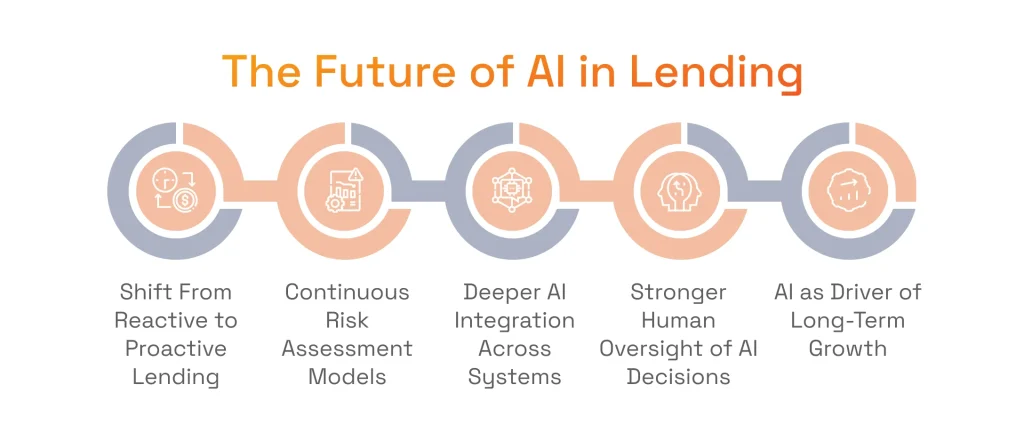
Replacing periodic reviews of performance and risk, a preemptive AI-based approach dynamically adjusts interest rates and credit limits in response to real-time changes in borrower behavior. Lenders will be able to anticipate emerging trends, making adjustments to portfolios and intervening before it’s too late.
Deeper Integration of AI Across Lending Systems
We should expect more integration of AI across lending platforms, eliminating its existence as an isolated solution. This will further enhance servicing, underwriting, origination, and compliance. Better integration will also increase accountability and deliver outcomes that are explainable and aligned with governance frameworks.
The Role of Human Oversight Alongside AI
Even as the power of AI increases, human review still remains an essential element. With the responsibility to guarantee ethical AI deployment, organizations must preserve fair and ethical AI systems that acknowledge country-specific values and norms. The combination of knowledgeable teams and governance structures ensures regulatory conformity, ethical decisioning and responsible usage.
Why AI Will Drive Long-Term Growth in Lending
With features like adaptive risk management, smarter decisions, and scalable operations, AI is set to become vital for long-term expansion and advancement in lending. Institutions that invest in future-ready AI systems will be best positioned to evolve with the market and customer expectations.
According to McKinsey research, generative AI alone could add between $200 billion and $340 billion in annual value to the banking industry by increasing productivity and innovation.
If you also want to lead the game with AI, discover the best fintech development companies with a proven history of implementing innovative lending solutions powered by AI.
Tapping into the Opportunity with SPD Technology’s Expertise
A proper implementation of AI in lending is much more than building effective predictive analytics models, as it needs to resolve a complex, system-level challenge: synchronizing technology, processes, and business strategy. Successful AI adoption demands embedding intelligent decisioning within present workflows, complying with regulations, and making sure that models operate reliably at scale. Without this systemic approach, even advanced AI initiatives risk underperforming or creating operational friction.
Serhii Leleko
ML & AI Engineer at SPD Technology
“At SPD Technology, we always align AI initiatives with the unique business goals of each client, connecting AI-driven credit scoring, risk assessment, and customer-facing automation with strategic priorities, operational processes, and enterprise systems. We help lenders transform isolated models into integrated, production-ready solutions by focusing on a full-cycle, systems-oriented approach.”
Our expertise combines deep AI/ML capabilities, fintech software development proficiency, and hands-on knowledge of the lending industry. We partner with financial institutions to design custom AI-driven lending solutions, build scalable and compliant systems, and integrate ML models. Whether developing custom lending platforms, embedding predictive analytics, or automating complicated tasks, we act as a dependable partner that turns AI potential into effective performance.
In one of our recent projects, we developed a custom SMB funding platform for a well-established provider of business funding and real-time financing services. The platform has already helped 4,000+ businesses secure funding, providing $350+ million in financing.

Conclusion
The discussion around using Artificial Intelligence for lending is often centered around trend-driven experimentation and faster decisions. Yes, these capabilities definitely matter but they are only part of the change for financial services. The truth is, AI is much more than a competitive advantage in lending; it embodies a strategic capability that influences efficiency, risk management, along with customer satisfaction.
The future of lending is looking to be very bright, as 67 % of financial institutions will have completed or will implement generative AI strategies in lending by 2026, with 83% planning to increase AI budgets that year, denoting a move from pilot projects to meaningful scale deployment, according to the report by Business Wire. Lenders that adopt AI thoughtfully benefit from accelerated processing, smarter risk assessment, and stronger portfolio oversight. At the same time, AI’s ability to individualize experiences and simplify service process delivery enhances borrower satisfaction.
Unfortunately, banks face major obstacles in implementing AI, including operational, technological, and regulatory obstacles. To truly leverage AI, banks require expandable solutions that can effectively work with external data. The real opportunity lies in the proper implementation of AI, as the results depend on secure and scalable systems, flawless integration, solid data governance, and reliable data.
At SPD Technology, we view AI-powered lending as a bridge between technological potential and tangible business value. By combining lending software development expertise with AI/ML and advanced analytics capabilities, we help our clients design, build, and evolve groundbreaking platforms.
FAQ
How can AI be used in lending?
It can introduce unprecedented automation while dramatically improving other areas. Specifically, for loan origination, AI automates application intake, document verification, and data validation, enabling lenders to process higher volumes faster and with greater consistency. As for credit scoring and underwriting, ML models use historical and live data to assess creditworthiness.
What are the benefits of AI for lenders?
AI brings massive improvements in risk control, productivity, and the ability to scale. Relying on automated workflows allows organizations to decrease manual effort and minimize operational spending, while still supporting fast decision-making at scale.
How does AI benefit borrowers?
Borrowers receive more transparent, quicker, and overall far more customized lending experiences. AI enables faster approvals by cutting down on manual steps and eliminating unnecessary friction. With more precise assessments, the list of qualified borrowers that traditional scoring methods overlook will expand.