

Product-led growth strategies live or die on data quality, yet poor data costs organizations an average of $12.9 million annually according to Gartner, and 67% of executives remain uncomfortable acting on insights from advanced analytics systems. For PLG companies, reliable data infrastructure is not a technical nicety but the operational engine behind every growth loop — from personalized onboarding and feature adoption nudges to expansion signals, A/B testing at scale, and churn prediction. Organizations that invest in scalable pipelines, unified data architecture, and real-time instrumentation consistently outperform those building product-led strategies on fragmented, siloed data foundations.
The success of a product-led growth strategy depends on one essential component: fast and trusted access to accurate data. Lacking this access may lead to an unfortunate failure of even the most promising products built on groundbreaking ideas.
According to Gartner, poor data quality already costs organizations an average of $12.9 million per year. If you add up the issues of data availability, the damage can be even more devastating. There is also a trust issue among executives. As stated in the Deloitte survey, 67% of executive respondents are uncomfortable using data from advanced analytics systems.
In the meantime, top-performing companies and products get their deciding market advantage thanks to accessible, high-quality data that helps guide winning decisions, experiment with possible options, and fuel personalization. Having access to real-time insights enables the conduct of quick iterations that result in sustainable growth. In this article, we will delve deep into data engineering and prove why it serves as a foundation for successful and scalable product-led businesses in 2025.
Why Product-Led Growth Needs a Data-Strong Foundation
The product-led growth model is a go-to-market strategy that relies heavily on data, as it does not involve sales representatives conducting onboarding and engaging with users. The product becomes a sales engine and storefront, so to ensure its success, accurate, accessible, and actionable data is mandatory.
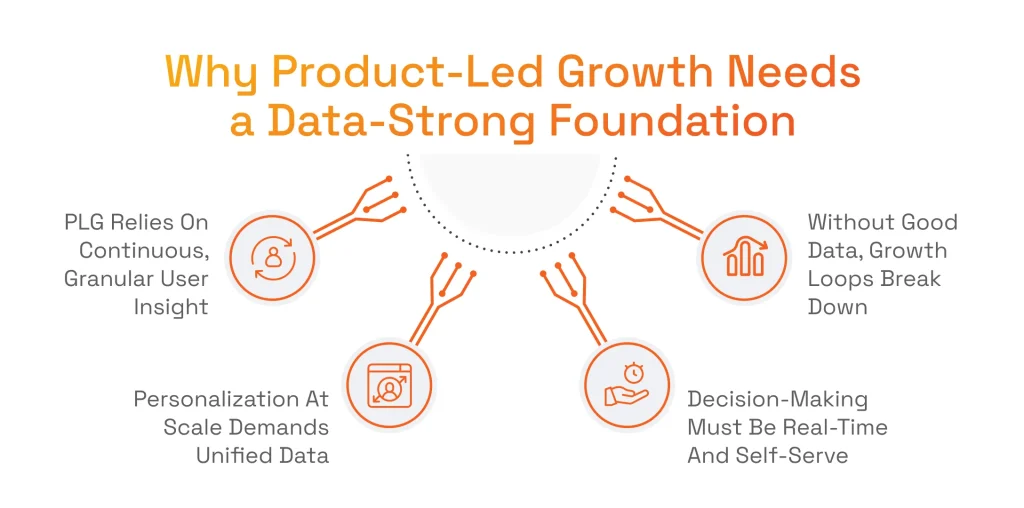
- PLG Relies on Continuous, Granular User Insight: From the very first click to the details on long-term engagement, product development teams require real-time access to all possible product-led growth metrics on user behavior to make necessary adjustments. Precise identity resolution and user tracking are vital to determining who and how is getting value from the product and who is stuck and frustrated.
- Personalization at Scale Demands Unified Data: Activation and retention depend heavily on unified behavioral, transactional, and profile data. It is impossible to create tailored user experiences without an effective data management strategy that prevents data silos.
- Without Good Data, Growth Loops Break Down: Growth loops are the hallmark of any successful PLG, and they rely on quality data at every step. The critical elements that require data may include triggering in-app nudges to activate users, identifying Product-Qualified Leads (PQLs), or analyzing the reasons behind a specific cohort’s declining retention.
- Decision-Making Must Be Real-Time and Self-Serve: Product managers, analysts, and growth teams require self-service dashboards and reliable metrics, rather than custom SQL queries or manual data pulls. Real-time, trustworthy data empowers teams to make informed decisions quickly, iterate more efficiently, and capitalize on what works.
5 Product-Led-Growth Examples That Depend on Solid Data Infrastructure
Having a data strategy framework that ultimately leads to a concrete data infrastructure service as the engine for a great product. Here are five real-world PLG tactics that are only possible with a solid data foundation in place.
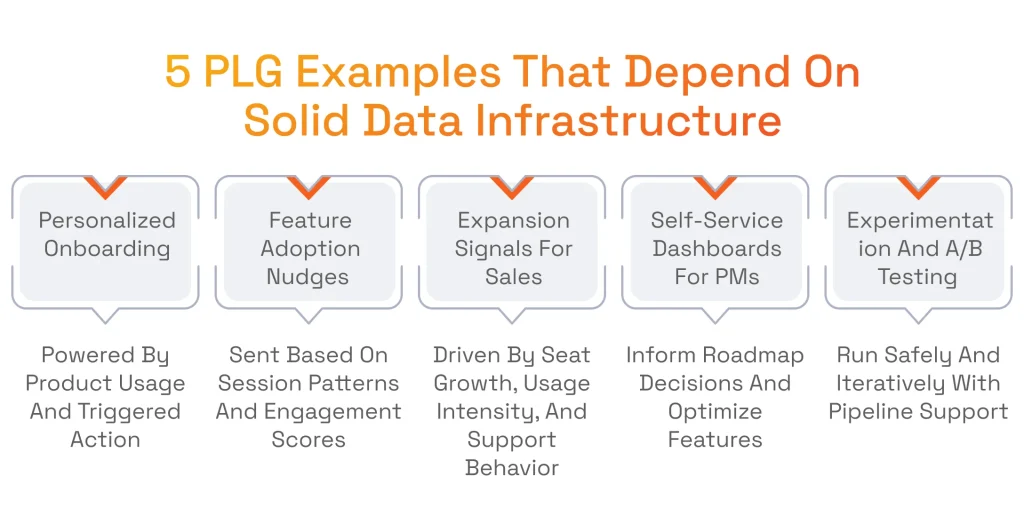
- Personalized Onboarding Flows: According to the survey by Salesforce, 73% of customers expect better personalization as technology advances, making smart onboarding flows a must for new products. To achieve them, an accurate analysis of user behavior is required, and you need to know which features were clicked and which ones were ignored.
- Feature Adoption Nudges: Like with much other software, the chances are users will only scratch the surface of the functionality of your product. Based on session data, time-in-app metrics, and engagement scores, product teams can send timely nudges or in-app tooltips to encourage deeper usage.
- Expansion Signals for Sales: Having insight into usage intensity spikes and user base growth within an account can signal opportunities for expansion or upselling. To detect these trends, the combined data from product usage, seat count, and support interaction is required.
- Self-Service Dashboards for PMs: By leveraging data strategy consulting and implementing clean data models and governed metrics, PMs can explore user behavior, feature usage, and funnel drop-offs independently, resulting in faster, data-driven roadmap decisions.
- Experimentation and A/B Testing at Scale: Being an essential part of any PLG model, testing new features and flows without user experience disruption is possible thanks to scalable data pipelines and event tracking.

Dmytro Tymofiiev
Delivery Manager at SPD Technology
“Beyond the aforementioned product-led growth examples, leading companies also have other widespread use cases, including identifying churn risks early through predictive behavior modeling and dynamically adjusting pricing tiers by analyzing usage patterns. Even something as basic as triggering contextual support or surfacing relevant documentation in-app depends on real-time data. Without a unified, trustworthy data infrastructure, none of these growth loops will function at scale.”
Core Data Engineering Capabilities That Power Product-Led-Growth Strategies
Based on our experience, PLG companies succeed only with continuous access to clean and well-structured data, which allows combining data engineering practices with deep product context. Here are the most important capabilities we recommend focusing on to support high-performing product-led growth strategies.
Data Engineering Capability | Tools and Approaches | PLG Business Impact |
|---|---|---|
Scalable Batch and Real-Time Pipelines | Apache Kafka, Airflow, dbt | Fresh, low-latency data flowing from product to analytics tools enabling real-time growth loop activation |
Identity Resolution and Cross-Platform Tracking | RudderStack, Segment, custom mapping logic | Unified user profiles across devices powering accurate personalization, experimentation, and growth scoring |
Unified Cloud Warehouse or Lakehouse | Snowflake, BigQuery, Databricks | Single source of truth eliminating data silos and enabling reliable cross-functional analytics |
Event Instrumentation Frameworks | Snowplow, Segment Protocols, Mixpanel taxonomy | Consistent, schema-validated event data preventing broken funnels and missing downstream metrics |
Feature Flag and Experimentation Infrastructure | LaunchDarkly, Statsig, custom solutions | Safe iterative releases and multivariate testing without engineering bottlenecks |
Role-Based Access and Data Governance | Fine-grained RBAC, lineage tracking, data catalogs | Data democratization with security compliance enabling self-service analytics across all growth roles |
Data Engineering Capability
Scalable Batch and Real-Time Pipelines
Identity Resolution and Cross-Platform Tracking
Unified Cloud Warehouse or Lakehouse
Event Instrumentation Frameworks
Feature Flag and Experimentation Infrastructure
Role-Based Access and Data Governance
Tools and Approaches
Apache Kafka, Airflow, dbt
RudderStack, Segment, custom mapping logic
Snowflake, BigQuery, Databricks
Snowplow, Segment Protocols, Mixpanel taxonomy
LaunchDarkly, Statsig, custom solutions
Fine-grained RBAC, lineage tracking, data catalogs
PLG Business Impact
Fresh, low-latency data flowing from product to analytics tools enabling real-time growth loop activation
Unified user profiles across devices powering accurate personalization, experimentation, and growth scoring
Single source of truth eliminating data silos and enabling reliable cross-functional analytics
Consistent, schema-validated event data preventing broken funnels and missing downstream metrics
Safe iterative releases and multivariate testing without engineering bottlenecks
Data democratization with security compliance enabling self-service analytics across all growth roles
Scalable Data Pipelines (Batch and Real-Time)
For a product-led approach to work, the data from your product should flow to data analytics tools in near real time. We have a profound expertise in enterprise data management, and to power up PLGs, we build robust batch and streaming pipelines that capture user events, backend logs, and third-party data, ensuring high throughput and low latency. Our engineers utilize tools such as Apache Kafka, Airflow, and dbt to ensure that data is always fresh, reliable, and analysis-ready.
Identity Resolution and Cross-Platform Tracking
A deep understanding of user journey across devices and platforms is a foundation for delivering personalized user experiences. To ensure the effectiveness of product-led growth methodology, we implement deterministic and probabilistic identity resolution strategies to unify user data from diverse sources. By integrating tools like RudderStack, Segment, or custom mapping logic, we help our clients build user-level profiles that fuel personalization, experimentation, and growth scoring.
Unified Cloud Warehouse or Lakehouse Architecture
Our experts design centralized data architectures following detailed data strategy roadmaps by leveraging solutions like Snowflake, BigQuery, or Databricks to prevent data silos. We will help you to choose between a data warehouse vs data lake, picking the best option for your individual case. While data warehouses are optimized for structured, high-performance analytics, data lakes handle large volumes of semi-structured or raw data at a lower cost.
Want to discover more details on building a data warehouse?
Explore its specifics in our featured article!
Event Instrumentation Frameworks
Reliable product analytics are impossible without consistent and clean tracking. We help define and enforce schema-first tracking plans using protocols such as Snowplow, Segment Protocols, or Mixpanel’s taxonomy, ensuring structured and meaningful event data. We avoid broken funnels and missing data downstream by implementing event validation, versioning, and observability.
Feature Flag and Experimentation Infrastructure
Thanks to our proficiency in custom software development, we know how to deploy experimentation frameworks that allow safe, iterative releases without engineering bottlenecks. Whether using LaunchDarkly, Statsig, or a tailored solution, our experts are successfully designing infrastructures that support multivariate testing, gradual rollouts, and real-time result analysis.
Role-Based Access and Data Governance
Data democratization is the heart of product-led organizations. However, it must be balanced with strict control. Our dedicated development teams implement fine-grained, role-based access controls and integrate governance frameworks to ensure data is both accessible and secure. We include lineage tracking, audit trails, and data catalogs in our solutions, allowing the product teams to explore confidently while complying with all security requirements.
How to Get Started with Data Engineering for Product-Led-Growth Strategy Boost
Even the most complex enterprise data strategy for product-led growth begins somewhere, so here’s how we help our clients take the first, most critical steps.
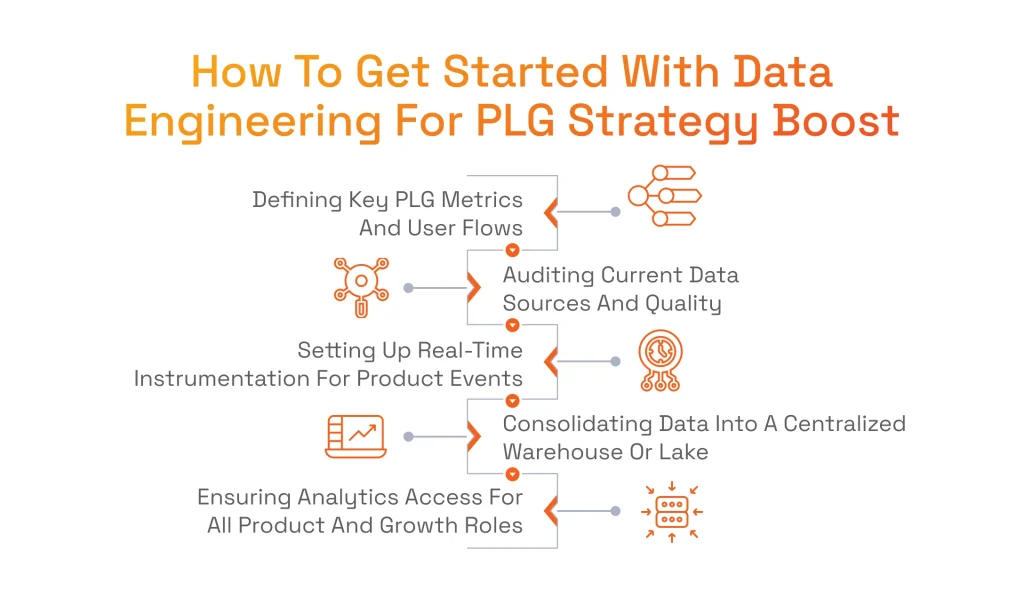
Defining Key PLG Metrics and User Flows
It all starts with determining what exact product behaviors bring value. The specific behaviors may include activation, engagement, retention, and expansion. Our clients get the full value out of the advantages of strategic technology consulting, as we work in close collaboration with product and growth teams to map user journeys and align on the metrics that matter the most.
Auditing Current Data Sources and Quality
Before creating custom software, we assess all data that your company already collects and determine its reliability and critical gaps from a product-led prism. This is a holistic audit that includes everything from CRM integrations and analytics tools to event tracking and backend logs.
Setting up Real-Time Instrumentation for Product Events
Based on our experience, the next best approach is to implement schema-driven tracking frameworks that capture every key event in the product, utilizing tools like Segment, Snowplow, or custom SDKs. Real-time data collection allows for immediate insights into vital processes.
Consolidating Data Into a Centralized Warehouse or Lake
After selecting the right approach for your case, we centralize behavioral, transactional, and third-party data using platforms like Snowflake, BigQuery, or Databricks, thereby eliminating silos and establishing a trusted foundation for effective analysis and automation. Whether it is an enterprise data warehouse or a data lake, our experts know how to maximize its impact for the PLG strategy.
Ensuring Analytics Access for All Product and Growth Roles
Next, we establish secure role-based access and self-service analytics functionality with intuitive dashboards. It enables analysts, marketers, and product managers to work with data independently and make decisions more quickly.
-
Define key PLG metrics and user flows upfront: map activation, engagement, retention, and expansion behaviors with product and growth teams before any instrumentation or pipeline work begins
-
Audit all existing data sources and quality — assess CRM integrations, analytics tools, event tracking, and backend logs for reliability, completeness, and critical gaps before designing new infrastructure
-
Implement schema-first event instrumentation — deploy validated tracking frameworks that capture every key product event consistently, with versioning and observability to prevent broken funnels and missing data
-
Consolidate behavioral, transactional, and third-party data into a centralized warehouse or lakehouse — eliminate silos and establish a trusted single source of truth before building dashboards or growth models
-
Establish role-based access and self-service analytics for all product and growth roles — ensuring analysts, marketers, and product managers can explore data and make decisions independently without IT dependency
Dmytro Tymofiiev
Delivery Manager at SPD Technology
“Once the foundational data engineering is complete, true scaling and growth begin. This is when product teams launch A/B tests at scale, sales teams act on expansion signals in real-time, and growth teams orchestrate hyper-personalized onboarding flows. At SPD Technology, we guide our clients through the ongoing optimization and scaling of their data stack so they can continuously experiment, learn, and win over other product-led competitors.”
Best Practices for Building a PLG-Ready Data Stack
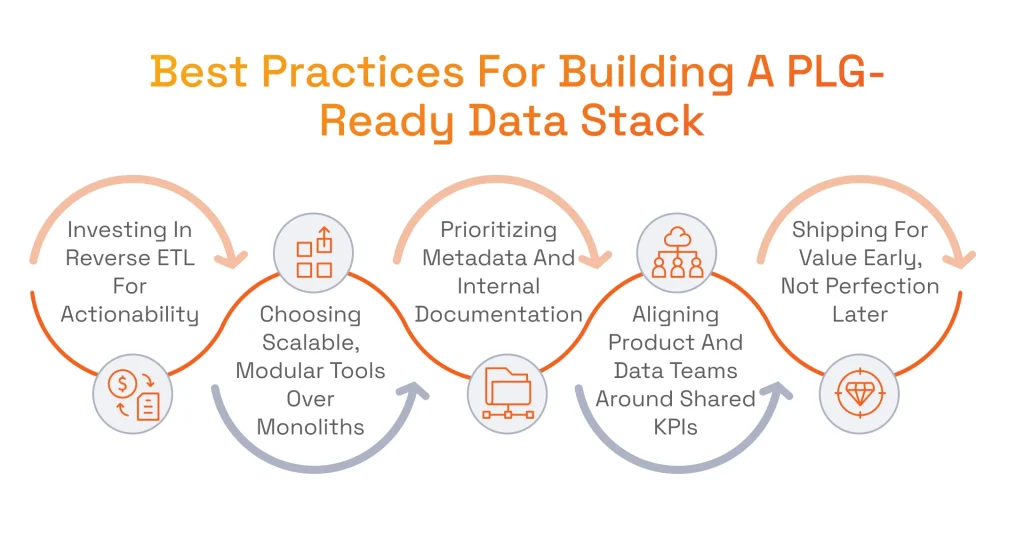
Creating a data stack for a PLG company is all about making the right decisions at the early stages. Here is what we recommend for implementing data architectures that accelerate growth:
- Investing in Reverse ETL for Actionability: This is a very impactful practice to turn data into action. By syncing clean, modeled data back into CRMs, onboarding flows, or marketing automation tools, teams can trigger personalized experiences and targeted campaigns without engineering support.
- Choosing Scalable, Modular Tools Over Monoliths: We recommend leveraging modular tools like Snowflake and Fivetran over all-in-one platforms that could potentially limit growth and flexibility. Having a modular stack will reduce the probability of vendor lock-in and will evolve with your needs.
- Prioritizing Metadata and Internal Documentation: A well-maintained data catalog and clear event tracking plans empower teams to work independently, preventing misunderstandings that can end up in significant operational expenses.
- Aligning Product and Data Teams Around Shared KPIs: This is of the utmost importance, so make sure that every engineering effort closely correlates with tangible business outcomes.
- Shipping for Value Early, Not Perfection Later: It is one of the most common CTO tips in outsourcing product development, and it holds in this case as well. We recommend starting with small, yet high-impact use cases to demonstrate quick results to stakeholders and prove that product-led growth leads to business benefits.
Want to scale your product-led growth (PLG), avoiding any possible data chaos?
We invite you to read our comprehensive guide on data quality management, based on our hands-on experience.
Challenges to Expect — And How SPD Technology Overcomes Them
If you aspire to become a product-led growth company, you should be aware of some of the most common challenges along the way. Here, at SPD Technology, we’ve seen it all and are ready to share our insights with you.
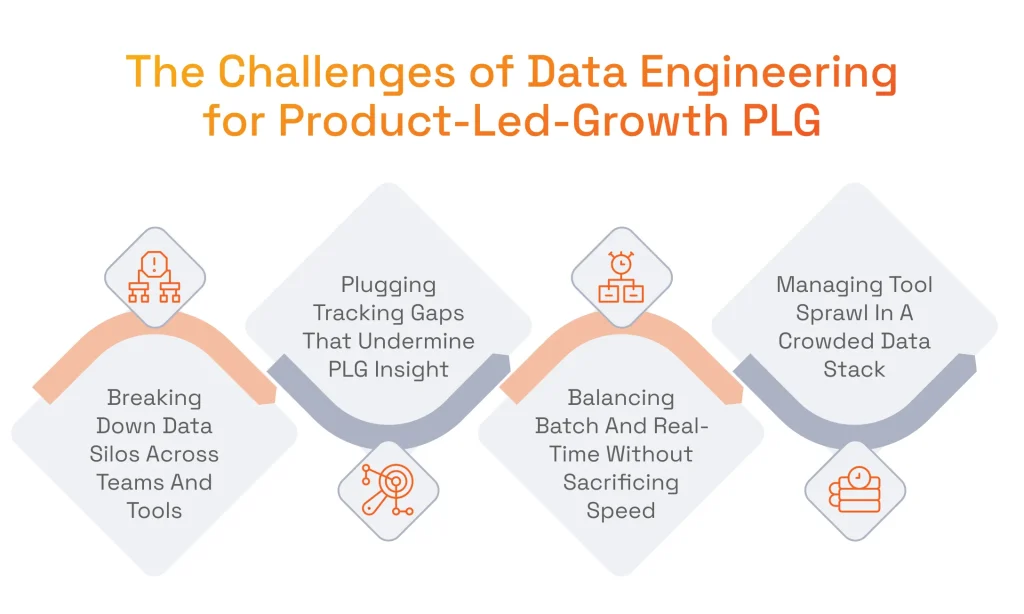
Breaking Down Data Silos Across Teams and Tools
Unfortunately, product teams often work in isolation using different disconnected tools, which results in fragmented and inconsistent data. This disconnect leads to a slowdown in growth initiatives and poor decision-making overall.
To address this challenge, we implement centralized data architectures and standardized schemas that unify data from all sources into a single, accessible layer, providing our clients with real-time, cross-functional visibility that accelerates product decisions and drives coordinated PLG efforts.
Plugging Tracking Gaps That Undermine Product-Led-Growth Insight
Missing or misconfigured tracking leads to blind spots in the user journey, limiting the ability to obtain valuable insights. Particularly, this incomplete data undermines experimentation, personalization, and growth loop optimization.
Our experts work diligently on designing and maintaining schema-first instrumentation frameworks with rigorous quality assurance to ensure consistent and complete data capture, resulting in accurate user analytics for our clients.
Balancing Batch and Real-Time Without Sacrificing Speed
Another common problem is delivering scalable batch analytics and low-latency real-time data simultaneously, which is crucial for responsive decision-making. Delaying data can derail time-sensitive personalization, as well as growth-loop activation.
We address this challenge by introducing hybrid pipelines that process essential data in real-time while supporting deep batch analysis, enabling our clients to make faster, data-driven decisions with confidence, and ultimately improving retention and engagement.
Managing Tool Sprawl in a Crowded Data Stack
Overlap and redundancy in tools result in additional complexity, integration issues, and, most importantly, increased operational costs. It also creates governance challenges and introduces unnecessary friction in cross-team workflows.
Here at SPD Technology, we design lean, modular, and scalable stacks using interoperable tools that align with our clients’ long-term business goals, thereby reducing costs and simplifying operations.
Consider a Strategic Tech Partnership for Data-Enabled Product-Led-Growth
Companies that are trying to answer the questions “what is product led growth?” and “how to implement this strategy in the most efficient way?” using only internal teams are at risk of facing delays, technical debt, and missed opportunities. Joining forces with an experienced software development company that fully understands Big Data and its business impact, and has proven experience in data engineering, is essential for PLG.
Product-led growth is built on cross-functionality, as it requires precise collaboration between product, engineering, growth, and data teams, each with their systems, priorities, and technical considerations. Without a unifying strategy and architecture, efforts become fragmented and results inconsistent.
Another critical factor is the speed of value, as in modern environments, long implementation cycles can lead to losing competitive ground. Modern data stacks are incredibly complex, evolving rapidly, and often bloated with redundant tools.
You need a vetted software developer to navigate all technical complexities with precision, while avoiding the trap of over-engineering, while still building for long-term flexibility. This means you can grow without constantly having to rip out and rebuild your foundation.
We prepared a list of the best data analytics companies to help you find your perfect match!
Here, at SPD Technology, we can become a partner that you’ve been looking for, because our core competencies include:
- Proven Experience with Product-Led Companies
- End-to-End Delivery Across Data and Product Layers
- Custom Architecture, Not Cookie-Cutter Stacks
- BI and ML Readiness by Design
- Cross-Disciplinary Expertise in Product, Data, and Cloud
Among our numerous AI and data engineering projects, this collaboration with the HaulHub platform stands out, as we delivered an all-in-one platform that incorporates and optimizes the transportation construction ecosystem. In addition to implementing advanced AI/ML models and NLP, we delivered scalable data pipelines, a robust Data Lake, and integrated third-party systems.

Key Takeaways
- Product-led growth depends on six core data engineering capabilities: scalable batch and real-time pipelines, identity resolution and cross-platform tracking, unified cloud warehouse or lakehouse architecture, event instrumentation frameworks, experimentation infrastructure, and role-based access with governance — each one a prerequisite for reliable growth loop operation
- Poor data quality costs organizations an average of $12.9 million per year, and for PLG companies where the product is the primary sales engine, fragmented or inconsistent data directly translates into broken onboarding flows, missed expansion signals, and failed personalization at scale; investing in robust data infrastructure and analytics from day one is the single most effective way to prevent these failures
- Identity resolution is one of the most underinvested capabilities in PLG data stacks — without deterministic and probabilistic strategies to unify user data across devices and platforms, personalization, experimentation, and growth scoring all operate on incomplete user profiles that produce unreliable results
- Five PLG tactics are impossible without solid data infrastructure: personalized onboarding flows, feature adoption nudges, expansion signals for sales, self-service dashboards for product managers, and A/B experimentation at scale all require clean, real-time, unified behavioral data to function effectively
- Data democratization is the cultural foundation of product-led organizations — organizations that invest in professional data analytics services to establish governed metrics, self-service dashboards, and role-based access consistently empower product managers, analysts, and growth teams to make faster, more confident decisions without IT dependency
FAQ
What data infrastructure is required to support a product-led growth strategy?
At minimum, PLG companies need a schema-first event instrumentation framework capturing every key user interaction in real time, a centralized cloud data warehouse or lakehouse consolidating behavioral, transactional, and third-party data into a single source of truth, and clean ETL and reverse ETL pipelines that move data reliably between product systems, analytics tools, and activation platforms. Identity resolution infrastructure to unify user data across devices and platforms, role-based access controls for self-service analytics, and an experimentation framework supporting A/B testing and feature flag management are additional prerequisites before any meaningful PLG data strategy can operate at scale.
What are the most common mistakes companies make when implementing PLG analytics?
The most frequent mistake is instrumentation without governance — teams implement event tracking reactively and inconsistently, producing broken funnels, missing data, and conflicting metrics that undermine trust in product analytics across the organization. Secondary mistakes include failing to resolve user identity across platforms before building personalization or growth scoring systems, building monolithic data stacks that cannot evolve with product complexity, prioritizing dashboard aesthetics over reliable underlying data models, and delaying data infrastructure investment until growth loops are already breaking down, at which point the cost of remediation far exceeds what proactive architecture would have required.
How much does building product analytics infrastructure for a PLG motion cost?
A focused PLG data infrastructure covering event instrumentation, a centralized cloud warehouse, basic ETL pipelines, and self-service dashboards for core product and growth metrics typically ranges from $40,000 to $150,000 depending on product complexity, the number of integrated data sources, and whether identity resolution and experimentation infrastructure are included in scope. A full production-grade PLG data stack spanning real-time and batch pipelines, unified lakehouse architecture, reverse ETL for activation, feature flag and A/B testing infrastructure, and governed self-service analytics across all product and growth roles can reach $200,000 to $800,000+, with ongoing pipeline maintenance, model refinement, and governance adding 15–20% of build cost annually.
How long does it take to instrument a product and start generating reliable PLG data?
A focused instrumentation engagement covering core user events: activation, feature usage, engagement milestones, and funnel drop-offs, with schema validation and basic pipeline integration can produce reliable initial data within four to eight weeks, provided a clear tracking plan and data governance framework are defined upfront. Achieving full PLG data reliability across all growth loops, including identity resolution, cross-platform tracking, experimentation infrastructure, and self-service analytics for all product and growth roles — typically requires three to six months of iterative instrumentation, quality assurance, and data model refinement before teams can confidently act on insights at scale.
What is the difference between product analytics and business intelligence in a PLG context?
Product analytics focuses specifically on user behavior within the product: tracking activation, feature adoption, retention, expansion signals, and growth loop performance at the individual and cohort level to inform product decisions and personalization in real time. Business intelligence in a PLG context operates at a broader organizational level — aggregating product, financial, marketing, and operational data into unified dashboards and reports that support executive decision-making, forecasting, and strategic planning across the entire business rather than the product experience specifically.