

eCommerce business intelligence transforms scattered sales, inventory, and customer data into actionable dashboards and reports that drive faster, more confident decisions. It covers everything from tracking sales performance and segmenting customers to monitoring inventory and analyzing campaign ROI. With the global BI software market projected to reach $36.35 billion by 2029, the real differentiator isn’t whether to adopt BI, but whether to choose a ready-made tool or a custom solution that matches the complexity of your business.
Establishing an eCommerce company always means operating in the highly competitive market, where it is crucial to make proactive decisions and act ahead of industry rivals. Otherwise, the business will be crushed down under the weight of competitors who are more agile, innovative, and responsive to market changes. To be able to withstand this competitive pressure, eCommerce business intelligence (BI) comes up as a solution that equips companies with tools for timely and informed strategic choices.
The worldwide investments in BI grows: according to Statista, the global BI software market is expected to achieve a market volume of $36.35 billion by 2029. The eCommerce sector, in turn, is just among many other domains that invest in BI. Given the growing trend of business intelligence adoption, this article covers the reasons for opting for the BI technology in eCommerce as well as the nuances of its implementation.
Definition and Importance of eCommerce Business Intelligence
As the impact of Big Data becomes more evident and powerful in retail, eCommerce businesses need to process and analyse that information to act on it. Business intelligence for eCommerce is doing just that. It offers a framework, tools, and processes that allow taking data from sales platforms, website analytics, CRM systems, and marketing channels and transforming it into reports and dashboards. Once this data has a digestible format and offers actionable insights, retailers gain the possibility to make decisions with a whole new level of awareness of the industry they are operating in, customers they are dealing with, and competitors they need to outperform.
eCommerce Business Intelligence vs eCommerce Data Analytics
Since the concepts of eCommerce BI and data analytics are sometimes used interchangeably, it would be right to draw a clear line between them. eCommerce BI encompasses the tools, processes, and technologies that aggregate historical data (sales, inventory levels, customer feedback, etc.) to create reports or visual representations. Its primary focus is on descriptive analytics. In contrast, data analytics in retail is a broader field that uses real-time data in addition to historical one. It delves into diagnostic, predictive, and prescriptive analytics to uncover deeper insights, identify trends, detect anomalies, and forecast future behaviors.
Both eCommerce BI and data analytics are essential for different stages of data-driven decision-making. To make the most out of them, it is advisable to start with BI to analyse the business’ past performance to highlight certain trends in processes or operational results and present them in accessible formats. Then, data analytics can come into play to leverage advanced statistical methods and ML algorithms for analyzing complex datasets and providing actionable recommendations for reinventing business strategies.
Want to dive deeper into how data analytics improves eCommerce?
Read our featured article!
The Rising Impact of Business Intelligence eCommerce
As consumer expectations continue to rise and eCommerce business models become more complex, BI emerges as a tool used in almost every aspect of eCommerce. The impact of BI in eCommerce is seen in:
- Growing demand for data-driven decision making in eCommerce as businesses generate enormous amounts of data that needs analysis.
- Adoption of self-service BI tools with advanced data visualization features to empower non-technical users to use data-driven insights.
- Measuring marketing ROI and customer value using historical data as BI consolidates historical marketing and sales data.
- Shifting from static reports to real-time BI dashboards to track sales, revenue, and customer activity as it happens.
- Evolution of augmented analytics that combines AI with BI to enhance data analysis and insight generation.
The Benefits of Using eCommerce BI Tools
With business intelligence, eCommerce enters a whole new dimension of data-enabled processes optimization and forward-thinking sales strategies. Retail companies that leverage BI tools across the main business departments gain the following advantages:
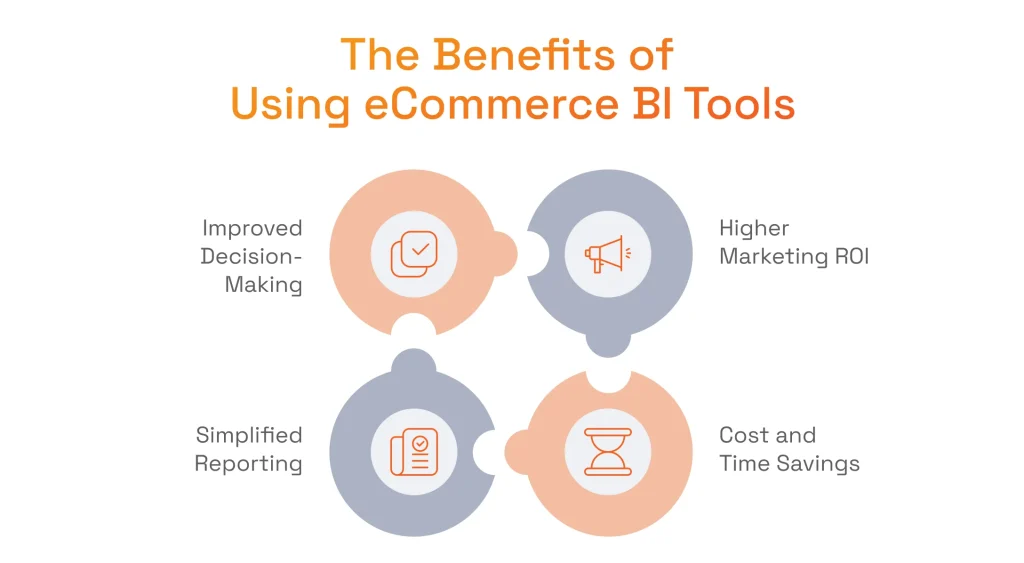
- Improved Decision-Making with Data-Informed Insights: With up-to-date dashboards, tools for BI in eCommerce enable businesses to quickly spot trends and respond to sudden market or customer behavior changes. This allows retail teams to make swift, evidence-based decisions, minimizing the risk of missed opportunities or costly errors.
- Higher Marketing ROI: BI makes it possible to analyze campaign performance across multiple channels, and, thus, help marketers identify which strategies yield the greatest returns. Such a data-driven approach improves ad spending and drives more effective, profitable marketing initiatives.
- Cost and Time Savings with Self-Service Reporting: With BI tools, non-technical teams have the chance to generate their own reports, without relying on IT departments. As a result, employees can access insights more rapidly and make informed decisions that save both time and money.
- Simplified Reporting for Compliance and Audits: BI systems consolidate data from multiple sources into standardized reports that meet regulatory requirements with ease. In this manner, businesses not only cut down on administrative effort but also enhance transparency and accountability throughout the audit process.

Serhii Leleko
AI & ML Engineer at SPD technology
“eCommerce deals with marketing campaigns, inventory, pricing, customer interactions with the websites, and BI won’t let this data be gone in vain. By generating reports and analytical dashboards, BI allows retail businesses to get insights into the smallest operational aspects to create an impactful strategic move.”
Types of eCommerce Market Intelligence Solutions
eCommerce is a broad domain that encompasses multiple functions where BI can be applied. If retail company stakeholders believe they can derive the most value from BI by using it in specific aspects of their business, they can choose a particular BI type based on its function.
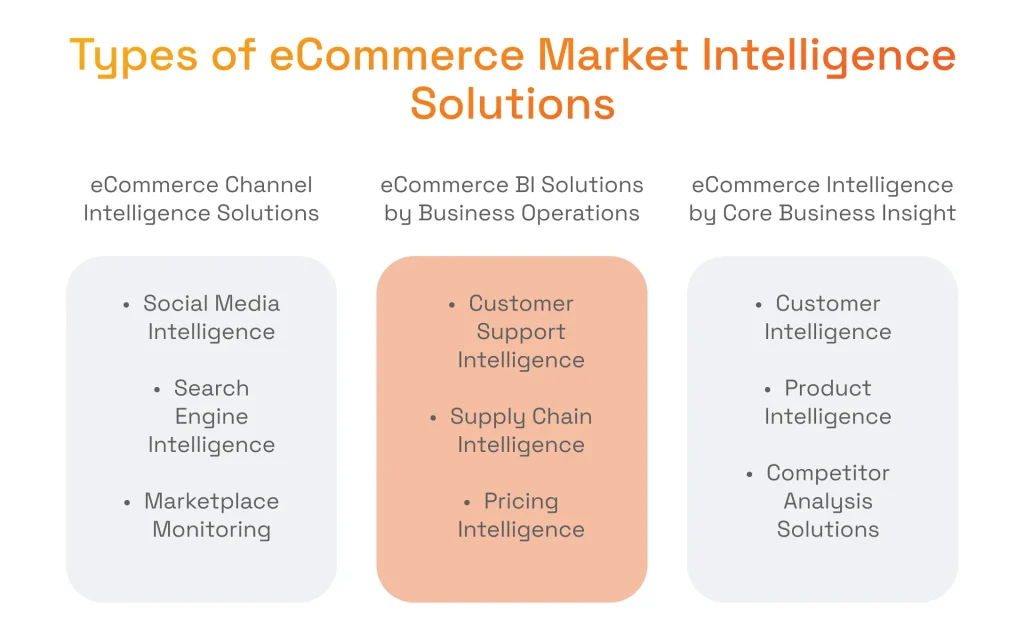
eCommerce Channel Intelligence Solutions
Retailers rely on multiple digital channels to engage potential customers, showcase products, and generate sales. By applying eCommerce channel intelligence, businesses get the chance to optimize their strategies in specific digital functions.
- Social Media Intelligence uses AI for monitoring social media where the brand is represented to collect quantitative metrics (likes, shares, comments, followers) and qualitative data (customer sentiment, influencer impact, viral trends) for customer behavior analysis to refine social media campaigns, improve brand reputation, and address customer concerns.
- Search Engine Intelligence focuses on analyzing performance metrics tied to search engines (keyword rankings, organic traffic, and the effectiveness of paid advertisements) to uncover which phrases customers use when seeking products or services to concentrate more efforts there.
- Marketplace Monitoring involves tracking product performance, pricing, competitor listings, and customer reviews on marketplaces (Amazon, eBay, etc.) to understand how listings perform amid competition, maintain competitive pricing, and find new sales opportunities.
eCommerce BI Solutions by Business Operations
eCommerce covers a wide range of operations, from inventory management to pricing. When applied in a specific area, BI can refine processes across business units. For example:
- Customer Support Intelligence leverages AI for enhancing customer services, including centralizing information from emails, customer support chats, phone calls, social media direct messages, and ticketing systems and analyzes the volume of support request, average resolution time, and recurring issues to identify and fix common pain points.
- Supply Chain Intelligence provides oversight of product movement, integrates data on inventory levels, supplier performance, shipping times, and returns to optimize stock levels, forecast demand, and prevent shipping disruptions.
- Pricing Intelligence collects and analyzes real-time data on competitor prices, demand patterns, and broader market trends to determine the most profitable prices for each product while maintaining competitiveness.
eCommerce Business Intelligence by Core Business Insight
Since retail businesses are so multifaceted, it is often difficult to have a holistic view of different aspects, be it your customer, product, or competitor. The next types of eCommerce BI solutions are designed to help with each.
- Customer Intelligence means the unification of the information from CRM systems, email marketing platforms, and purchase histories, and more to create a relevant customer profile for personalizing customer experiences.
- Product Intelligence compiles data on sales trends, return rates, margins, and customer feedback to give retailers a complete understanding of top-performing and underperforming items, as well as guide future product development.
- Competitor Analysis Solutions provide an overview of rivals’ pricing models, promotions, market positioning, and more to know when to enter new markets, adjust pricing, or differentiate product features to beat competition.
Applications of eCommerce Intelligence Software
In the eCommerce industry, BI tools are used across departments and businesses. This is because many modern eCommerce intelligence software, mostly enhanced by AI and advanced analytics, allows covering several use cases, including those mentioned below.
Use case | What it tracks | Business outcome |
|---|---|---|
Sales performance | Average order value, conversion rates, sales by channel, revenue per visitor, cart abandonment | Identifies high-performing segments and addresses conversion bottlenecks |
Purchase patterns | Purchase frequency, product combinations, seasonal buying trends | Tailors marketing campaigns and refines product recommendations |
Real-time dashboards | Live sales transactions, marketing platforms, and inventory data in one unified view | Enables swift, data-driven actions like adjusting marketing spend or reallocating inventory |
Inventory levels | Stock levels, reorder points, and product movement trends | Prevents stockouts, reduces holding costs, and improves demand forecasting |
Customer segmentation | Demographics, purchase behaviors, and engagement patterns | Drives higher conversion rates through targeted promotions and personalized experiences |
Marketing campaigns | Click-through rates, conversion rates, and return on ad spend across channels | Optimizes future budgets and refines targeting for maximum ROI |
Customer reviews | Product reviews and feedback sentiment trends via NLP | Enables proactive improvements to product quality and customer experience |
Use case
Sales performance
Purchase patterns
Real-time dashboards
Inventory levels
Customer segmentation
Marketing campaigns
Customer reviews
What it tracks
Average order value, conversion rates, sales by channel, revenue per visitor, cart abandonment
Purchase frequency, product combinations, seasonal buying trends
Live sales transactions, marketing platforms, and inventory data in one unified view
Stock levels, reorder points, and product movement trends
Demographics, purchase behaviors, and engagement patterns
Click-through rates, conversion rates, and return on ad spend across channels
Product reviews and feedback sentiment trends via NLP
Business outcome
Identifies high-performing segments and addresses conversion bottlenecks
Tailors marketing campaigns and refines product recommendations
Enables swift, data-driven actions like adjusting marketing spend or reallocating inventory
Prevents stockouts, reduces holding costs, and improves demand forecasting
Drives higher conversion rates through targeted promotions and personalized experiences
Optimizes future budgets and refines targeting for maximum ROI
Enables proactive improvements to product quality and customer experience
1. Tracking Sales Performance
BI tools are perfect for such tasks as collecting and analyzing metrics. They can focus on average order value, customer lifetime value, conversion rates, sales growth rates, and sales by channel to provide a clear picture of overall revenue generation and performance. This BI functionality also highlights revenue per visitor, cart abandonment rates, and best-selling products in order to help businesses identify high-performing segments, optimize pricing strategies, and address conversion bottlenecks.
2. Analyzing Customer Purchase Patterns
Deloitte found that 80% of consumers prefer brands that offer personalized experiences, and these consumers report spending 50% more with such brands. This indicates the importance of understanding customer behaviors, which can be both trend-induced and need-focused.
Thanks to AI enhancements, which are very common for BI software, eCommerce intelligence uncovers buying behaviors and purchase histories, revealing how often customers buy, which products they frequently combine, and how seasonal trends affect purchasing decisions. Combined with AI for the retail industry, BI equips stakeholders with the possibility to tailor marketing campaigns, refine product recommendations, and develop loyalty programs that align with customer preferences and habits.
3. Generating Real-Time Dashboards
When enabled by advanced data analytics, BI empowers businesses with close-to-real-time data visualization dashboards that consolidate live data from sales transactions, marketing platforms, inventory systems, and other channels into a unified, up-to-date view of operations. This creates an impeccable visibility, which enables swift, data-driven actions, such as adjusting marketing spend or reassigning inventory. As a result of such a well-informed approach, eCommerce teams can stay agile and responsive to market shifts.
4. Monitoring Inventory Levels
Retail businesses can integrate BI tools with supply chain and warehouse management systems to identify trends in stock levels, reorder points, and product movement. As long as these tools help identify understocked or overstocked products, businesses can avoid stockouts to prevent lost sales, reduce holding costs, and forecast demand with better precision. In this manner, retailers can set up an optimal fulfillment process.
5. Segmenting Customers
Deloitte found that GenAI-driven customer segmentation for personalized marketing led to a 50% increase in conversion rates in luxury retail. BI tools can be helpful here as they allow this segmentation by grouping customers based on demographics, purchase behaviors, or engagement patterns. Thus, eCommerce companies can target specific segments with tailored promotions, product recommendations, and personalized user experiences to expect higher conversion rates and increased lifetime value.
6. Tracking Marketing Campaign Performance
From social media ads to email promotions and PPC campaigns, BI platforms allow retail business stakeholders to measure key metrics such as click-through rates, conversion rates, and return on ad spend. With such a detailed approach to analysis of marketing promo campaigns, stakeholders get the chance to see which campaigns deliver the best ROI. Based on this information, they can optimize budgets for future marketing endeavors and refine targeting to maximize outcomes.
7. Identifying Trends in Customer Reviews
Once eCommerce businesses want to get the most out of reviews on their products, they can use BI tools that leverage ML-powered Natural Language Processing (NLP) tailored specifically for retail. These tools can analyze product reviews and customer feedback and spot emerging positive and negative sentiment trends. These insights enable companies to make proactive improvements to product quality, service offerings, or user experience. In such a way, retailers can boost brand reputation and strengthen customer relationships.
Want to explore how else machine learning empowers eCommerce?
Read our article about the latest applications of ML in retail!
Custom vs Ready-Made eCommerce Intelligence Solution: What Fits Your Business?
When opting for a BI tool, the market can offer you a multitude of options. Microsoft Power BI, Tableau, Qlik, and Looker are some of them, and they can cover a majority of BI needs within an organization. These solutions (or similar to them) typically come with predefined dashboards, integration options, and best-practice metrics, making it an easy-to-use and cost-effective choice for small to mid-sized eCommerce businesses, especially if their employees are new to data analytics.
However, larger businesses can require more advanced capabilities, such as AI-driven insights, predictive modeling, and workflow automation. In this case, it is more suitable to go for a custom-built BI solution. While custom development requires greater upfront investment and technical expertise, it provides the flexibility, scalability, and depth of analysis needed to maximize long-term ROI.
Here is the concise comparison of ready-made vs. custom BI tools for eCommerce:
Criteria | Ready-Made BI Tools | Custom BI Tools |
|---|---|---|
Development Time | Immediate setup and implementation. | Longer development time. |
Cost | Lower upfront costs, usually subscription-based. | Higher initial investment. |
Flexibility and Customization | Limited customization, predefined features. | Highly flexible. |
Maintenance and Support | Vendor-provided support. | Requires in-house or contracted support. |
Scalability | Scales within the limits of the tool and vendor capacity. | Fully scalable. |
Ease of Use | Typically user-friendly with intuitive interfaces. | User interface tailored to business needs. |
Integration | Pre-built connectors for common systems. | Fully integrated into the business ecosystem. |
Features | Basic features like reporting, dashboards, and analytics. | Advanced, tailored features. |
Vendor Dependency | Dependent on the vendor for updates, features, and support. | No vendor lock-in. |
Criteria
Development Time
Cost
Flexibility and Customization
Maintenance and Support
Scalability
Ease of Use
Integration
Features
Vendor Dependency
Ready-Made BI Tools
Immediate setup and implementation.
Pre-built, quick integration.Lower upfront costs, usually subscription-based.
Ongoing fees.Limited customization, predefined features.
Vendor-provided support.
Dependent on SLA terms.Scales within the limits of the tool and vendor capacity.
Typically user-friendly with intuitive interfaces.
Pre-built connectors for common systems.
Limited integration options.Basic features like reporting, dashboards, and analytics.
Dependent on the vendor for updates, features, and support.
Custom BI Tools
Longer development time.
Built from scratch, requires planning.Higher initial investment.
Predictable long-term costs.Highly flexible.
Fully tailored to business needs.Requires in-house or contracted support.
Full control over management.Fully scalable.
Designed to evolve with business growth.User interface tailored to business needs.
Can be complex initially.Fully integrated into the business ecosystem.
Seamless data flow.Advanced, tailored features.
Includes AI, predictive analytics, and custom models.No vendor lock-in.
Full control over features and updates.
Criteria for Choosing a BI Solution: Custom vs Ready-Made
The following criteria can help eCommerce businesses to settle on the right one.
Existing BI solutions are ideal when:
- A business cannot afford the long and costly development process.
- A business requires a quick set up, intuitive design and features for fast user adoption.
- An eCommerce business operates in a standardized environment where common BI features (like sales tracking, customer segmentation) are sufficient.
Custom BI solutions are ideal when:
- An eCommerce business needs a highly flexible and scalable tool that can evolve with business needs.
- A retail business has highly specific data needs or complex workflows that aren’t well-supported by off-the-shelf tools.
- A business has its unique vision for a BI platform and can invest in building, maintaining, and scaling a custom solution.
The Challenges of eCommerce Intelligence Implementation
The organization can find setting up BI tools for eCommerce business intelligence challenging, especially for companies with rigid processes and legacy systems. Nevertheless, we managed to always overcome these challenges for our clients with the correct approaches and technology. Below are some of the common difficulties in eCommerce BI implementation and SPD Technology’s solutions to them.
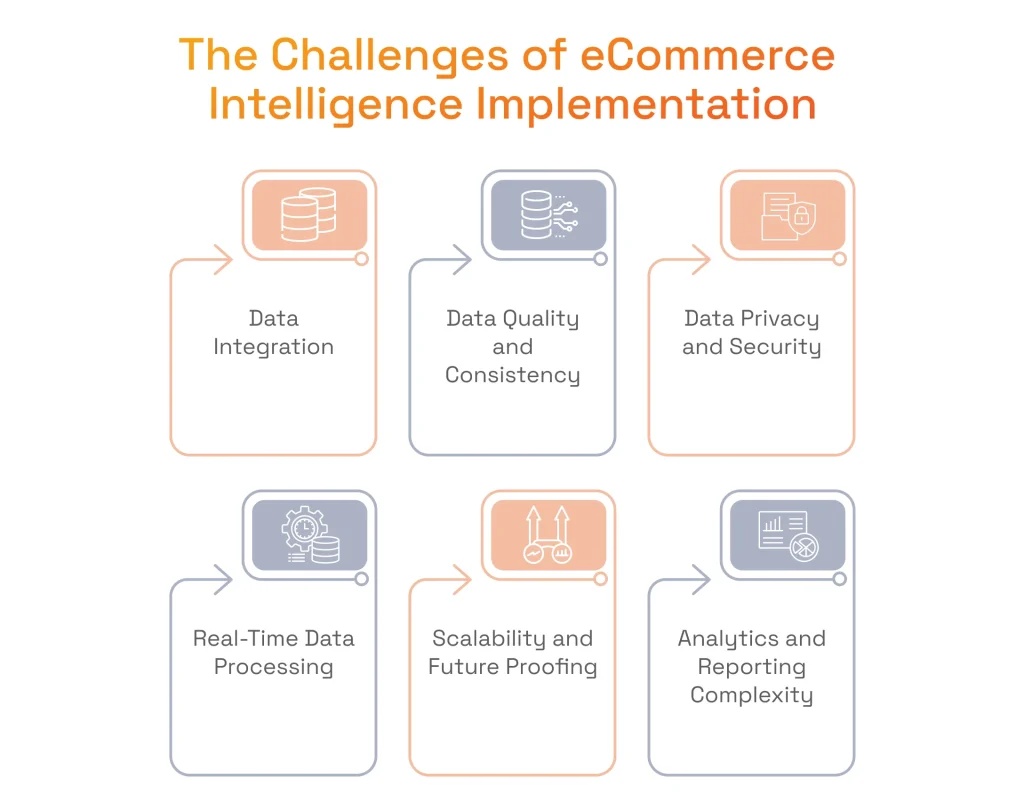
Data Integration
Many eCommerce companies have several systems they rely on. Those are CRM systems, eCommerce platforms (e.g., Shopify, Magento), inventory management, marketing automation, and many more. The importance of data integration from that platforms to eCommerce BI systems is evident as BI is fueled by data and can only drive results when that data is accessible and accurate. Yet, many of those systems are hard to couple together, mostly because they use different data schemas, APIs, and communication protocols.
This issue is very common, and most of our projects required a specific approach to similar integrations. This approach entailed engineering APIs to seamlessly connect all data sources or middleware that aggregates disparate data before feeding it into the BI system. Thus, we could standardize formats, maintain data integrity, and reduce the complexity associated with managing multiple, often incompatible, systems.
Data Quality and Consistency
Most clients say they struggle with ensuring data quality, accuracy, and consistency. This happens because data is scattered across multiple siloed systems and lacks standard validation and cleaning processes. However, BI requires trustworthy, unified datasets, because poor data quality leads to misinformed decisions, reduced productivity, and missed opportunities. In fact, Gartner states that low-quality data costs $12.9 million annually on average.
When we encounter poor quality of data in projects, our data engineers set up a clear data governance framework, where an eCommerce business can establish ownership and accountability across teams. Next, we implement automated validation and cleansing processes as part of data quality management techniques. This helps us catch inconsistencies, duplicates, and missing information at the point of entry. It’s also crucial to integrate data from disparate systems through standardized formats since this helps prevent fragmentation and siloed information.
Data Privacy and Security
Our eCommerce clients prioritize protecting sensitive customer and business data since it is all about brand reputation and regulatory compliance. Yet, many of them also were subject to data breaches attempts and cybersecurity attacks. Therefore, they emphasize the need to safeguard their data as well as ensure compliance with regulations like GDPR.
To help clients establish effective security measures, our specialists implement encryption, access controls, and secure data storage. Another measure we prioritize is ensuring an ML-powered fraud detection mechanism that spots anomalies and signals potential frauds. Plus, we establish clear data governance policies that ensure the data is handled consistently and responsibly across the organization, aligning with GDPR requirements for data protection, consent management, and the right to be forgotten.
Real-Time Data Processing
When the business of our clients grows, they start experiencing increased latency and data bottlenecks connected to their BI platforms. This happens because the volume and velocity of their data escalate as well. In this case, both custom BI solutions and ready-made BI tools need additional work to have enough scalability and resources to maintain optimal performance under heavy data loads.
In such cases, we rely on the benefits of cloud-based infrastructures, such as AWS or Google Cloud. They provide the flexibility and computational power necessary to handle large data volumes. We additionally enhance the power of cloud computing services with distributed data processing frameworks and, thus, establish seamless real-time data ingestion, processing, and analysis. In some cases, when data consistency needs a particular attention, we also apply data normalization and synchronization techniques.
Scalability and Future Proofing
Again, when eCommerce businesses expand, their data volumes surge and their analytical needs become increasingly complex. This often explains why some of our clients have issues with performance and speed. The problem behind those issues are the growing influx of transactional data, customer interactions, and diverse data sources that do not seamlessly integrate into their existing BI infrastructure and overwhelm their BI systems.
Apart from standard choice for AWS or other cloud systems, we design a microservices architecture for these BI platforms. This allows individual components within a platform to be independently scaled and updated as needed. Once such architectural choice is made, the system can be almost endlessly scaled without major performance and speed issues.
Analytics and Reporting Complexity
Reporting and analytics are often unique and intricate for each individual company. When a company deals with a custom solution, developing these complex features demands significant time, specialized expertise, and substantial financial resources. On the other hand, existing BI tools, while offering a range of standard reports and dashboards, may fall short in delivering the precise, tailored analytics that specific eCommerce businesses require.
When a client tasked us with such a challenging solution, we prefer to combine the strengths of both custom and ready-made BI solutions. For that, we leverage flexible, scalable BI platforms that offer robust customization capabilities, allowing us to tailor reports and dashboards to the specific needs of each eCommerce client. In case this functionality requires integrations, we opt for modular architecture to facilitate the process and ensure a seamless connection of several platforms.
Serhii Leleko
AI & ML Engineer at SPD technology
“The challenges mentioned above may seem scary, however, they are pretty much typical for most projects. Since we worked on numerous BI projects for eCommerce, we already have an established approach to dealing with each of these complexities.”
Start Using Business Intelligence for eCommerce Like a Pro
While eCommerce in-house development teams focus on industry-specific platform functionality, a business may require additional expertise focused particularly on eCommerce market intelligence. In this case, it is always reasonable to partner with a technical vendor.
From the very first steps of collaboration with an expert team, retailers can feel the advantages of strategic technology consulting, such as specialized knowledge and unbiased advice. Just these two can make a lot of difference in terms of navigating a completely new ground with BI. Further, once retailers decide to seal the partnership with vendors and start a development project, they get:
- Cost-Effectiveness and Future-Proofing: By outsourcing BI development, retailers can reduce the costs associated with building and maintaining an in-house team, yet still ensuring their BI infrastructure is scalable and adaptable to future business growth and technological advancements.
- Access to the Latest Expertise and Best Practices: Expert engineers have specialized technical knowledge and industry-leading methodologies, which guarantees that their BI development strategies are both effective and aligned with current market standards.
- Access to Cutting-Edge Technology: A BI team utilizes the latest tools and technologies to help retailers harness advanced analytics, real-time data processing, and innovative visualization techniques to gain deeper insights into the market, competitors, and product performance.
- Customization to Fit Specific Needs: With the help of a dedicated BI development team, retailers can receive tailored BI solutions that address their unique business challenges and objectives as well as align with their operational workflows.
Consider SPD Technology as Your BI Implementation Partner
Our team has dealt with multiple eCommerce BI projects as part of data analytics services and possesses a deep understanding of the unique challenges and opportunities within the online retail niche. With years of hands-on experience, we have successfully integrated sophisticated BI solutions for diverse eCommerce platforms, including Shopify, Magento, and custom-built systems. This extensive experience enables us to deliver tailored analytics and reporting tools that align perfectly with your specific business needs.
Choosing SPD Technology means getting:
- Expertise in Custom BI Development and Integration: We ensure that your unique data sources and business processes are effectively unified to deliver actionable insights.
- Industry-Specific Knowledge: Our team tailors BI solutions that address the unique challenges and opportunities within your particular eCommerce sector.
- Dedicated Team of Experts: We are committed to understanding your business needs and delivering personalized, high-quality BI solutions that drive your success.
- Scalable Solutions for Growth: Our specialists guarantee that your analytics infrastructure can handle increasing data volumes and evolving business requirements.
- Data Security and Compliance: Our engineers design robust measures to protect sensitive information and ensure adherence to regulations like GDPR.
Success Story: Enhancing a Shopify Store with BI Functionality for Improved Marketing
One of the notable BI projects we delivered for the eCommerce industry was custom BI features development for a store, specializing in sustainable and eco-friendly home products.
Business Challenge
Our clients experienced rapid growth over the past few years on the retail market. Their customer base expanded, so did the complexity of their data. Operating on the Shopify platform, the client relied on standard analytics to monitor sales and website traffic.
However, these tools fell short in providing concise insights into customer behaviors, preferences, and lifetime value. The reason for that was fragmented data that existed in several different channels, including email marketing system, customer support tickets, and a social media platform. This made it difficult for our client to create detailed customer profiles and strategize marketing.
SPD Technology’s Approach
To create a powerful BI functionality, we needed to develop a custom solution since none of the off-the-shelf platforms was ideal for our clients. The main functionality needed was predictive capabilities, which required ML-enhancements. So, our software engineering team built a unique solution that was connected to the client’s Shopify platform with API connections.
To make sure the BI solution seamlessly exchanges data with Shopify, we created a centralized data warehouse, while also implementing robust ETL processes to ensure data accuracy and consistency. Our team also incorporated advanced analytics and ML algorithms to uncover deeper customer insights and create predictive features that our client prioritized.
Value Delivered
We successfully incorporated ML-driven BI functionality for our client. This allowed the retailer to integrate data from all touchpoints and understand individual customer preferences and lifetime value. At the same time the platform allowed the client to predict demand for one or another product. As a result of our efforts, the retailer experienced a 25% increase in email campaign conversion rates and a 15% boost in customer retention.
Key Takeaways
- eCommerce BI and data analytics serve different purposes: BI focuses on descriptive analytics of historical data, while data analytics adds diagnostic, predictive, and prescriptive capabilities.
- 80% of consumers prefer brands offering personalized experiences and spend 50% more with them, making customer segmentation through BI a direct revenue driver, especially when GenAI-enhanced segmentation has delivered conversion increases as high as 50% in luxury retail.
- Poor data quality costs companies an average of $12.9 million annually. For eCommerce businesses pulling data from CRM, inventory, and marketing systems simultaneously, this makes data governance and validation a prerequisite for trustworthy BI dashboards.
- The choice between ready-made and custom BI tools depends on business complexity, not company size alone: ready-made tools suit standardized needs with fast deployment, while custom solutions are justified when a business requires AI-driven insights, predictive modeling, or workflows that off-the-shelf platforms can’t support.
- Real-time BI dashboards directly affect competitive responsiveness. eCommerce teams relying on static, delayed reports lose the ability to adjust marketing spend or reallocate inventory before opportunities close.
In short: eCommerce BI succeeds when it’s built on clean, integrated data and matched to the right tool for the business’s complexity. Companies that get both right turn scattered operational data into measurable gains in conversion, retention, and marketing ROI.
FAQ
How much does eCommerce BI implementation cost for a mid-size online retailer?
For a mid-sized online retailer, a typical ecommerce BI implementation costs between $80,000 and $400,000. The lower end covers standard cloud warehousing and integration with 1 to 2 basic systems like Shopify and a CRM. The higher end includes complex, automated data pipelines connecting up to 7 distinct sources, such as inventory management, multi-channel advertising platforms, and ERP software, alongside machine-learning-powered analytics and real-time monitoring.
What are the most common eCommerce BI failures that result in unused dashboards?
The primary reason dashboards end up abandoned is a lack of operational relevance. If reports are built around vanity metrics (like page views) instead of actionable business outcomes (like customer acquisition cost or net margin per SKU), teams stop checking them. Failures also happen when data is laggy, when metrics are overcomplicated, or when teams don’t receive proper training, leading them to fall back on their old spreadsheet habits.
How long does it take to implement business intelligence for an eCommerce platform?
A standard ecommerce BI implementation generally takes 3 to 6 months.
- Weeks 1-4: Focuses on planning, defining business KPIs, and mapping data sources.
- Weeks 5-14: Consumes the most time, as engineers extract, transform, and clean messy historical transactional data into pipelines.
- Weeks 15+: Dedicated to designing dashboards, validation testing, and onboarding internal teams.
What eCommerce data sources are most frequently missing from BI implementations?
Firms usually remember to connect their storefronts and ad networks, but frequently omit crucial operational pieces:
- Returns and Defect Data: Forgetting to pull return-logistics and customer service data leaves a massive blind spot regarding true product margins.
- Hidden Fulfillment and 3PL Costs: Leaving out storage, picking, and packaging fees masks your real profitability.
- Siloed Email and SMS Retention Data: Omitting marketing automation platforms prevents accurate customer lifetime value (CLV) calculations.
What is the difference between eCommerce analytics and eCommerce business intelligence?
The two terms serve entirely different operational scopes and timelines:
- eCommerce analytics is specialized, real-time, and tactical. It tracks immediate, localized storefront behaviors to answer quick questions.
- eCommerce business intelligence is broad, historical, and strategic. It consolidates structured data from your entire retail operation, such as sales, supply chains, ad spend, and finances, to answer macro-level questions.