

Enterprise business intelligence is the process of delivering trusted, organization-wide insights through centralized data, analytics, and reporting systems. It integrates data sources, governance policies, and analytical tools to support consistent decision-making across departments. As organizations grow, enterprise BI helps improve visibility, scalability, and control over business performance metrics.
Business Intelligence (BI) has gained traction across various niches, including e-commerce, insurance, IT and beyond. Due to its ability to accelerate processes and help achieve strategic goals, medium and large-sized enterprises, in particular, are among the leading adopters of BI tools and solutions. This has influenced the global BI market, which is growing rapidly, from $31,98 billion in 2024 to $63,20 billion in 2032 (with a CAGR of 8,9%). And it isn’t just about new technology, it’s a sign that your competitors are already acting on data.
Enterprise business intelligence fills the gaps, offering real-time visibility, actionable insights and predictive foresight. Taking the fact that modern corporate BI is no longer just about dashboards, you can get integration with AI, automation and predictive analytics which in turn can become a strategic layer that touches every part of your company. Organizations that delay BI solutions adoption risk falling behind, as others move faster and transform raw data into actionable insights and sharper, evidence-based decisions.
What Is Enterprise Business Intelligence?
Speaking about enterprise business intelligence (BI), experts mean applying comprehensive strategies, methodologies, tools and processes that help collect, integrate, analyze and present business data across an entire organization. Specifically, enterprise BI improves:
- Data Integration: if you bring together all your data from multiple sources and departments into a cohesive framework (often using a data warehouse), you improve visibility and can reduce data quality issues through standardization, validation, and data governance, leading to better insights.
- Processes: so you get accurate, real-time data from all levels of the enterprise, ensuring that leaders and teams can make more informed choices and eventually improve internal and external processes with their enterprise BI solutions.
- Efficiency: if you require support in decision-making, enterprise BI solutions can get it for your organization through automation, predictive analytics and real-time data visualization (you will operate more efficiently by reducing manual data handling).
- Cross-Department Collaboration: this is about the ability to integrate and analyze data across various functions, breaking down silos and helping departments work more collaboratively towards shared goals.
What Makes Enterprise BI Different from Standard BI?
In contrast to traditional business intelligence systems, typically used by startup teams or individual departments, enterprise business intelligence platforms are built for complexity and cross-functional integration. As organizations expand, so does the volume of your data and operations. So, for leadership roles like CTOs or CEOs, the ability to access accurate, real-time insights across all departments becomes a strategic necessity. Enterprise business intelligence (BI) provides this capability, supporting both short-term and long-term strategic planning. Below are the key features that typically set enterprise BI apart from traditional BI systems:
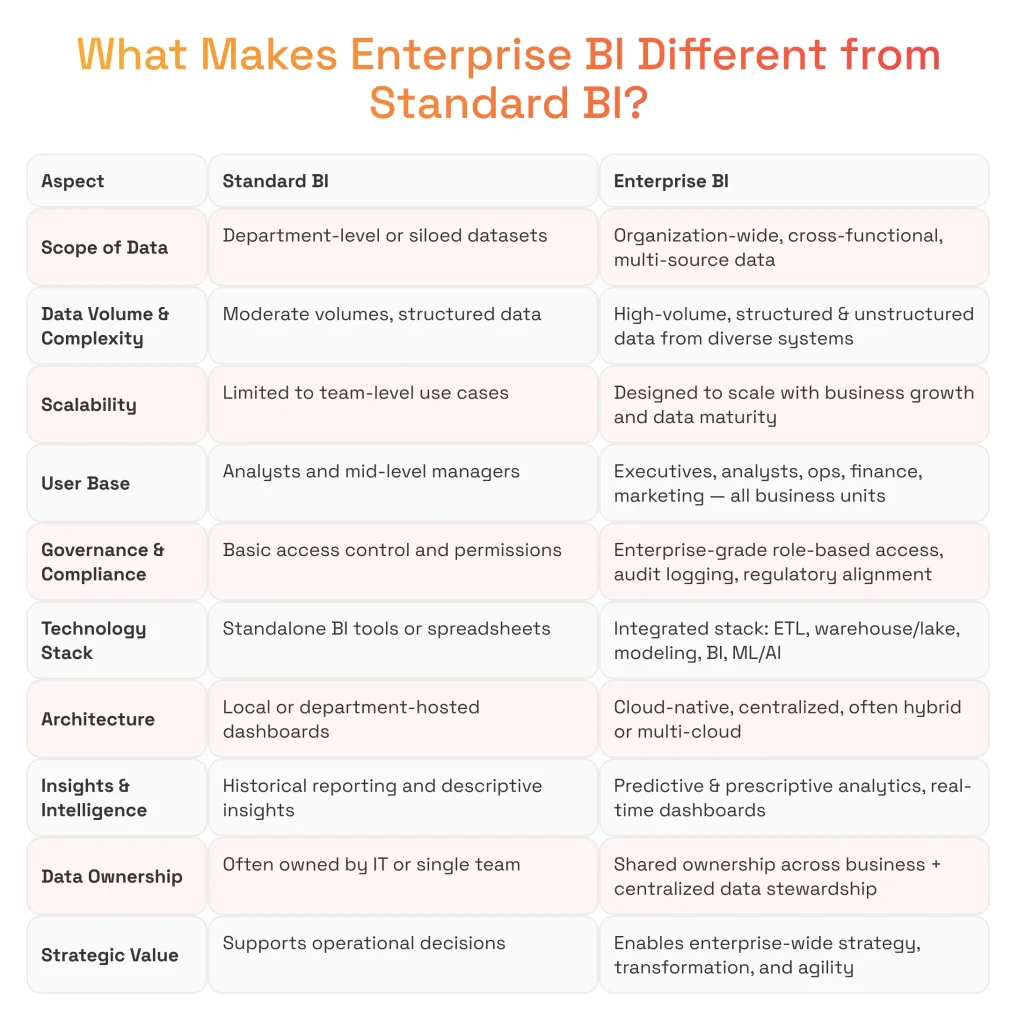
So, for leadership roles like CTOs or CEOs, the ability to access accurate, real-time insights across all departments becomes a strategic necessity. Enterprise business intelligence (BI) provides this capability, supporting both short-term and long-term strategic planning. Here’s what else sets Enterprise solutions apart:
- Scale and Complexity of Data: as we mentioned above, the approach handles vast amounts of data from various sources, ensuring that insights you gain are comprehensive and reflect the entire organization.
- Multi-Departmental Access and Governance: you get a unified enterprise BI platform where different departments and teams can quickly access relevant data while maintaining strict governance and security protocols.
- Real-Time, Predictive and Prescriptive Capabilities: beyond historical analysis, you can find real-time dashboards, get prescriptive analytics and see predictive recommendations for the next steps.
- Integration with ERP, CRM, Cloud Data Platforms and AI Workflows: you can be sure that data from multiple sources like ERP and CRM systems are brought together into one unified system, so you can get a view of your organization’s operations, track and analyze data from various departments.
Ready to take the next step? Explore the essential components of enterprise data strategy in our dedicated guide.
The Competitive Edge of Using Enterprise Business Intelligence (BI)
As the concept of Big Data rises and modern technologies are generating vast amounts of information, we now require advanced tools with cloud computing infrastructure benefits to process and analyze it. Unfortunately, standard programs such as Excel cannot manage such massive data volumes.
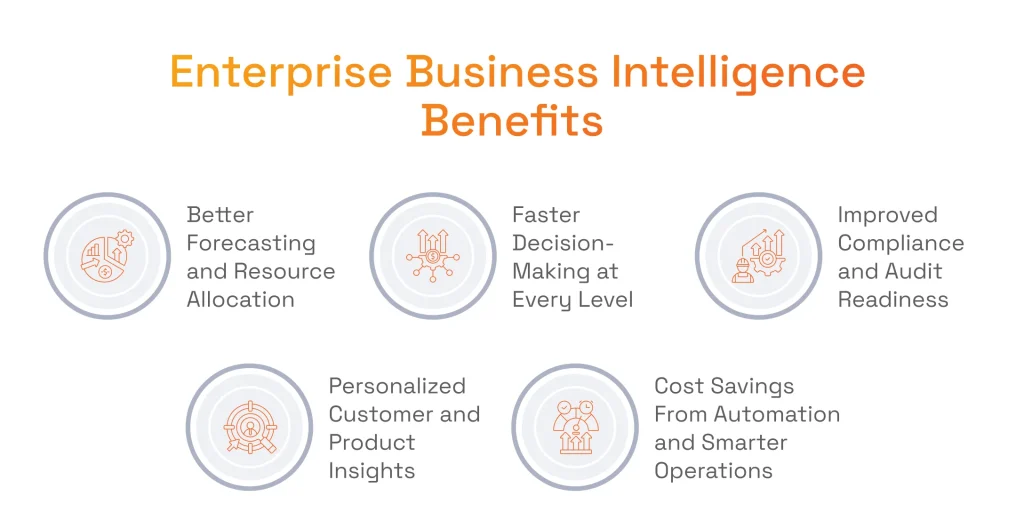
So, by deploying and implementing enterprise business intelligence solutions, you can gain the following advantages:
- Better Forecasting and Resource Allocation: you can apply predictive analytics on unified business data from strong data integration to foresee market trends and allocate resources efficiently, especially when the underlying data quality is consistent.
- Faster Decision-Making at Every Level: with real-time access to access data via interactive dashboards, teams can leverage data faster and make decisions based on the most current information available.
- Improved Compliance and Audit Readiness: strong data governance and data management improve tracking and reporting, helping protect sensitive data with role based access control, data encryption, and end-to-end data security to meet regulatory standards and simplify audits.
- Personalized Customer and Product Insights: by integrating and analyzing customer business data, organizations can better leverage data to tailor marketing strategies and product development based on behavior and preferences.
- Cost Savings from Automation and Smarter Operations: automating data collection and analysis within centralized data warehouses reduces manual work, improves data quality, minimizes errors, and leads to significant cost savings.
With the rise of AI and data analytics, companies across various sectors are transforming their operations. One example is HaulHub, which used AI and data to make significant advancements in the transportation and construction sectors. As a result of our long-term collaboration with this company, we developed an all-in-one enterprise BI platform that consolidates data from transportation agencies, suppliers, and vendors into a single dashboard, providing instant visibility and smooth collaboration among stakeholders.
The benefits of enterprise BI become more tangible when viewed through the lens of specific business applications. While the underlying platform remains the same, different departments use enterprise BI to solve unique operational, financial, and strategic challenges. The table below highlights common enterprise BI use cases across business functions.
Business Function | Enterprise BI Application | Business Outcome |
|---|---|---|
Executive leadership | Enterprise performance monitoring and strategic planning | Faster, data-driven decision-making |
Finance | Budgeting, forecasting, profitability analysis, and financial reporting | Improved financial visibility and planning accuracy |
Sales | Pipeline analysis, revenue forecasting, and performance tracking | Better forecasting and sales optimization |
Marketing | Campaign performance analysis and customer segmentation | More effective targeting and higher marketing ROI |
Operations | Process monitoring, productivity analysis, and resource planning | Improved efficiency and operational visibility |
Supply chain | Inventory tracking, demand forecasting, and logistics analytics | Reduced disruptions and optimized inventory levels |
Customer service | Service performance monitoring and customer behavior analysis | Improved customer experience and retention |
Human resources | Workforce analytics, retention tracking, and talent planning | Better workforce management and planning |
Business Function
Executive leadership
Finance
Sales
Marketing
Operations
Supply chain
Customer service
Human resources
Enterprise BI Application
Enterprise performance monitoring and strategic planning
Budgeting, forecasting, profitability analysis, and financial reporting
Pipeline analysis, revenue forecasting, and performance tracking
Campaign performance analysis and customer segmentation
Process monitoring, productivity analysis, and resource planning
Inventory tracking, demand forecasting, and logistics analytics
Service performance monitoring and customer behavior analysis
Workforce analytics, retention tracking, and talent planning
Business Outcome
Faster, data-driven decision-making
Improved financial visibility and planning accuracy
Better forecasting and sales optimization
More effective targeting and higher marketing ROI
Improved efficiency and operational visibility
Reduced disruptions and optimized inventory levels
Improved customer experience and retention
Better workforce management and planning
How Enterprise Business Intelligence Works
The enterprise BI solutions aggregate large volumes of data from various sources, process it and deliver insights that help leaders and teams understand performance and identify trends. Actually, the business impact of Big Data is significant here, as it enables companies to analyze everything from customer behaviors to their pain-points, preferences and needs.
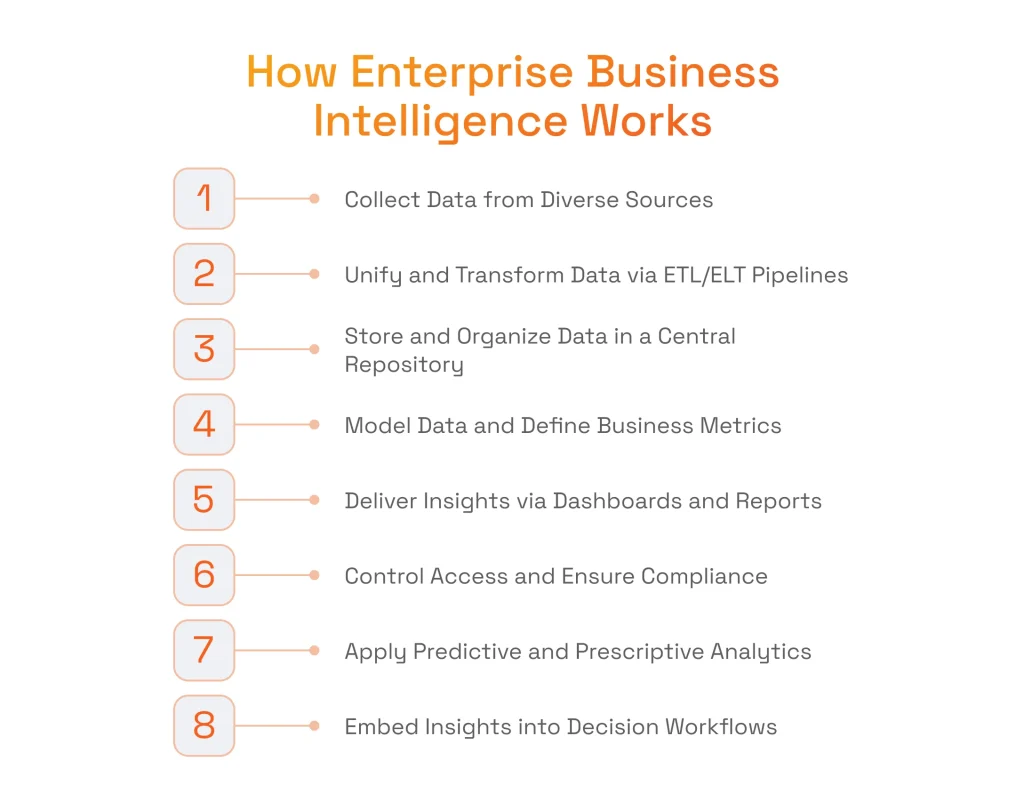
In this way, BI applications transform information into meaningful data which helps businesses understand the processes better. Enterprise systems usually include several interconnected components that work together to transform raw data into actionable insights:
1. Data Sources: The Starting Point of BI Solutions
Enterprise Resource Planning and Customer Relationship Management are often integrated with enterprise business intelligence software to provide a more comprehensive view of the operations. So data is collected from these various sources, like ERP and CRM internal systems, as well as external sources such as market trends and social media. Collected data is then ingested and integrated into a centralized system, ensuring consistency and accuracy across the organization. There are three main types of data:
- Unstructured Data: this usually includes text documents, videos and other information that can’t be easily read or organized by computers (a large portion of internet data, such as social media posts or customer reviews, is unstructured).
- Structured Data: data that’s organized in fixed formats, such as names, addresses or sales figures, making it easy to store and query using software tools.
- Semi-Structured Data: it is a bit of a mix between structured and unstructured data.
2. Data Ingestion & Integration
The next step is to collect data, which you will then ingest and integrate into the BI system to ensure accuracy across various data sources. Experts usually use the Extract, Transform and Load (ETL) technique. It is also about the the importance of data integration process that involves:
- extracting data from various sources we mentioned above (databases, flat files, APIs or other storage mechanisms).
- once the data is extracted, it often needs to be transformed into a format suitable for analysis/reporting (this is our step: data ingestion and integration), and then goes load.
- alongside ETL, many enterprises enable self service data preparation so analysts can clean, join, and standardize datasets faster without waiting on engineering.
3. Centralized Data Storage (Data Warehouse/Data Lake/Lakehouse)
Integrated data is stored in centralized repositories like enterprise data warehouse or data lakes/lakehouse, facilitating easy access and analysis. Before data is used for analysis, it typically undergoes several transformation steps to improve quality and usability. The transformation of data here can also involve various operations:
- Cleaning the data (e.g., correcting errors)
- Enriching the data (like combining it with other sources)
- Summarizing data
- Converting types or formats
- Applying rules or calculations.
4. Data Modeling & Semantic Layer
Data modeling involves structuring the data to reflect business processes, while the semantic layer provides a user-friendly interface for data interaction. It means that your enterprise business intelligence solutions get data modeling with organized raw data to see real-world business processes, defining relationships, hierarchies and metrics for easier analysis. It ensures the data structure reflects how a business operates.
At the same time, the semantic layer simplifies data access by translating complex datasets into familiar business terms. This way, you can help non-technical users understand insights and interact with the data without needing to understand database structure. This layer bridges the gap between technical data models and business users.
5. BI Tools & Dashboards
Modern enterprise BI also enables self-service analytics, allowing teams to explore data, build reports, and answer questions on demand within governed boundaries. Enterprise BI tools visualize complex data through interactive dashboards and reporting, making it easier to spot trends, patterns, and KPIs, and turn raw data into actionable insights. Here are some top enterprise BI solutions to research:
- Power BI: it provides interactive data visualizations and business intelligence capabilities.
- Microsoft Power BI: supports interactive dashboards, data modeling, and broad connectivity for enterprise reporting.
- Tableau: you can find here drag-and-drop analytics that creates real-time visualizations and analyzes complex datasets.
- Google Data Studio: it is actually a free tool for creating customizable reports and dashboards, possible to integrate with other Google products.
6. Governance, Access Control, and Security
Implementing strict governance and security measures is about ensuring that data is protected. Access is granted based on user roles and responsibilities:
- Governance: it establishes data ownership, standards and policies.
- Access Control: you get role-based access that ensures users only see data relevant to their responsibilities (you can use tools like Active Directory and Azure AD).
- Security: it involves encryption (at rest and in transit), audit logging and regular vulnerability assessments.
The success of your data strategy largely depends on how well it is managed. You need to be sure that your data is accurate, accessible and secure across all systems.
To get a better understanding of best practices for enterprise data management, check out our ultimate guide!
7. Advanced Analytics & Machine Learning
Advanced data analytics and machine learning algorithms are applied to predict trends and identify patterns. It actually involves the work of data analysts that use sophisticated techniques to analyze historical data and provide actionable insights. Analytics capabilities offer a step beyond traditional BI, which focuses on descriptive data analytics services.
Advanced analytics can also apply predictive and prescriptive analytics. For example, predictive analytics uses historical data to forecast future outcomes. Prescriptive analytics is based on predictive models, but suggests specific actions or decisions to improve outcomes.
8. Insights to Action: BI Embedded into Decision Workflows
Here, the ultimate goal is to apply received insights into daily decision-making processes. So it means integrating BI solutions and data directly into the day-to-day decision-making processes across the organization. Additionally, data strategy consulting can help you with initial implementation, ensuring that all stakeholders, from top management to operational staff, are involved and trained to use BI tools.
Instead of business leaders and teams having to extract and analyze reports separately, BI insights are readily available within the workflow. For example, in an e-commerce enterprise, customer service teams can access real-time analytics to identify trending products, enabling them to proactively offer promotions or address queries. Similarly, HR teams can make decisions based on employee performance data embedded directly within their system.

Dmytro Tymofiiev
Delivery Manager at SPD Technology
“BI Enterprise isn’t just about dashboards. You can see that it’s about creating a data-driven culture where insights are integrated into every decision-making process of your team.”
Summing up, enterprise BI delivers value through multiple interconnected components: from data integration and governance to analytics and decision-making workflows. We’ve already explained how enterprise BI transforms raw data into actionable insights through data integration, centralized storage, governance, analytics, and embedded decision-making. The table below summarizes the core capabilities of an enterprise BI platform and the business value each capability delivers.
Enterprise BI Capability | What It Does | Business Value |
|---|---|---|
Data integration | Consolidates data from ERP, CRM, operational systems, cloud applications, and external sources | Eliminates data silos and creates a unified view of the business |
Centralized data storage | Stores structured and unstructured data in a consistent analytics environment | Improves accessibility, scalability, and reporting consistency |
Data modeling & semantic layer | Organizes data into business-friendly structures and definitions | Simplifies analysis and reduces dependence on technical teams |
Data governance | Establishes ownership, quality standards, policies, and controls | Improves trust, consistency, and regulatory compliance |
Security & access management | Controls access based on user roles and responsibilities | Protects sensitive data and reduces operational risk |
Reporting & dashboards | Delivers KPIs, performance metrics, and operational visibility | Enables faster and more informed decision-making |
Self-service analytics | Allows business users to explore data independently | Increases agility and reduces reporting bottlenecks |
Advanced analytics & AI | Supports forecasting, anomaly detection, and predictive insights | Helps organizations anticipate trends and optimize decisions |
Embedded analytics | Delivers insights directly within operational workflows | Accelerates action and increases adoption |
Enterprise-wide collaboration | Aligns teams around shared metrics and objectives | Improves cross-functional decision-making and strategic alignment |
Enterprise BI Capability
Data integration
Centralized data storage
Data modeling & semantic layer
Data governance
Security & access management
Reporting & dashboards
Self-service analytics
Advanced analytics & AI
Embedded analytics
Enterprise-wide collaboration
What It Does
Consolidates data from ERP, CRM, operational systems, cloud applications, and external sources
Stores structured and unstructured data in a consistent analytics environment
Organizes data into business-friendly structures and definitions
Establishes ownership, quality standards, policies, and controls
Controls access based on user roles and responsibilities
Delivers KPIs, performance metrics, and operational visibility
Allows business users to explore data independently
Supports forecasting, anomaly detection, and predictive insights
Delivers insights directly within operational workflows
Aligns teams around shared metrics and objectives
Business Value
Eliminates data silos and creates a unified view of the business
Improves accessibility, scalability, and reporting consistency
Simplifies analysis and reduces dependence on technical teams
Improves trust, consistency, and regulatory compliance
Protects sensitive data and reduces operational risk
Enables faster and more informed decision-making
Increases agility and reduces reporting bottlenecks
Helps organizations anticipate trends and optimize decisions
Accelerates action and increases adoption
Improves cross-functional decision-making and strategic alignment
What Holds Enterprises Back from BI Success
Despite the clear benefits, several challenges can arise during the implementation of the BI enterprise methodology, especially in the early stages. Below are some of the most common ones, along with the solutions we, at SPD Technology, offer our customers to ensure BI implementation success.
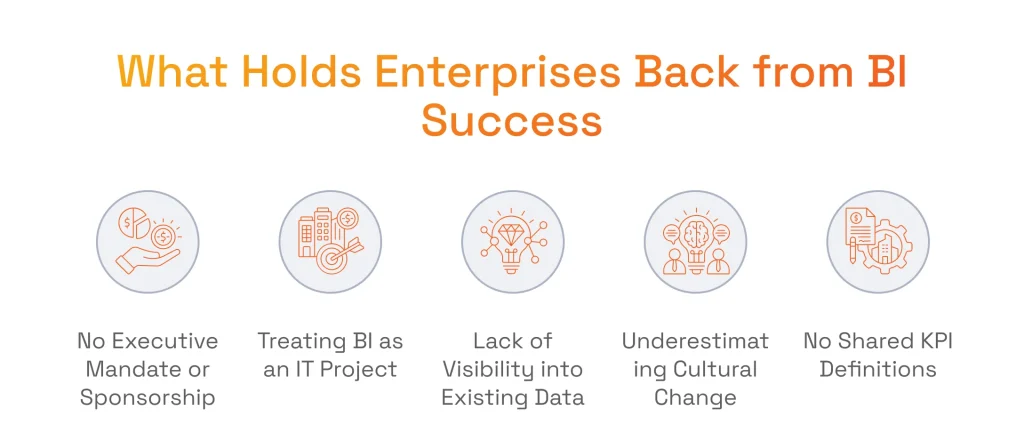
- No Clear Executive Mandate or Sponsorship: we work closely with leadership to secure a clear executive mandate from the start. A successful initiative needs strong support, so we help define a shared vision, clarify priorities and ensure commitment as a solid foundation for BI projects success right from day one.
- Treating BI as an IT Project, Not a Business Initiative: our approach emphasizes the strategic business value of BI, ensuring cross-departmental collaboration. What does it mean? Our efforts with strategic goals bring business and technical teams together, we build a collaborative framework that reflects the organization’s real priorities.
- Data Chaos or Lack of Visibility into What’s Already Available: let’s say, we make comprehensive data audits to identify existing data assets and help with data management to avoid chaos. When data is outdated or poorly documented, the real insights are hard to reach, so we begin with a full data audit, cataloging what already exists, identifying gaps and setting up centralized data access.
- Underestimating the Cultural Shift Required: upskilling employees is crucial, so we provide dedicated consultants to bridge BI expertise gaps and start training within management support. Such guidance can help build data literacy and culture, strengthening a company-wide commitment to data-driven decisions.
- No Shared Understanding of KPIs or What Success Looks Like: at the end, it is crucial to highlight that we lead interactive workshops to define clear KPIs and success metrics aligned with business objectives. We work with stakeholders and ensure that every team is aligned on what value looks like.
Looking for a reliable partner to empower a strategic BI implementation for your enterprise?
Take a look at our curated list of the best business intelligence consulting companies.
The Future of Enterprise Business Intelligence Services: Tapping into Opportunities Now
Now let’s talk about how to turn data into action because the future of enterprise BI isn’t just about dashboards. It’s about proper enterprise BI strategy and making sure the right people get the right insight exactly when they need it. And then actually doing something with it.
Modern enterprise BI systems are not only about engines. Instead of just showing what happened last quarter, they also highlight trends, suggest what’s likely to happen next and even recommend steps to take. This is where AI and machine learning expertise come in first.
Moving Toward AI-Augmented and Action-Oriented BI Platforms
The integration of Artificial Intelligence into BI systems is enhancing analysis and already transforming how enterprises analyze data. Such tools help by offering advanced capabilities like Artificial Intelligence for customer behavior analysis, allowing businesses to predict users preferences and personalize experiences based on large sets of behavioral data. The AI-driven tools also help:
- Spot patterns in your data
- Predict what might happen next
- Suggest actions (not just insights)
- Automate responses in some cases.
Data Culture Will Outperform Data Volume
Organizations that cultivate a strong data culture, where data is accessible and actually used consistently, will outperform those that focus solely on data accumulation. Just having a lot of data doesn’t guarantee success. What matters more is how well your company can:
- Give people access to data
- Ensure the data is trustworthy
- Encourage employees to actually rely on it.
In other words, companies with a strong data culture will do better. Also, AI for Business Intelligence can help businesses enhance operational efficiency by automating repetitive tasks and providing predictive insights from large datasets, freeing up resources for more creative and strategic tasks.
Capturing the Opportunity Requires a Strategic Partner
Implementing enterprise BI software is incredibly complex. It requires strategic planning and execution with reliable partners. The practice usually involves:
- Understanding your goals
- Aligning different teams
- Choosing the right tools
- Managing the change it brings.
An enterprise BI partner like SPD Technology can guide you through such processes, delivering all of the advantages of strategic technology consulting. We make sure your BI platform setup is not just functional, but truly supports long-term business value.
Key Takeaways
- Enterprise BI and centralized data management reduce reporting inconsistencies and improve confidence in business metrics.
- Organizations that establish strong data governance improve reporting consistency and reduce interdepartmental conflicts.
- Integrating data across business functions enables leaders to make decisions using shared metrics rather than isolated reports.
- Self-service reporting increases agility, but organizations still need standards for data ownership and metric definitions.
- Enterprise BI initiatives require alignment between business goals, technology architecture, and organizational processes to succeed.
- Long-term BI success depends on continuous governance, adoption, and optimization efforts.
In short: enterprise BI helps organizations unify data, standardize reporting, and scale analytics across departments. A successful strategy combines technology, governance, and business adoption to deliver reliable insights and measurable business value.
FAQs
How much does enterprise BI implementation cost compared to departmental BI tools?
Enterprise BI implementations typically require a significantly greater investment because they support organization-wide data integration, governance, security, and reporting. Departmental BI projects often range from $20,000 to $100,000, while enterprise BI initiatives commonly range from $150,000 to $500,000+. Large-scale programs involving extensive integrations, custom analytics, and enterprise-wide adoption may exceed $1 million.
While the upfront cost is higher, enterprise BI can deliver broader value by improving data consistency, reducing reporting duplication, and enabling more informed decision-making across the organization.
What are the most common enterprise BI projects that exceed budget and timeline?
Enterprise BI projects often exceed budget and timeline when organizations underestimate data integration complexity, data quality challenges, governance requirements, or user adoption efforts. Initiatives that attempt to consolidate numerous legacy systems without clearly defined priorities are particularly vulnerable to delays and scope expansion.
Organizations typically achieve better outcomes by delivering BI capabilities in phases, focusing on specific business objectives, measurable results, and stakeholder alignment before expanding enterprise-wide.
How long does an enterprise BI rollout take across a large organization?
Implementation timelines depend on organizational size, data complexity, and project scope. Initial enterprise BI capabilities can often be delivered within 3–6 months, while full enterprise rollouts involving multiple business units, governance frameworks, self-service analytics, and advanced reporting typically require 6–18 months or longer.
Many organizations begin with high-value business areas and gradually expand BI adoption across departments. This phased approach helps reduce implementation risk, improve user adoption, and deliver business value sooner.
What data governance failures most frequently derail enterprise BI initiatives?
Common governance failures include unclear data ownership, inconsistent metric definitions, poor data quality controls, and inadequate access management policies. When departments define key business metrics differently, reporting inconsistencies can undermine trust in analytics.
Successful enterprise BI initiatives establish governance frameworks that define responsibilities, standards, quality requirements, and security controls before large-scale reporting begins.
What is the difference between enterprise BI and self-service BI?
Enterprise BI focuses on centralized governance, integrated data, standardized reporting, and organization-wide decision-making. Self-service BI enables business users to create reports, dashboards, and analyses without relying heavily on technical teams.
Rather than replacing enterprise BI, self-service BI typically operates within the governance framework established by an enterprise BI strategy. This approach balances user flexibility with consistency and control over organizational data.