

Data analytics in eCommerce helps online retailers turn customer, transaction, marketing, and operational data into actionable business insights. By analyzing purchasing behavior, customer journeys, inventory trends, and campaign performance, retailers can improve personalization, optimize inventory, increase conversion rates, and make more profitable business decisions.
Statista forecasts that by the end of 2026, the global revenue of the eCommerce market will reach an astonishing USD 3,880 billion, making the market more competitive than ever before. Those looking to thrive in this competitive industry are already leveraging eCommerce marketing analytics to gain invaluable insights and get a bigger piece of the pie.
In this article, we will take a deeper look at this critical aspect of eCommerce companies’ growth and share our experience with the effective use of E-commerce data analytics.
The Growing Impact of eCommerce Analytics
According to a survey by Forbes, 95% of businesses face at least some kind of need to manage their unstructured data, while over 40% say they need to manage unstructured data frequently. The eCommerce industry is not an exception, furthermore, analyzing vast amounts of data can be turned into game-changing strategic insights, enhancing almost any business operation.
The Benefits of e-Commerce Analytics
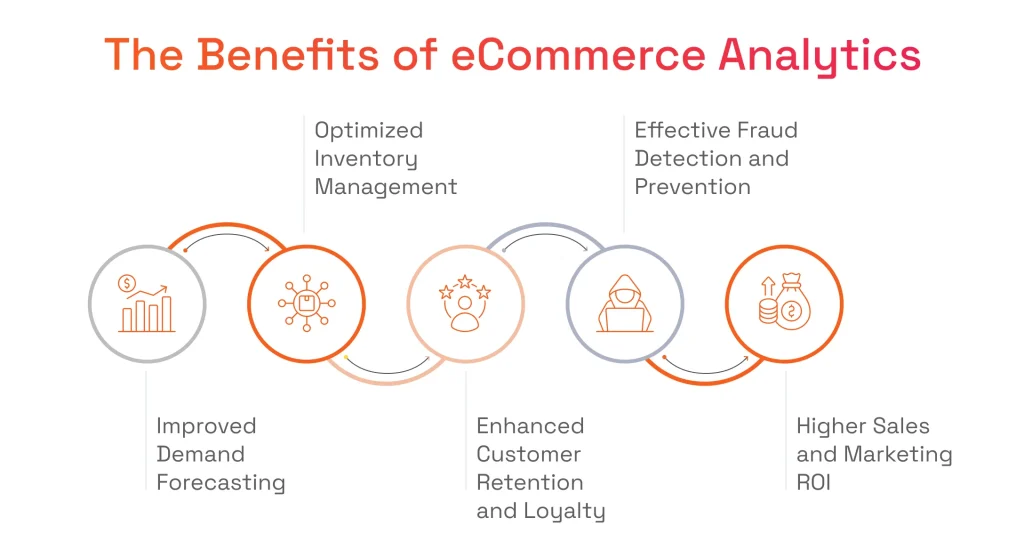
Here are some of the most impactful advantages of eCommerce customer analytics that result in the next-level competitive edge for organizations that use it:
- Improved Demand Forecasting: data analytics eCommerce allows businesses to anticipate changes in demand based on historical trends, seasonal patterns, and customer behavior. We have already overviewed the process of demand forecasting in Retail with machine learning, so you are welcome to read this article for more details.
- Optimized Inventory Management: organization can drastically improve inventory management, reducing holding costs and minimizing excess stock by analyzing real-time sales data, historical trends, and supply chain variables.
- Enhanced Customer Retention and Loyalty: companies can personalize customer interactions, anticipate needs, and improve conversion rates thanks to analysis of purchase history, browsing patterns, and preferences.
- Effective Fraud Detection and Prevention: unfortunately, eCommerce businesses are frequent targets of different types of fraudulent attacks. ML-powered data analytics solutions can help prevent fraud in real time by spotting suspicious transaction attempts and sending instant alerts.
- Higher Sales and Marketing ROI: data-driven eCommerce analytics positively impact marketing efforts as well, allowing companies to target audiences more effectively and spend budgets wisely.

Dmytro Tymofiiev
Delivery Manager at SPD Technology
“What makes eCommerce data analytics initiatives work and unlock all aforementioned benefits is having a structured and scalable data analytics strategy, ready to adapt to any market changes and meet evolving customer expectations. So, it will be a good idea to craft such a strategy relying on real business and tech expertise, before embarking on an eCommerce web analytics project.”
How Does eCommerce Data Analytics Work?
eCommerce data analytics works by collecting, processing, and analyzing data from various online business activities. Customer online interactions or at the physical point of sale are a great example of this. Leveraging various analytical techniques, businesses analyze the data to identify trends, patterns, and correlations. This may include, but is not limited to, using the following analytical techniques:
- Descriptive Analytics: delivers information on what happened in the past by summarizing all historical data.
- Diagnostic Analytics: dives into specific events of the past and builds cause-and-effect relationships.
- Predictive Analytics: allows forecasting events that might happen in the future based on historical data patterns.
- Prescriptive Analytics: this one goes beyond eCommerce predictive analytics by offering guidance and potential strategies for scenarios that might occur.
Dmytro Tymofiiev
Delivery Manager at SPD Technology
“In a real-world scenario, all four aforementioned types are combined in a layered, looped approach to create a comprehensive eCommerce analytics solution that not only accurately interprets the previous performance, but also helps to proactively shape the future growth. ” –
Main Application Areas of Analytics for eCommerce
The eCommerce data analytics techniques we described above are used by businesses to analyze data from different sources (eCommerce websites, social media, customer feedback, etc.). Let’s discover the application areas of analytics for eCommerce that deliver the most valuable insights for businesses.
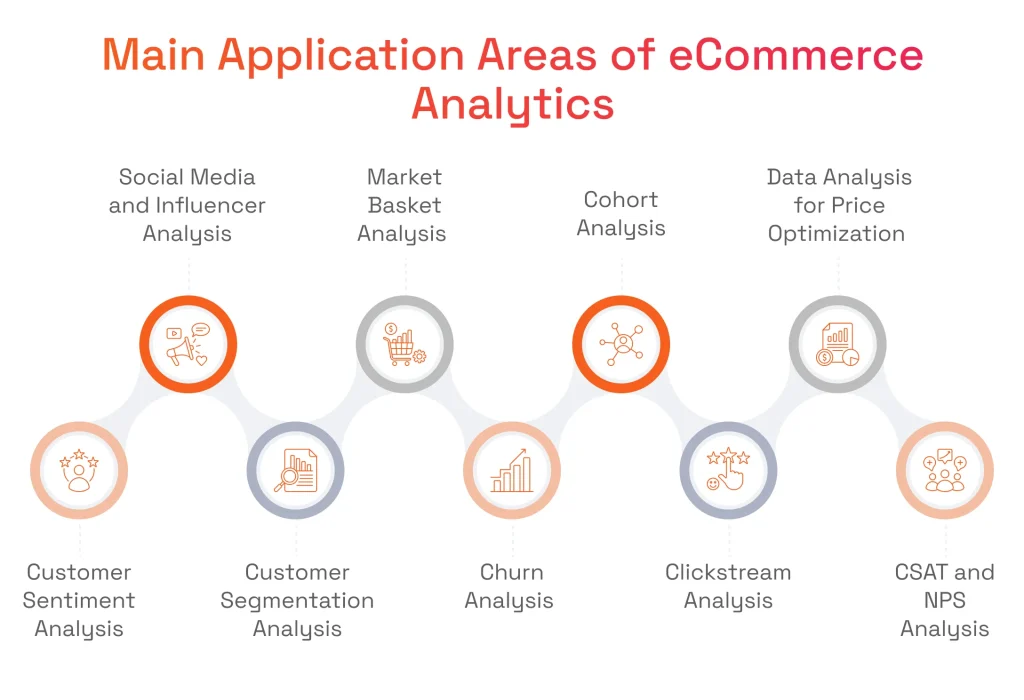
Customer Sentiment Analysis
As one of the main implementations of Natural Language Processing (NLP) for retail businesses and eCommerce, it allows for the automatic assessment of customer opinions on specific brands or products. This is achieved by allowing ML algorithms to analyze reviews, comments, social media posts, and other online information.
Social Media and Influencer Analysis
Similarly, companies analyze the performance of specific social media accounts, processing engagement levels, brand mentions, and sentiment on a specific platform. In addition to that, advanced data analytics can also evaluate influencers, recommending the most suitable and effective potential business partners.
Customer Segmentation Analysis
Modern solutions with the right amount and quality of data can easily segment customers based on demographics, purchase history, or browsing behavior, allowing businesses to tailor and pinpoint their marketing efforts, increase revenue, and minimize the bounce rate.
Market Basket Analysis (Affinity Analysis)
This type of analysis identifies the products that are bought together, helping businesses to develop highly effective cross-sell and upsell strategies. With automated analysis of purchase patterns, platforms can recommend personalized bundles without the involvement of employees.
Churn eCommerce Analysis
This identifies specific customers with a high risk of leaving, helping organizations to take action before important clients leave. In practice, ML models can detect the signs of churn, including lowered purchase frequency or engagement, and automatically deploy targeted retention campaigns.
Cohort Analysis
With this analysis, organizations group customers based on specific characteristics or experiences within a given timeframe to track their engagement and retention over time. The insights obtained here allow for the evaluation of the success of marketing campaigns over certain periods.
Clickstream Data Analysis for eCommerce
This one is tracking the customer interactions with a website, resulting in an overview of user behavior, page visits, time spent, and actions taken. When done correctly, it allows the detection of problems in the user journey, suggests page load time optimizations and website design changes, contributing to better conversion rates as a result.
eCommerce Data Analysis for Price Optimization
Modern, data-driven price optimization tools can analyze competitors’ pricing and demand changes, detect emerging purchase trends, and recommend optimal product prices. Some eCommerce data analytics tools can optimize product prices to align with users’ financial profiles. To build such a profile, user behavior, demographic data, and indirect indicators (such as which price ranges users click on and how often they abandon cart items based on price) can be used.
Customer Satisfaction (CSAT) and Net Promoter Score (NPS) Analysis
The information from these two scores is critical for getting a direct insight into customer satisfaction and loyalty. Combined with feedback analysis, automated solutions can track customer sentiment and understand the factors that influence customer loyalty.
The applications discussed above address different parts of the customer journey and business operations. Some focus on understanding customer behavior, while others focus on improving retention, optimizing pricing, or strengthening forecasting capabilities. Together, they show how analytics can influence both customer-facing and operational decisions across an eCommerce business.
Application | Analyzed Data | Primary Objective | Business Outcome |
|---|---|---|---|
Customer sentiment analysis | Reviews, surveys, social media posts, support interactions | Understand customer perceptions and satisfaction levels | Improved products, customer experience, and brand reputation |
Customer segmentation analysis | Demographics, purchase history, browsing behavior, engagement data | Group customers based on shared characteristics and preferences | More effective personalization and marketing performance |
Market basket analysis | Transaction histories, product combinations, order contents | Identify products frequently purchased together | Increased cross-selling, upselling, and average order value |
Churn analysis | Purchase frequency, engagement metrics, loyalty activity | Identify customers at risk of leaving | Improved customer retention and reduced revenue loss |
Cohort analysis | Customer behavior across specific time periods or acquisition groups | Measure retention, engagement, and purchasing trends | Better marketing optimization and lifecycle management |
Conversion rate analysis | Website interactions, user journeys, checkout behavior | Identify barriers to purchase and optimize conversions | Higher conversion rates and revenue growth |
Dynamic pricing analysis | Competitor pricing, demand patterns, inventory levels, seasonality | Adjust pricing based on market conditions | Increased margins, competitiveness, and profitability |
Customer satisfaction (CSAT) analysis | Surveys, reviews, support interactions, customer feedback | Measure customer satisfaction and service quality | Improved loyalty, retention, and customer experience |
Customer lifetime value (CLV) analysis | Purchase history, retention rates, customer profitability | Identify high-value customer segments | More efficient customer acquisition and retention spending |
Product performance analysis | Product views, purchases, returns, ratings, inventory data | Evaluate product demand and profitability | Better merchandising and assortment decisions |
Application
Customer sentiment analysis
Customer segmentation analysis
Market basket analysis
Churn analysis
Cohort analysis
Conversion rate analysis
Dynamic pricing analysis
Customer satisfaction (CSAT) analysis
Customer lifetime value (CLV) analysis
Product performance analysis
Analyzed Data
Reviews, surveys, social media posts, support interactions
Demographics, purchase history, browsing behavior, engagement data
Transaction histories, product combinations, order contents
Purchase frequency, engagement metrics, loyalty activity
Customer behavior across specific time periods or acquisition groups
Website interactions, user journeys, checkout behavior
Competitor pricing, demand patterns, inventory levels, seasonality
Surveys, reviews, support interactions, customer feedback
Purchase history, retention rates, customer profitability
Product views, purchases, returns, ratings, inventory data
Primary Objective
Understand customer perceptions and satisfaction levels
Group customers based on shared characteristics and preferences
Identify products frequently purchased together
Identify customers at risk of leaving
Measure retention, engagement, and purchasing trends
Identify barriers to purchase and optimize conversions
Adjust pricing based on market conditions
Measure customer satisfaction and service quality
Identify high-value customer segments
Evaluate product demand and profitability
Business Outcome
Improved products, customer experience, and brand reputation
More effective personalization and marketing performance
Increased cross-selling, upselling, and average order value
Improved customer retention and reduced revenue loss
Better marketing optimization and lifecycle management
Higher conversion rates and revenue growth
Increased margins, competitiveness, and profitability
Improved loyalty, retention, and customer experience
More efficient customer acquisition and retention spending
Better merchandising and assortment decisions
Gen AI and Analytics in eCommerce – The Next Level Use Cases of Their Combination
Statista reports that the global generative AI market will reach USD 394.66 billion by the end of 2024, showing the massive popularity of this ML-powered advancement, focused on content creation. But how does generative AI work in conjunction with eCommerce data analytics, and what impact do they make?
Generative AI models that are used for E-commerce analysis require a large amount of data from customer behavior, transaction histories, and market trends. Based on this information, Generative AI identifies the most prominent tendencies and can come up with personalized product recommendations or even tailored marketing messages.
Data analytics, in turn, continuously feeds data into Gen AI models, creating a loop in which insights collected from data analytics are being enhanced by Gen AI and result in improving customer experience. As a result, the impact is creating ultimately personalized experiences with dynamically tailored content in resonance with the demands of each user.
Now, let’s discuss some specific use cases of Generative AI and data analytics combination.
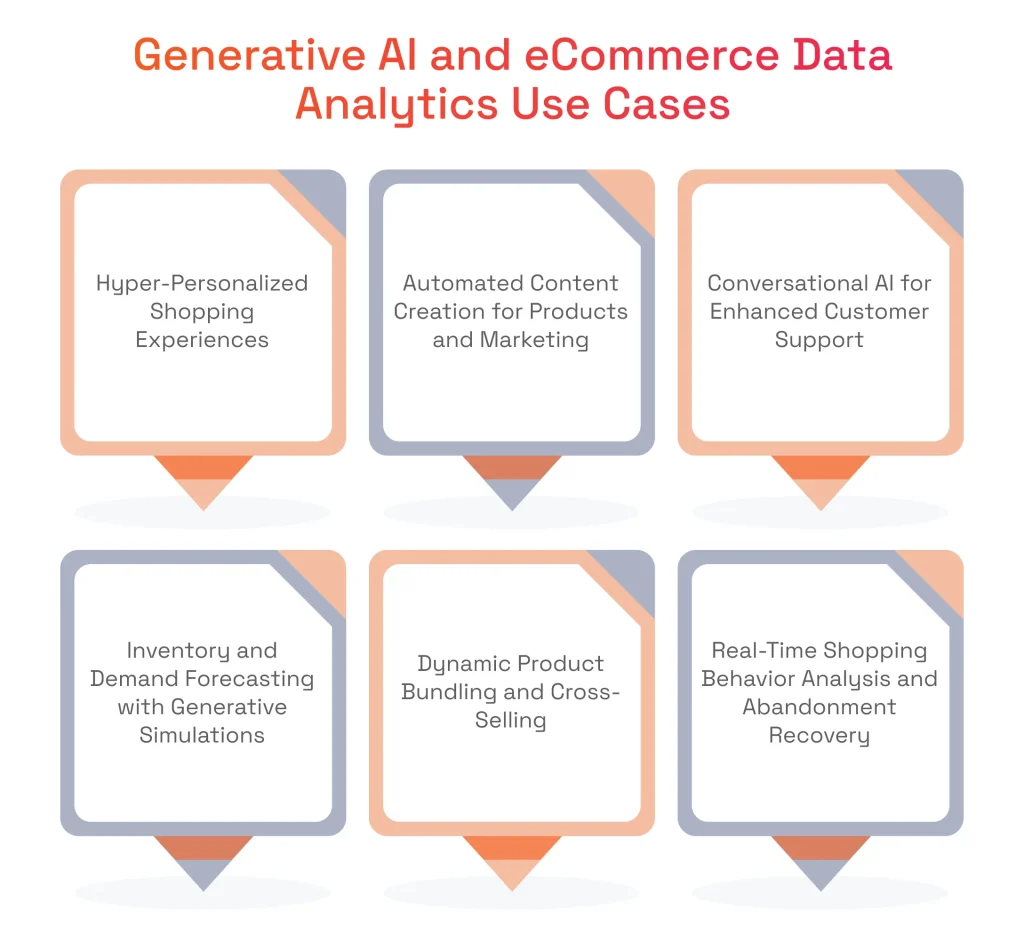
eCommerce Web Analytics for Hyper-Personalized Shopping Experiences
Generative AI can create custom product recommendations in real time as the customer browses the website. These suggestions are being adjusted based on specific click patterns and other engagement metrics captured by the eCommerce website analytics.
Automated Content Creation for Products and Marketing
Based on top keywords, product attributes, and customer preferences, provided by web analytics for eCommerce, generative AI can create SEO-optimized descriptions of the products, text for the chains of marketing emails, or even entire ad articles on specific products or services, which saves time for marketers.
Conversational AI for Enhanced Customer Support
Integration of data analytics multiplies the benefits of using chatbots and virtual assistants, as it helps Gen AI to understand the most common customer queries, pain points, and purchasing patterns. With this information, bots and assistants can comprehensively answer questions and suggest the most appropriate similar products, and, in some cases, help with complex queries as well.
Inventory and Demand Forecasting with Generative Simulations
While data analytics is tracking sales patterns, trends, and purchasing data, Generative AI can create insights in seconds by simulating multiple scenarios for inventory demand prediction, which is especially useful in peak seasons or during special promotions.
eCommerce Marketing Analytics for Dynamic Product Bundling and Cross-Selling
This is another area where the combination of the two shines. Data analytics identifies customer purchasing patterns while Gen AI delivers dynamic, relevant, and personalized product bundles tailored to specific customers. In cross-selling cases, AI can even suggest custom promotions for complementary products.
Real-Time Shopping Behavior Analysis and Abandonment Recovery
Analytics in online retail allow businesses to detect, in real time, the precise moment when a customer is about to abandon the cart. Gen AI can instantly respond to this and create personalized messages or discounts on the spot to prevent this unfortunate scenario.
Dmytro Tymofiiev
Delivery Manager at SPD Technology
“While we are still at the stage of the early GenAI adoption, we, at SPD Technology, have already completed numerous projects that prove its effectiveness in combination with data eCommerce analytics. I think we should expect not only the transformation of the industry from the two but also big steps in the evolution of eCommerce as the responsive and adaptive space during the next few years.”
The shift toward AI-powered commerce is changing how retailers interact with customers and manage operations. Rather than simply analyzing historical performance, the capabilities below help businesses generate content, personalize experiences, predict behavior, and automate decisions in real time, creating a more responsive and scalable eCommerce environment.
AI-Powered Capability | How It Works | Primary Benefits | Business Impact |
|---|---|---|---|
Personalized shopping experiences | Generates product recommendations based on customer behavior, preferences, and purchase history | Improved relevance and customer engagement | Increased average order value and conversion rates |
Automated content creation | Creates product descriptions, emails, ad copy, and promotional content | Faster content production and greater scalability | Faster product launches and reduced content creation costs |
Conversational AI support | Uses chatbots and virtual assistants to answer questions and guide purchases | Improved service availability and customer support efficiency | Reduced support workload and faster issue resolution |
Inventory and demand forecasting | Combines historical and real-time data to predict future demand | More accurate planning and inventory optimization | Fewer stockouts and lower excess inventory levels |
Dynamic product bundling and cross-selling | Recommends complementary products based on purchase patterns | Higher basket size and merchandising effectiveness | Higher revenue per customer transaction |
Real-time abandonment recovery | Detects abandonment signals and triggers personalized interventions | Improved conversion opportunities | More recovered carts and completed purchases |
Behavioral prediction | Identifies patterns associated with future purchases or churn | More proactive customer retention efforts | Improved customer retention and repeat purchase rates |
Marketing campaign optimization | Generates and adjusts content based on customer responses and performance data | More efficient marketing spend and targeting | Lower customer acquisition costs and higher marketing ROI |
Search and discovery enhancement | Improves product search relevance using NLP and AI models | Better product discoverability and user experience | Increased product findability and reduced bounce rates |
AI-Powered Capability
Personalized shopping experiences
Automated content creation
Conversational AI support
Inventory and demand forecasting
Dynamic product bundling and cross-selling
Real-time abandonment recovery
Behavioral prediction
Marketing campaign optimization
Search and discovery enhancement
How It Works
Generates product recommendations based on customer behavior, preferences, and purchase history
Creates product descriptions, emails, ad copy, and promotional content
Uses chatbots and virtual assistants to answer questions and guide purchases
Combines historical and real-time data to predict future demand
Recommends complementary products based on purchase patterns
Detects abandonment signals and triggers personalized interventions
Identifies patterns associated with future purchases or churn
Generates and adjusts content based on customer responses and performance data
Improves product search relevance using NLP and AI models
Primary Benefits
Improved relevance and customer engagement
Faster content production and greater scalability
Improved service availability and customer support efficiency
More accurate planning and inventory optimization
Higher basket size and merchandising effectiveness
Improved conversion opportunities
More proactive customer retention efforts
More efficient marketing spend and targeting
Better product discoverability and user experience
Business Impact
Increased average order value and conversion rates
Faster product launches and reduced content creation costs
Reduced support workload and faster issue resolution
Fewer stockouts and lower excess inventory levels
Higher revenue per customer transaction
More recovered carts and completed purchases
Improved customer retention and repeat purchase rates
Lower customer acquisition costs and higher marketing ROI
Increased product findability and reduced bounce rates
The Best Practices for eCommerce Analytics Implementation
The advanced use cases of eCommerce data analytics and the ultimate benefits it delivers make both large and small retailers think about implementing this technology into their workflows. Below are some of the best practices for turning eCommerce analytics into a disruptive power to enhance business operations.
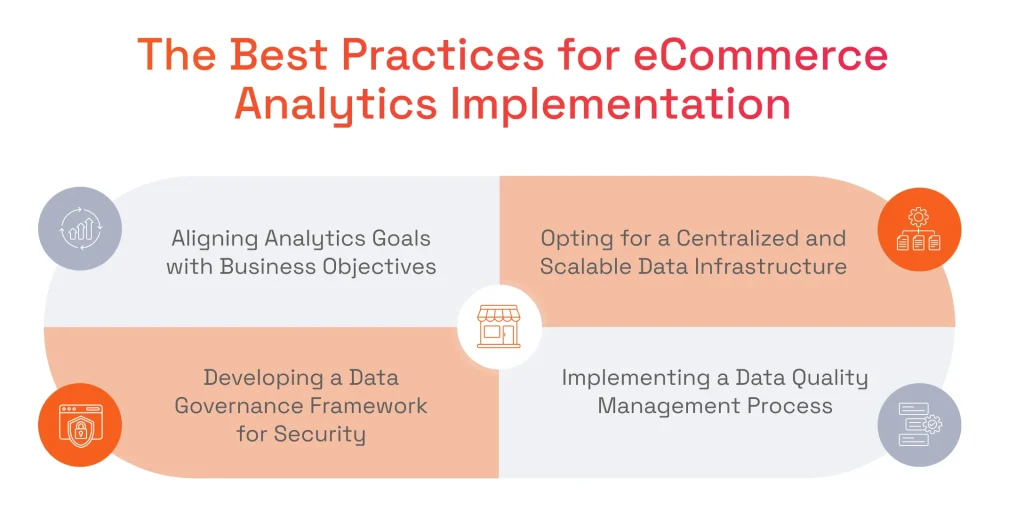
Aligning Analytics Goals with Business Objectives
As the starting point of data analytics implementation, all data-related initiatives should be closely aligned with key business goals, for example, improving conversion rate and customer acquisition, optimizing supply chains, or inventory management. Here, at SPD Technology, we understand that data should have a direct value, so we collaborate closely with our clients to identify specific objectives and design analytics frameworks that accommodate these goals.
Opting for a Centralized and Scalable Data Infrastructure
The importance of data integration cannot be overstated, as information from multiple channels, such as websites, CRM systems, and mobile apps, should flow seamlessly into a central repository for effective analysis. In our projects, we always prioritize advanced cloud infrastructure that fully meets current and future data requirements, with scalable environments ready to handle traffic spikes.
Developing a Data Governance Framework for Security and Compliance
Security measures like these are mandatory in the data-intensive eCommerce industry, which places the highest demands on customer privacy. A data governance framework specifies how information is collected, stored, accessed, and processed, in accordance with current regulations, while clear policies protect data across departments. We at SPD Technology consider data governance of the utmost importance, always implementing encryption standards, regular compliance audits, and role-based access controls in our projects.
Implementing a Data Quality Management Process
The effective process of data quality management addresses common issues like duplicate records, incomplete fields, and outdated information, ensuring that data-driven insights are precise and reliable. We make sure that our clients can trust their analytics by implementing fully automated validation checks and data cleansing protocols, as well as conducting continuous monitoring practices.
Dmytro Tymofiiev
Delivery Manager at SPD Technology
“These practices are just a bare minimum of what we are doing in the real-world projects because every case is unique and requires tailored approaches to get the best results. Our company is doing everything possible to ensure accurate E-commerce insights for the clients, harnessing the power of AI/ML and Big Data, while following proven security requirements.”
eCommerce and Data Analytics: The Most Common Challenges
We, at SPD Technology, understand the wide range of unique challenges that the implementation of data analytics in eCommerce creates. In this section, we will discuss them and share our real-life solutions.
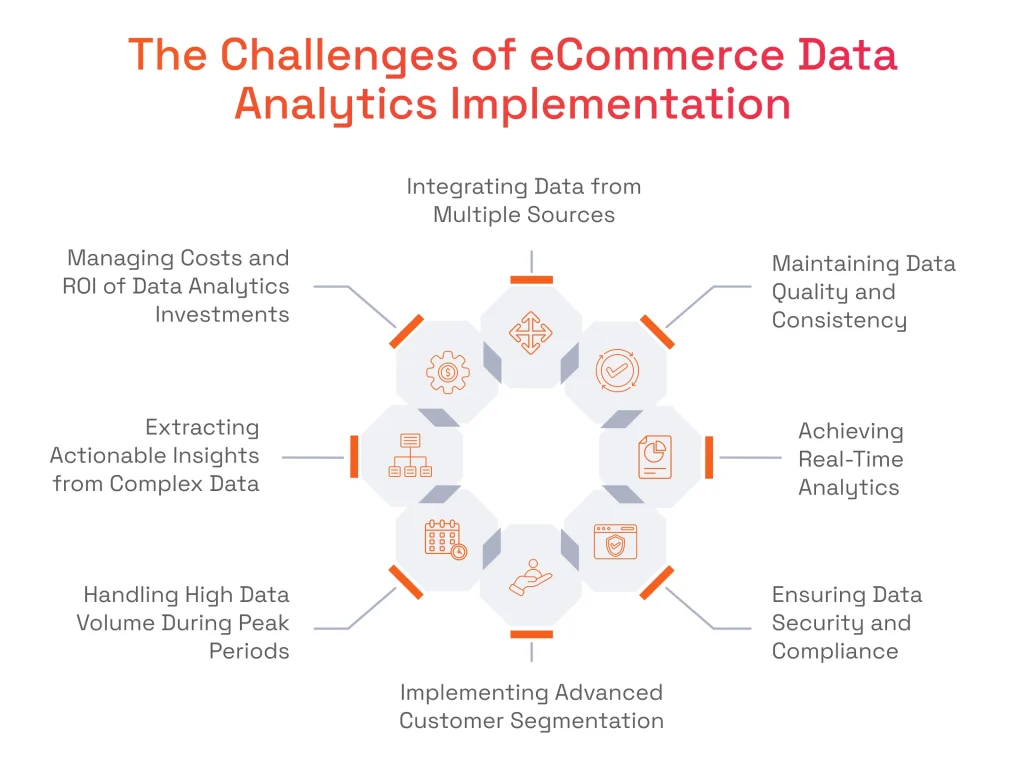
Integrating Data from Multiple Sources
This is quite a common problem, since the data in our projects is often scattered across different platforms, websites, CRMs, inventory management systems, and social media channels. The fragmentation hinders our clients’ ability to gain a holistic view and implement cutting-edge solutions, such as machine learning models for fraud detection.
We unify disparate data sources into a single ecosystem by setting up centralized data platforms that sync data in real time, enabling fast decision-making without any friction.
We discussed some of the latest applications of machine learning in retail in our recent article!
You are welcome to read it for some of the more intricate insights!
Maintaining Data Quality and Consistency
This is another crucial challenge with serious consequences, as inconsistent and inaccurate data hinders eCommerce customer data and analytics, resulting in poor recommendations and missed opportunities.
We excel in providing data quality management of the highest quality and conduct effective automated validation checks, regular audits, and deduplication strategies, ensuring data is consistently clean, accurate, and actionable.
Achieving Real-Time Analytics
This is essential for the industry, as quick decisions are required for responding to dynamic situations, including sudden traffic spikes, price adjustments, or inventory shifts.
We implement scalable analytics solutions utilizing streaming data pipelines and event-based architectures, allowing data teams to monitor essential metrics, such as cart abandonment rates and inventory status. Our clients always make timely, data-driven adjustments that keep them agile and responsive to evolving market conditions.
Ensuring Data Security and Compliance
Handling financial data and complying with all relevant regulations, such as GDPR and CCPA, is mandatory, and failing to secure data appropriately can lead to severe penalties and reputational damage.
We know how to implement data management strategies of the highest security requirements, specifically tailored to eCommerce analysis with extensive usage of advanced encryption protocols, strict access controls, and routine security audits. Additionally, we educate our clients on the compliance requirements, helping to avoid costly penalties.
Implementing Advanced Customer Segmentation
Effective segmentation is vital for targeted marketing, yet many businesses still struggle to achieve it due to the large volumes and complexity of data in this industry.
We rely on our proficiency in Artificial Intelligence and machine learning to develop models that effectively segment customer data, based on behavior and demographics. For our team, ensuring the highest data quality is of the utmost importance since we are in charge of implementing winning solutions for customer segmentation.
Handling High Data Volume During Peak Periods
Dealing with high volumes of data is a common challenge for the industry, especially when the peaks from seasonal events are happening. Due to this, data infrastructure efficiency can be impacted, leading to slower processing times and data bottlenecks.
Keeping this challenge in mind, we always build scalable architectures using cloud-based solutions. Our clients have stable access to real-time eCommerce performance analytics even during the busiest periods.
Extracting Actionable Insights from Complex Data
The raw E-commerce data by itself does not bring any business value, as many organizations struggle to make sense of complex data and derive any significant insights.
We have vetted data visualization experts in our team, who develop custom dashboards and highly tailored reporting tools to support specific business objectives. We work closely with our clients to make sure that they correctly understand the analytics results, as we turn complex datasets into actionable recommendations.
Managing Costs and ROI of Data Analytics Investments
As with any software development project, keeping budget in control is a common concern that we are very familiar with. Making highly accurate estimates for a data analytics project is the proven practice for an experienced vendor like us, and is one of the advantages of strategic technology consulting that our clients receive.
Still, keeping the estimated budget in control is more difficult. To ensure transparency and proper resource management, we deliver phased implementations, making sure that early value is showcased, demonstrating to our clients the tangible benefits of technological initiatives, and helping companies maximize their analytics investments and see sustained ROI over time.
Dmytro Tymofiiev
Delivery Manager at SPD Technology
“To deal with these challenges, a holistic approach with a blend of tech proficiency, expertise, and practical experience is required. We at SPD Technology are able to provide you with strategic guidance to overcome the toughest challenges related to data analysis for eCommerce. We successfully overcame all aforementioned challenges in our projects, during our 18+ years of development experience for this industry.”
The benefits and use cases above demonstrate what analytics can achieve, but successful implementation requires the right foundation. Before scaling analytics initiatives, retailers should ensure that the key data, technology, governance, and operational requirements are already in place.
-
Define measurable business objectives and KPIs
-
Identify critical customer, transaction, and operational data sources
-
Centralize data from websites, CRM systems, marketplaces, and marketing platforms
-
Assess data quality, consistency, and completeness
-
Establish governance, security, and compliance controls
-
Implement reporting and visualization capabilities
-
Prioritize high-value use cases such as personalization or forecasting
-
Build a scalable cloud-based analytics infrastructure
-
Evaluate opportunities for AI and machine learning adoption
-
Continuously monitor analytics performance and business outcomes
Building Tech Infrastructure for eCommerce Data Analysis: Tools, Technologies, Talent, and Resources
Setting up an E-commerce analytics infrastructure requires orchestrating a set of components into an effective ecosystem to generate actionable insights, support marketing analytics, and improve customer acquisition efficiency. Let’s take a look at and discuss the key tech elements.
Tools
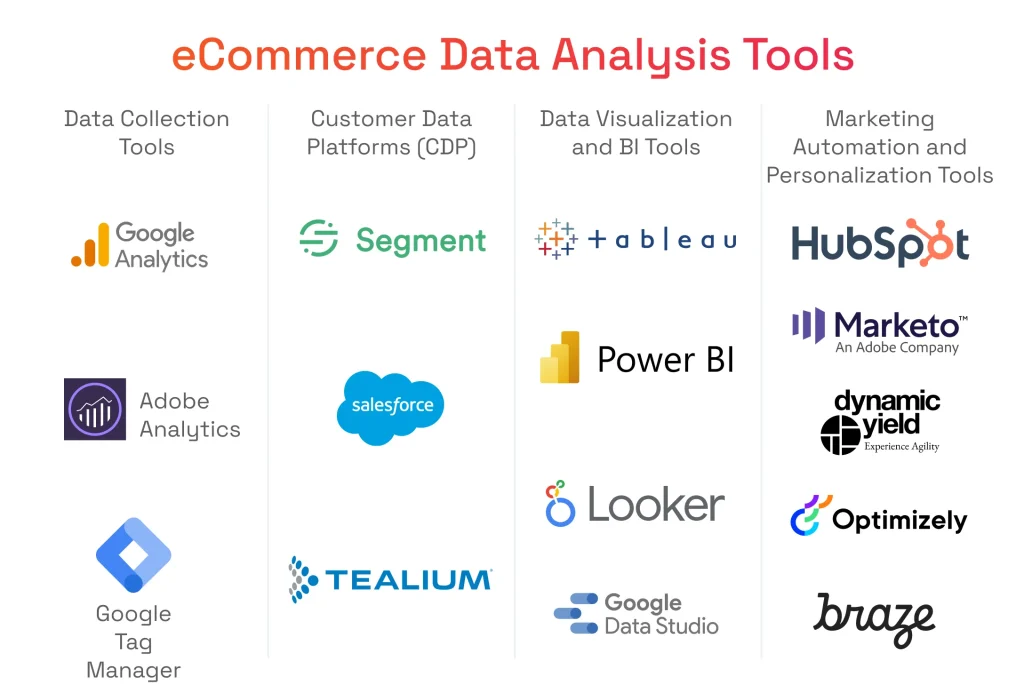
To capture, store, and interpret data, effective tools are required for each respective purpose. Here is our classification of the necessary ones:
Data Collection Tools
- Google Analytics & Adobe Analytics: provide critical insights into website traffic, user behavior, and conversion metrics.
- Google Tag Manager: Allows businesses to manage and deploy marketing tags on websites or mobile apps without modifying the code.
Customer Data Platforms (CDP)
Segment, Salesforce CDP, and Tealium AudienceStream are prominent examples in this category, as they effectively consolidate customer data from entirely different sources into a unified profile. These platforms showcase the true power of Artificial Intelligence for customer behavior analysis and provide personalized experiences based on the tracking of customer behavior data in real time.
Data Visualization and Business Intelligence (BI) Tools
These tools are designed to help businesses obtain a visual representation of complex data sets, and the most common off-the-shelf solutions include Tableau, Microsoft Power BI, Looker, and Google Data Studio.
Marketing Automation and Personalization Tools
Solutions from HubSpot, Marketo, Optimizely, Dynamic Yield, and Braze offer targeted email campaigns, A/B testing, and behavior-based messaging, which allow businesses to drive conversions through personalized content and automate marketing workflows.
Technologies
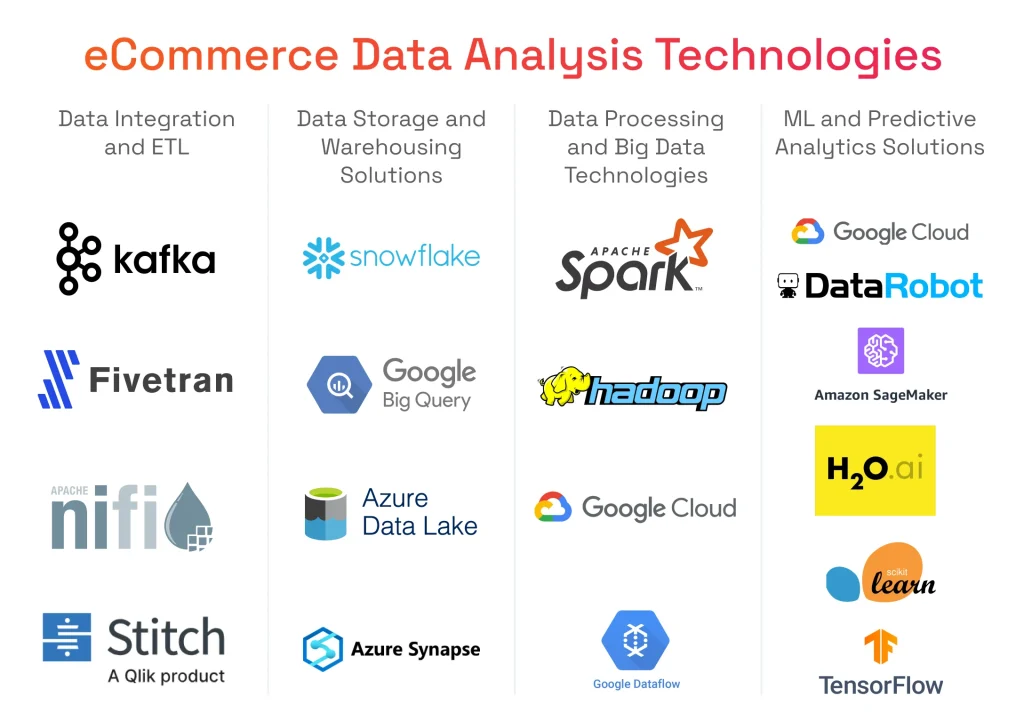
These technologies form the technical backbone of a modern eCommerce data analytics ecosystem, harnessing the full potential of data.
Data Integration and ETL (Extract, Transform, Load)
The most common data integration technologies include Apache Kafka, Fivetran, Stitch, and Apache NiFi, which enable experts to collect data from different sources and formats, standardize it, and prepare it for future processing. While ETL processes make sure that data flows seamlessly across different platforms and is fully accessible for BI tools, data integration technologies ensure that data from various sources can be consolidated into a single source of truth.
Data Storage and Warehousing Solutions
eCommerce datasets are typically enormous, so Snowflake, Amazon Redshift, Google BigQuery, AWS S3, Azure Data Lake, and Azure Synapse Analytics are the most common solutions with required scalable storage and data warehousing. These solutions centralize and organize diverse datasets, enabling businesses to efficiently store, query, and analyze large volumes of structured and unstructured data in data warehouses or data lakes, depending on the data’s specifics and organizational needs.
Want to learn more about how to build a data warehouse?
Read our article and get our practical insights on this topic!
Data Processing and Big Data Technologies
Apache Spark, Hadoop, and Google Cloud Dataflow facilitate the processing of large datasets, enabling eCommerce companies to analyze millions of data points rapidly and truly benefit from the business impact of Big Data, uncovering the untapped potential of customer information.
Machine Learning and Predictive Analytics Solutions
The platforms, including Google Cloud AI Platform, AWS SageMaker, DataRobot, H2O.ai, Scikit-learn, and TensorFlow, represent off-the-shelf solutions that support the creation, deployment, and monitoring of ML models, enabling predictive analytics in eCommerce and personalized customer experience.
Human Resources
In addition to tools and technologies, there is a need for a proficient team of skilled professionals who will ensure that data is collected, processed, and applied most efficiently:
- Data Engineers: they are responsible for designing, building, and maintaining data pipelines, as well as managing ETL processes and overseeing data accessibility.
- Data Analysts: these experts interpret data for decision-making, with the help of advanced Business Intelligence tools.
- Data Scientists: they develop, train, and refine ML models that can offer predictive analytics for eCommerce with personalized recommendations, along with other advanced features.
- Machine Learning Engineers: these experts focus on deploying ML models into production and maintaining their performance, working with data scientists to improve the models.
- Project Managers and Business Analysts: essential to any project, these professionals keep everything on track by overseeing project timelines and budgets, aligning analytics initiatives with business goals, and ensuring frictionless collaboration across all teams.
- Data Governance and Compliance Specialists: like with any data-related initiative, these experts are invaluable as they ensure that data practices comply with regulations like GDPR and CCPA.
Financial Resources
Investments across several areas are required if you want to set up an effective infrastructure. Here are those cost categories:
- Software Licensing Costs: E-commerce analytics software, BI tools, CDPs, and marketing automation platforms require recurring subscription costs.
- Cloud Infrastructure Costs: while cloud computing infrastructure benefits your organization greatly, you should be ready to be billed based on the usage of required solutions.
- Personnel Costs: keeping skilled professionals in your team, especially data analysts and ML engineers, can take a significant chunk of the budget.
- Training and Development: investing in upskilling and training of the team members is a natural process in the evolving technological landscape of data analytics for eCommerce, especially if you hire them in-house.
- Maintenance and Support: to perform at the highest capacity, analytics platforms require constant optimization, so you should be ready to pay for routine updates, system monitoring, and support services.
- Consulting and Implementation Services: finally, there is a high possibility that you will require external professional help to implement your E-commerce analytics software setup in a complex environment.
Consider Top-Tier eCommerce Analytics Services
Partnering up with a professional data analytics services vendor not only gives you instant access to the most effective modern tools and tech stacks but also allows you to gain tangible, precise results in the shortest time possible. Accelerating time to value through professional support will deliver greater benefits to your organization in the long run than the lengthy, costly process of setting up a digital commerce analytics environment with your internal experts.
Additionally, the professional involvement of a reputable vendor ensures the highest standards of data quality, as well as adherence to compliance and regulatory requirements. When qualified experts are in charge of eCommerce business analytics, the risk of costly errors is minimized, ensuring the effective budget management and sustainable growth of your data initiatives.
Partner with a Reliable eCommerce Business Analytics Development Vendor
Partnering up with us, you will get a reliable, vetted software development company with first-hand experience in building the world’s leading eCommerce solutions and unlocking the full potential of trending technologies like artificial intelligence and the Internet of Things. We know how to drive innovation through data initiatives and are ready to dig into the complexities of your business to deliver results.
Strategic Partnerships with Leading eCommerce Businesses
We are well-known for helping top eCommerce companies reach the top of the industry in long-term partnerships. Our 7+ year-long cooperation with BlackHawk Network is a prime example of this, as we continue to offer our 78+ team of dedicated experts to build scalable, secure, and data-driven solutions for this client.

Data and AI/ML Engineering Expertise Blend
We pride ourselves on being an innovative AI/ML development company, driving the evolution of artificial intelligence for the retail and eCommerce industries. Our team has the practical experience and knowledge to combine data with AI/ML engineering, turning complex commerce data into understandable, actionable insights.
Data Analytics Services Focused on ROI
All services we provide, from advanced analytics in eCommerce to cutting-edge data visualization, are focused on maximizing the return on investment for our clients. We ensure that all our data initiatives directly contribute to the business value of an organization, and treat each project as a unique scenario with its specific challenges.
Customized Data Solutions
We tailor each eCommerce and data analytics project to the needs and vision of our clients. Whether the goals are to improve customer experience, streamline operations, or optimize inventory management, we know how to do it based on data and are ready to offer our 600+ team and a powerful recruiting department to build the right solution for you.
SPD Technology’s Success Stories
Let our data-driven eCommerce analytics projects speak for themselves, as we briefly overview two of the most impressive case studies in this category.
High-Load Support AI Chatbot for an Online Fashion Store
Business Challenge
Our client is a French B2C eCommerce company operating in the Fashion industry, with a challenge to automate customer support with an AI-powered chatbot for resolving customer queries in the online store, one of the truly groundbreaking applications of generative AI in eCommerce. Our team was tasked to develop this chatbot, along with detailed integration guidelines.
SPD Technology Approach
To build this chatbot, we leveraged the LangChain agent powered by Mistral LLM, designed to handle user queries by retrieving data from AWS S3-stored content via a PostgreSQL-based vector database. This architecture choice allowed us to receive quick and precise responses by turning data into vectors. We implemented guardrails to ensure response reliability and GDPR-compliant data anonymization.
The Mistral LLM model and the AWS embeddings model were refined through prompt engineering, resulting in efficient query handling. When the models were ready, we constructed the LangChain agent stack and fine-tuned the system with black-box testing, using the RAG Triad method to ensure language consistency and response quality.
Packaged as an API with detailed documentation, the chatbot was deployed on EC2 instances with Kubernetes, enabling autoscaling to manage high traffic seamlessly.
Value Delivered
- Efficient Automation of Customer Queries: we developed an outstanding solution that can process 99% of queries in under 10 seconds, providing lightning-fast responses and significantly improving customer experience, as well as customer retention.
- 100% Reliability of the Solution: we managed to make the system constantly available during peak hours, able to process 30 requests per second.
Ultimately, we delivered mission-critical functionality for the client, providing another impressive example of how artificial intelligence transforms customer service and lightens the burden on human employees, allowing experts to focus solely on sophisticated customer queries.
Leveraging AI/ML for Expanded Product Range and Enhanced eCommerce Product Listings
Business Challenge
Our client is an online retail business based in the United States, operating via a drop-shipping model with a powerful B2C web solution providing access to a diverse selection of over 1,000,000 products with a wholesale catalog totaling over 300,000 items. Our company was initially contacted to help with performance optimization, SEO enhancements, and UI/UX improvements, but after we completed those goals, the scope expanded.
SPD Technology Approach
We achieved massive website responsiveness improvements by implementing SQL query optimization, streamlining navigation, and improving UI/UX. The SEO activities of our team included keyword research, content optimization, and strategic backlinking to improve search rankings and drive organic traffic, while cleanup and indexing adjustments boosted site crawlability.
During our collaboration, the client set a goal to expand a product listing, so we developed a scalable parsing solution to achieve it. Leveraging our proficiency in generative AI development, we used ChatGPT to classify over a million products with 90% accuracy and applied OCR with image captioning to remove irrelevant content from product images. There was also an autosuggestions feature, in which we integrated ChatGPT with Algolia to improve relevance. Outstanding scalability was achieved by using AWS Batch and Elastic Beanstalk to run processes in parallel across multiple instances, delivering robust performance and resource efficiency.
Value Delivered
- Improved User Engagement and Operations Efficiency: we leveraged the latest AI/ML technologies to accurately categorize products, clean up irrelevant data, and improve search functionality for the client.
- Significant Product Expansion: our team was able to expand the product range for the client by adding over 1,000,000 products from major global retailers.
- Massive Performance Boost: we achieved a tangible increase in loading speed with a Google PageSpeed score improvement from 29 to 97 (web) and from 12 to 90 (mobile), improving user experience and getting better positions in search engine rankings.
Overall, we delivered the planned scope of work and showed an innovative approach to AI/ML for E-commerce data analysis in this project, finding new ways to effectively implement critical functionalities for the client.
Key Takeaways
- eCommerce analytics helps businesses understand customer behavior, improve marketing effectiveness, optimize inventory, and increase profitability.
- Data analytics for eCommerce is more relevant than ever, with the global e-Commerce analytics market expected to reach $96.34 billion by 2035.
- Advanced analytics supports forecasting, automation, personalization, and fraud prevention initiatives.
- Demand forecasting reduces inventory risks by helping retailers anticipate future purchasing patterns.
- Generative AI and ML expand analytics capabilities through personalized shopping experiences, automated content creation, and advanced customer support.
- Data quality, integration, scalability, and security remain critical requirements for successful analytics initiatives.
In short: eCommerce analytics transforms customer, operational, and transactional data into actionable insights that improve customer experiences, increase revenue, optimize operations, and support long-term business growth.
FAQ
How much does eCommerce data analytics implementation cost for a growing online retailer?
The cost depends on the number of data sources, reporting requirements, AI capabilities, integration complexity, and infrastructure needs. Basic analytics implementations focused on dashboards, reporting, and marketing insights often range from $30,000–$100,000, while enterprise-grade analytics platforms that include customer 360 views, forecasting, personalization, AI models, and real-time processing typically range from $150,000–$750,000+.
Costs usually include data integration, cloud infrastructure, analytics engineering, dashboard development, governance controls, and ongoing support. Many retailers start with a specific business objective, such as customer segmentation or demand forecasting, before expanding the platform.
What are the most common eCommerce analytics mistakes that lead to wrong business decisions?
The most common mistakes include relying on incomplete customer data, analyzing channels in isolation, using inconsistent business definitions, and focusing on vanity metrics rather than business outcomes. Many retailers also struggle with fragmented customer journeys spread across websites, marketplaces, CRM systems, and marketing platforms.
Another common issue is poor data quality. Duplicate customer records, missing transaction data, and inconsistent product information can distort forecasting models, customer segmentation efforts, and marketing performance analysis.
How long does it take to build a production-grade eCommerce analytics platform?
Basic reporting environments can often be deployed within 2–4 months, while production-grade analytics platforms that include data warehouses, customer analytics, AI-powered forecasting, personalization capabilities, and governance controls typically require 6–12 months.
The timeline depends heavily on data readiness, integration complexity, and the number of systems involved. Organizations that already have a centralized data infrastructure usually achieve results faster than those starting with fragmented systems.
What customer data privacy risks must eCommerce analytics platforms address?
eCommerce analytics platforms process large volumes of customer data, including purchase history, browsing behavior, account information, loyalty data, and marketing interactions. This creates privacy obligations under regulations such as GDPR, CCPA, and other regional data protection laws.
Key risks include unauthorized access, excessive data collection, weak consent management, improper data retention practices, and insufficient security controls. Strong governance, encryption, access controls, and audit processes are essential for reducing these risks.
Which eCommerce analytics use cases deliver the highest and fastest revenue impact?
Customer segmentation, personalization, abandoned cart recovery, recommendation engines, demand forecasting, and pricing optimization often deliver the fastest measurable business impact because they directly influence conversion rates, average order value, customer retention, and inventory efficiency.
Many organizations also see strong returns from customer lifetime value analysis and churn prediction, which help focus marketing investments on the customers most likely to generate long-term revenue.