

Artificial intelligence (AI) optimizes, automates, and accelerates operations in most modern organizations, from customer service and marketing to finance, supply chain, and HR. McKinsey’s 2025 Global Survey on AI reports that 78% of respondents say their organizations integrate AI into at least one core process. Yet, some companies struggle to execute. Internal teams often prioritize core platforms, domain requirements, and delivery deadlines, meanwhile AI tools change faster than teams can scale and acquire new skills.
78% of surveyed leaders also plan to increase AI spending next year, according to Deloitte. Same number, greater urgency. Once leaders commit resources, the constraint often shifts to skilled labor and delivery capacity. This is why many teams rely on AI outsourcing to launch AI fast.
Key Takeaways
- AI is widely used, but teams are often slowed down by limited delivery capacity and a lack of specialized skills.
- AI outsourcing includes all steps, from handling data and building models to integration and optimization. The process is naturally iterative.
- Demand for outsourcing is growing because AI technology is advancing quickly, talent is hard to find, and most organizations are not ready to scale beyond pilot projects.
- The most commonly outsourced solutions include NLP, computer vision, automation and RPA, predictive systems, generative AI, and conversational assistants.
- A good outsourcing partner helps reduce risks by focusing on security, governance, integration, and making sure goals and metrics are clearly aligned.
What Is AI Outsourcing?
AI outsourcing relies on an external partner to handle artificial intelligence and machine learning work (discovery, data preparation, model operations, integration, ongoing optimization, etc.) instead of building everything internally. Within that broader scope, AI development outsourcing is specifically about designing and training models, developing AI features, productionizing them with MLOps, and delivering working AI components. To clarify what’s included and how it will be delivered, many companies put clear cooperation terms in place through a service level agreement (SLA) for product development.
However, unlike traditional outsourcing, which covers a software product development process focused on delivering predefined features, AI outsourcing involves uncertainty, iteration, and continuous learning because AI results are not fixed and improve as models learn from new data.
There are several common IT engagement models suitable for outsourcing AI services:
- Project-based AI projects: Often aligned with tech talent augmentation, this model is suitable for validating specific use cases, pilots, or time-bound AI initiatives.
- Dedicated AI teams: A dedicated software development team focused exclusively on AI, working as an extension of the client’s organization with shared goals and a deeper domain context.
- One-stop-shop AI outsourcing partner: An approach that may include setting up an offshore development center, covering strategy, data, development, deployment, and long-term scaling under a single partnership model.
Want to learn about the most popular cooperation model?
Explore the dedicated team approach in our article on how to hire a dedicated development team.
Why the Demand for AI Outsourcing Is Growing Now
Artificial intelligence adoption is only picking up speed. And even though we’re still early in the curve, artificial intelligence outsourcing is accelerating, too. There are three main reasons for it.
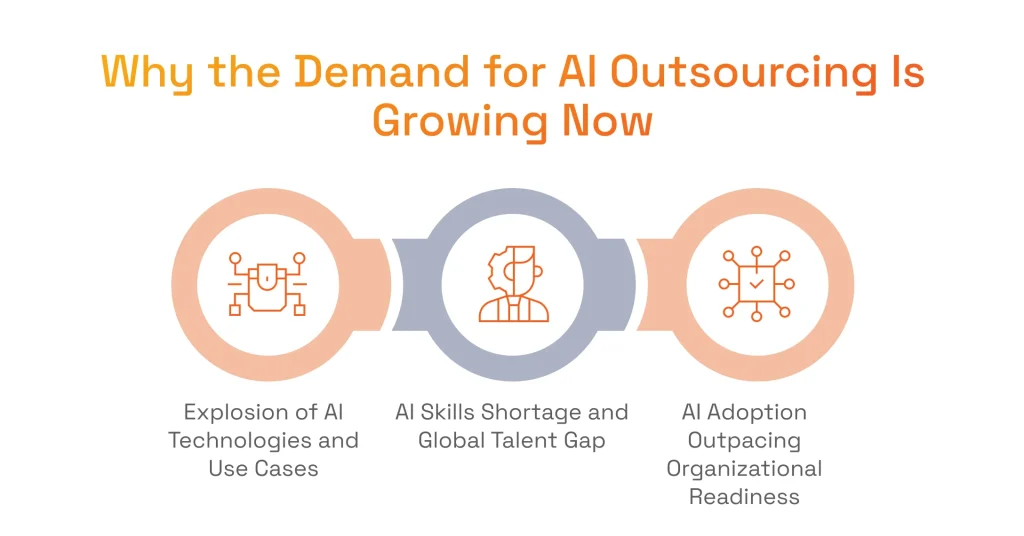
Explosion of AI Technologies and Use Cases
In 2025, Gartner forecast that worldwide generative AI spending would total $644 billion, up 76.4% from 2024. This is a huge pace for artificial intelligence, which evolves alongside machine learning and deep learning.
At the same time, companies are moving beyond single-task models toward more complex systems like AI agents that can execute multi-step workflows. McKinsey’s 2025 State of AI report says that 23% of organizations are already scaling an agentic AI system, and another 39% are experimenting with AI agents. Businesses risk losing competitiveness without them because they power multiple use cases connected to, among many others, customer support agents, sales and marketing copilots, finance and procurement automation, IT and security assistants, and supply chain planning.
These systems are complex because they combine data engineering, model selection/training, evaluation, MLOps, security and governance, and integration into business workflows. Their development and setup require specialized skills that can often be acquired through outsourcing.
AI Skills Shortage and Global Talent Gap
Many organizations are held back by a shortage of AI experts who can take models beyond prototypes and deliver reliable, monitored, secure systems in production. In McKinsey’s “AI in the workplace” research, U.S. CxOs most often cited talent skill gaps, reported by 46%, as the top reason for not moving forward with AI initiatives, followed by resourcing constraints at 38%.
Building in-house takes time, and required skills change fast. Gartner found that 41% of HR leaders say their workforce lacks needed skills, and 62% see future-skill uncertainty as a major risk. This is exactly why global artificial intelligence outsourcing is growing, as it gives organizations faster access to specialized expertise and necessary skills in AI technologies without waiting through long recruitment cycles or overloading internal teams.
AI Adoption Outpacing Organizational Readiness
McKinsey’s 2025 “State of AI” report found that 88% of survey participants noted regular AI/ML use in one business function. This number proves that more teams want AI results faster. In the same report, only about one-third say they’ve begun scaling AI programs at the enterprise level, while others note that they are still experimenting or piloting.
Gartner also highlights little maturity in AI technologies, with only 9% of organizations at an advanced level of artificial intelligence capability. Companies feel pressure to move from scattered proofs of concept to production AI/ML with governance, monitoring, integration, security, and repeatable delivery. AI development outsourcing helps close the readiness gap. It is done by adding experienced execution capacity and specialized skills so internal teams can scale outcomes without slowing down core delivery.

Oleksandr Boiko
Delivery Director at SPD Technology
“Outsourcing AI development solves multiple challenges at once, providing talent, focus, and technical insight. But most importantly, our clients note that they choose outsourcing because it lets their teams concentrate on strategy and customer value, while we keep innovation and delivery moving.”
Common AI Solutions Companies Outsource
Outsourcing providers can deliver solutions end-to-end, guiding the process through data preparation, model development, deployment, integration, and ongoing optimization. Below are the most common solution types businesses delegate to external teams.
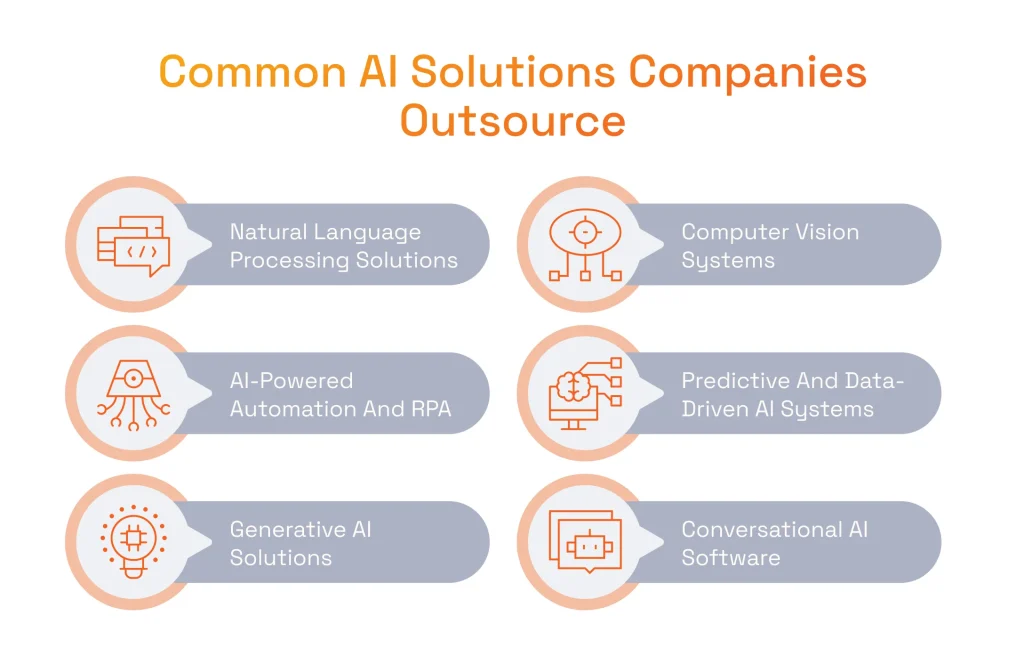
Natural Language Processing (NLP)
Natural language processing is a cornerstone technology for chatbots and conversational interfaces, text classification for routing requests, and sentiment analysis for customer and market insight, helping systems understand and generate human language. Modern natural language processing models learn patterns from data and handle ambiguity, intent variation, and multilingual input.
Computer Vision
Computer vision is often handled by specialized outsourcing providers because it requires experience with data labeling strategies, model selection, and edge-to-cloud deployment. Common solutions include image and video analysis, object detection, and recognition tasks such as identifying defects on production lines, tracking shelf availability in retail, or supporting clinical workflows in healthcare imaging.
AI-Powered Automation and RPA
Companies frequently use outsourcing services to combine robotic process automation and intelligent automation with AI for workflows that are too variable for rules alone. Examples include automating data entry from documents, extracting fields from invoices and forms, and handling repetitive back-office processes with human-in-the-loop controls. Plus, AI-powered automation can flag exceptions, suggest next steps, and cut manual review time.
Predictive and Data-Driven AI Systems
Forecasting and optimization are outsourced when organizations need production-ready predictive analytics fast. Teams build models for everyday business predictions and planning, and wrap them with dashboards and alerting. This work typically combines data engineering and data analytics to deliver real-time insights supported by reliable pipelines, clean feature data, and measurable model performance.
Generative AI Solutions
Building knowledge assistants for internal documentation, content generation with guardrails, summarization for customer communications, or automated reporting needs generative AI. Because GenAI projects touch multiple AI technologies at once, including retrieval, orchestration, evaluation, and governance, many businesses choose an experienced partner to accelerate delivery.
Conversational AI Software
Conversational AI is needed for intent recognition, tool calling, context management, and integrations. An outsourcing partner helps connect assistants to existing systems like CRMs, ticketing platforms, and knowledge bases, so users can actually complete tasks. Done well, these assistants become a scalable interface layer that supports customers and employees across functions with consistent quality.
Benefits of AI Outsourcing
The availability of skilled labor from an outsourcing partner can accelerate delivery and improve product quality. With the right expertise in place, outsourcing companies create cost-effective, well-run solutions for several critical business processes, in part thanks to the benefits of outsourcing, as we discuss below.
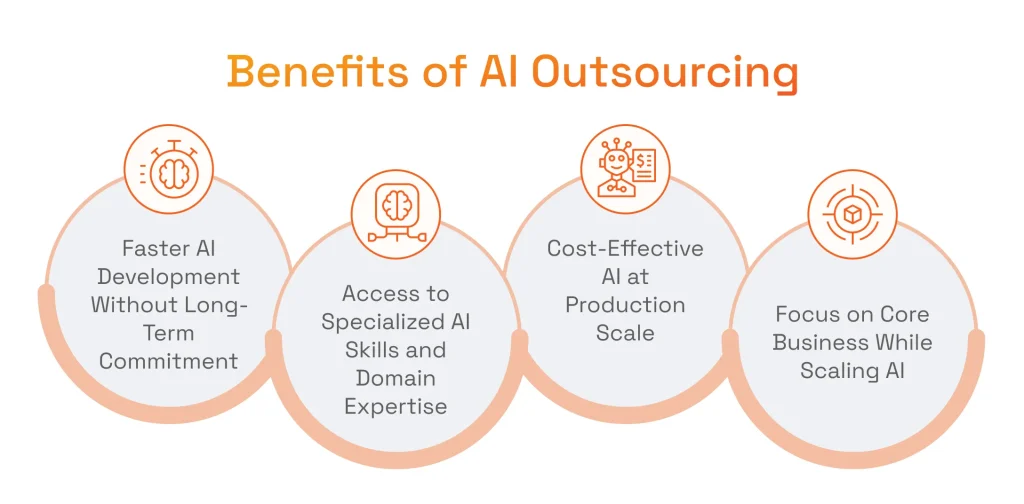
Faster AI Development Without Long-Term Commitment
Outsourcing AI services helps teams move from idea to working prototype and from prototype to production without waiting months to hire, onboard, and build internal capacity. Clients find this especially useful when priorities shift, scopes evolve, or they need to validate a use case before committing to a long-term roadmap.
These are the reasons why outsourcing can mean faster AI development:
- Faster kickoff with ready-to-go specialists and proven processes that adapt to changing project scope;
- Quicker experimentation cycles to validate value early;
- Shorter path to deployment with production-focused engineering and MLOps;
- Flexibility to scale effort up or down without permanent headcount.
Access to Specialized AI Skills and Domain Expertise
Outsourcing gives you access to a broader expertise than in-house software development. In particular, clients onboard ML engineers, data scientists, and data engineers with proven track records who have shipped real systems and demonstrated model training, validation, scalability, and operational reliability. On top of that, specialists can provide domain expertise because they’ve built similar solutions before and have learned the patterns, constraints, and failures, and can set up models with the right data assumptions, workflow context, and success metrics.
Here’s how specialized skills in AI/ML benefit outsourcing clients:
- Cross-functional AI roles available immediately: ML, data science, data engineering, MLOps;
- Experience choosing the right approaches for model training, evaluation, and validation;
- Practical know-how for scaling AI systems;
- Stronger outcomes when teams understand your industry processes and constraints.
Cost-Effective AI at Production Scale
Scaling AI in production introduces cost drivers that are easy to underestimate, such as compute infrastructure, training workloads, data pipelines, and data annotation. Outsourcing helps manage these costs with the help of reusable components, optimized workflows, and the right level of expertise for each stage.
Below is a list of factors that contribute to delivering cost-effective solutions:
- Lower ramp-up costs than building internal resources from scratch, supporting faster cost reduction;
- Better control over infrastructure spending through right-sized architectures;
- Efficient model training and iteration cycles to reduce wasted compute;
- Smarter data annotation strategies to protect quality;
- Clearer separation of operational costs vs. strategic investment in capability.
Focus on Core Business While Scaling AI
Outsourcing is the critical factor that lets internal teams stay focused on product priorities, customer needs, and business delivery while external specialists handle the complexity of AI execution. So, companies obtain both reduced operational strain and faster time-to-market.
The following is what outsourcing partners bring to the table for scalability:
- Internal teams keep ownership of strategy and business outcomes;
- External teams handle execution-heavy work;
- Reduced management overhead with clear roles, improved communication, deliverables, and accountability;
- Faster progress without slowing down core platform and product development.
Oleksandr Boiko
Delivery Director at SPD Technology
“Artificial intelligence can bring plenty of other advantages beyond these. But most clients come to us for something straightforward, reflected in the four benefits above: they want production-ready AI built faster, with the right expertise, and with costs and risks kept under control.”
When AI Outsourcing Makes Sense and When It Doesn’t
While outsourcing AI specialists can speed up some initiatives, it’s not a silver bullet. In some cases, it can be overkill or a poor fit for business operations. So, it is important to distinguish when teaming up with outsourcing providers supports the company’s goals and when it creates friction.
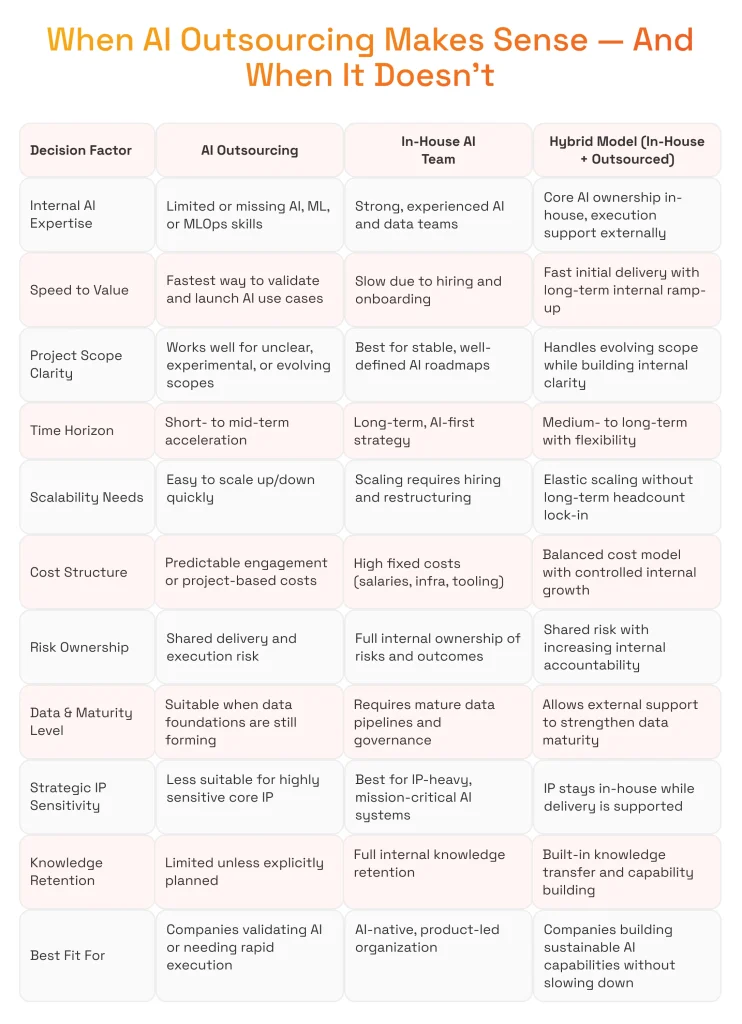
When AI Outsourcing Is the Right Choice
Companies may choose to outsource when they don’t have enough in-house expertise to build and productionize solutions across fast-moving AI technologies, or when their data analytics capabilities aren’t yet strong enough to support reliable AI at scale. It’s especially useful when leadership needs to validate use cases quickly, whether that’s a GenAI assistant, an automation workflow, or predictive analytics, without waiting months to hire and ramp up a full team. It also fits when the scope is evolving, or the project needs deep data analysis before the best approach is clear.
When Building an In-House AI Team Is Better
Building internally is often the better path for long-term, AI-first product companies that need continuous iteration, deep internal context, and tight control over their roadmap. If your organization already has strong data maturity, an internal team can compound that advantage over time.
This approach is also preferable when AI is tied to highly sensitive IP and a business wants maximum control over architecture and decisions. Compared to working with a distributed software development team, in-house execution can simplify oversight of ethical concerns and mitigate risks related to ownership, compliance, and long-term knowledge retention.
Hybrid Models: Combining In-House and Outsourced AI
Two previous models combine effectively when companies aim to retain core ownership in-house while accessing external skills and creativity for execution. This is especially suitable for projects that require quick delivery now but aim to build internal capability in the future.
Ideal partners make hybrid delivery a structured ramp-up where externals lead early, internals gain via collaboration, and document sharing. Done well, this approach becomes a sustainable strategy, enabling companies to scale delivery.
Key Challenges and Risks in AI Outsourcing
Even when outsourcing is a better fit for a business, it would still be wrong to assume the engagement will be problem-free. Fortunately, most common challenges can be addressed. As follows, we explain how our company resolves typical issues.
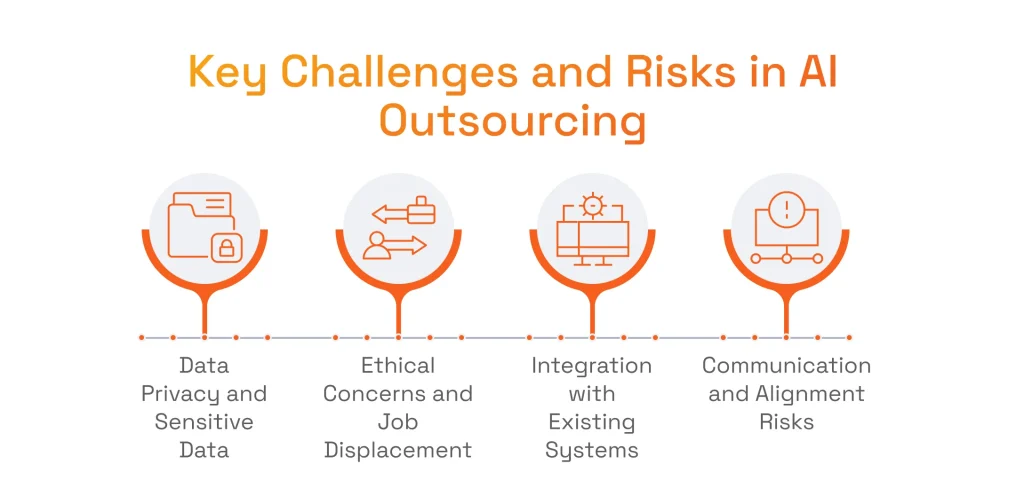
Data Privacy and Sensitive Data
Our clients are often concerned about sharing data with external teams, sometimes across borders. This raises security, compliance, and regulatory concerns. Apart from data leakage, the risk also lies in mishandling personal or sensitive information, unclear data ownership, and non-compliance with regional requirements.
To reduce this risk, we perform the following practices:
- Early data classification and defining what can/can’t be shared;
- Using privacy-by-design approach;
- Choosing secure environments and defining access controls;
- Putting legal guardrails in place;
- Running security reviews and compliance checks.
Ethical Concerns and Job Displacement
More than once, our clients asked us to ensure that AI was free from bias, didn’t reduce transparency in decision-making, and didn’t affect jobs by automating parts of workflows. Outsourced development of AI technologies can disregard these concerns if ethical requirements are not defined upfront and tested continuously.
However, we implement the following measures to make sure these concerns are addressed:
- Setting fairness and safety requirements;
- Audit datasets for representativeness and harmful proxies;
- Build transparency with explainability tools;
- Add human-in-the-loop for high-impact decisions;
- Plan workforce impact.
Integration with Existing Systems
AI systems must connect to business platforms, data sources, and workflows. And some of the most common concerns of our clients are that integration issues can delay deployment, degrade performance, or create reliability problems, especially when real-time responses are required.
These issues can indeed be significant, but our team overcome them by:
- Mapping target workflows and systems and defining interfaces;
- Using API-first architecture and clear contracts;
- Planning for latency and reliability;
- Implementing MLOps for production;
- Aligning security with enterprise standards;
- Run staged rollouts.
Communication and Alignment Risks
When starting AI projects, we always warn our clients that they can fail when business goals, success metrics, and technical execution drift apart. Together, we never start work without strong feedback loops, since this can lead to a model that performs well in isolation but doesn’t solve the business problem.
To make sure the communication supports progress, our team incorporates the following:
- Defining success metrics upfront;
- Establishing a single owner and clear decision rights;
- Using frequent checkpoints with real-time communication;
- Setting up shared backlog and visible progress metrics;
- Creating tight feedback loops;
- Treating AI as iterative with possible scope changes;
- Maintaining shared artifacts.
Choosing the Right AI Outsourcing Partner: The 90% Success Factor
Initiatives with AI technologies often fail at the execution stage. This happens because delivery breaks down when teams try to move from prototype to production. Also, AI projects often entail uncertain outcomes, evolving scope, and continuous learning and iteration.
The right team determines whether AI aligns with business goals, is built on solid data, and can scale over time. Partner quality shows up in data readiness, clear success metrics, and maintainable engineering as models and tools evolve. That’s why choosing the right partner is often the decision that protects ROI and delivers a competitive advantage.
Key Responsibilities an AI Outsourcing Partner Must Own
The right outsourcing partner goes beyond building AI models to ensure alignment, data readiness, security, and scalability. Here are the key responsibilities to look for:
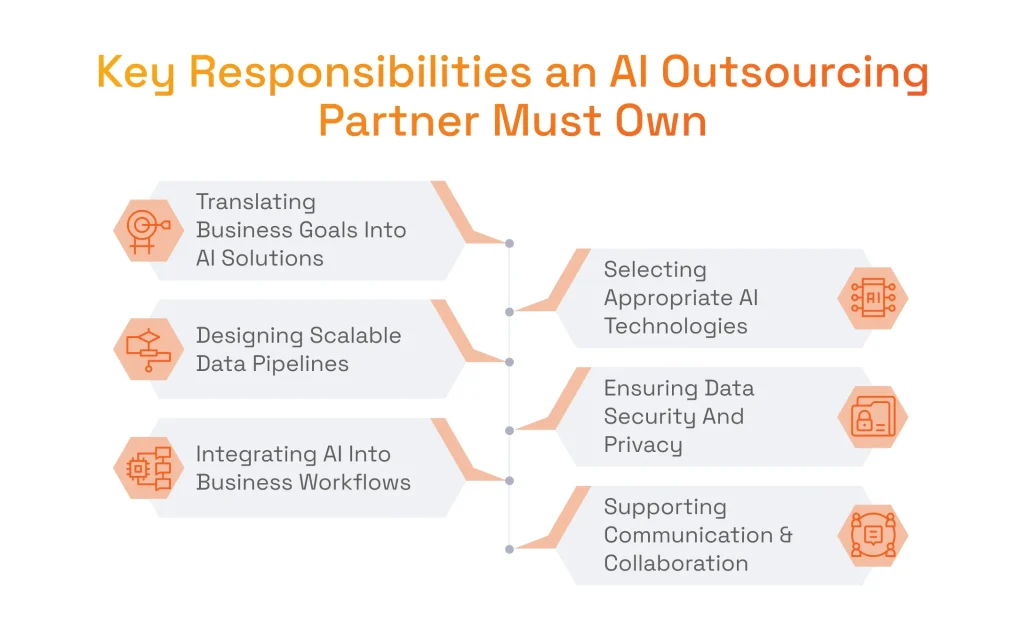
- Translating business goals into feasible AI-powered solutions;
- Selecting appropriate AI technologies and AI models;
- Designing scalable AI systems and data pipelines;
- Ensuring secure data processing and data privacy;
- Integrating AI solutions into existing systems and workflows;
- Supporting clear communication and real-time collaboration.
How SPD Technology Supports AI Outsourcing Initiatives
At SPD Technology, we work with teams to turn AI plans into production-ready AI systems that improve operations. We start by shaping a clear AI strategy, then design, build, and deploy solutions, from data preparation and model development to MLOps, monitoring, and continuous improvement.
We also help integrate AI technologies into enterprise environments where data and workflows span multiple platforms. Our approach emphasizes responsible AI technologies, with a focus on transparency, sensitive data protection, reliability, and strong data governance, so systems remain trustworthy and scalable as business needs evolve.
Not sure which outsourcing provider to choose?
Check our list of the top AI development outsourcing companies.
Conclusion: AI Outsourcing as a Path to Sustainable AI Adoption
Today, every function needs AI, and outsourcing partners help companies stay focused while still growing. AI powers capabilities such as NLP, computer vision, automation, predictive analytics, data analytics, GenAI, and conversational AI across many everyday tasks. It supports data-driven decisions, faster operations, scalable delivery, and lower costs.
Choosing the right outsourcing vendor is critical for data privacy, ethical considerations, integration into existing systems, and clear alignment on risks and responsibilities. If you’re looking for a partner, feel free to contact us. We bring AI expertise across multiple industries and can deliver the right solution for your business needs.
FAQ
What Is AI Outsourcing?
AI outsourcing is partnering with external experts to create an AI strategy, plan, develop, deploy, and scale AI solutions like models and systems, bypassing in-house hiring costs.